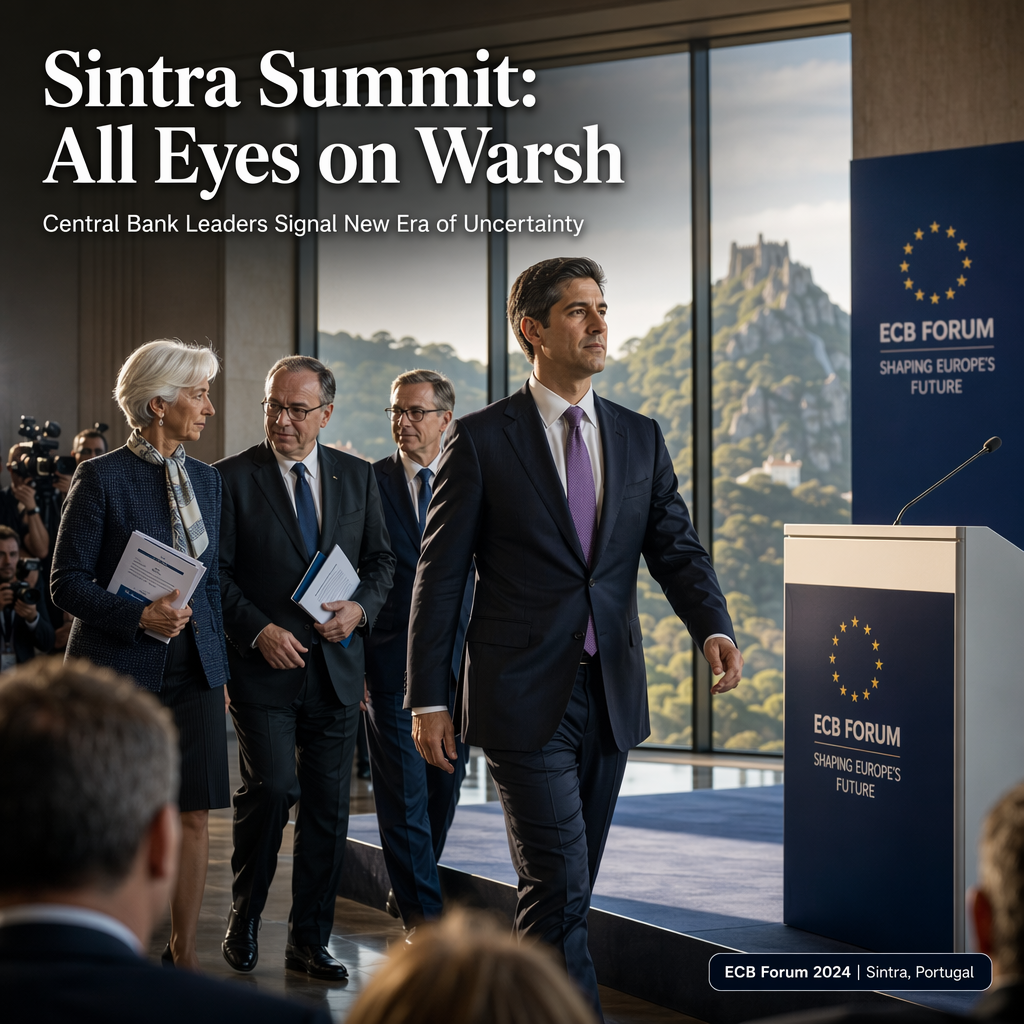
The annual European Central Bank (ECB) Forum is taking place in Sintra, Portugal, from June 29 to July 1, bringing together top central bankers including Federal Reserve Chair Kevin Warsh, ECB President Christine Lagarde, Bank of England Governor Andrew Bailey, and Bank of Canada Governor Tiff Macklem for a policy panel on Wednesday at 13:00 GMT [1][2]. This year's theme is 'Shaping Europe's future: innovation, growth and stability,' with discussions expected to focus on innovation, productivity, financial stability, and long-term growth [1][2].
Markets are paying particular attention to Fed Chair Warsh, who is making his first public appearance outside the US since taking office and chairing his first FOMC meeting in June [1]. At that meeting, the FOMC kept the Federal Funds Rate unchanged at 3.5%-3.75%. Warsh's press conference introduced a new communication strategy: a shorter policy statement, removal of forward guidance, and no indication about future rate decisions, summarized by his remark, 'We've dropped forward guidance' [1]. This shift means investors are expected to scrutinize every public appearance for policy clues, increasing the potential for market volatility [1].
On the currency front, BNY’s Geoff Yu notes a recurring pattern of Euro strength following the Sintra forum, typically driven by hawkish ECB communication from Christine Lagarde, with gains often fading by mid-July [2]. Yu expects renewed Euro buying in the coming weeks but cautions that weaker fiscal support and supply-side pressures mean any early-July Euro strength should be seen as tactical rather than a sustained breakout [2]. Additionally, ECB Governing Council member Mārtiņš Kazāks stated there is 'no need' for multiple ECB hikes in a 'rushed' way, and market expectations for a full 25bp hike this year are low [2]. The latest ECB inflation expectations survey shows easing household fears about inflation, and softer global headline inflation is anticipated due to reduced energy price sensitivity [2].
Deutsche Bank Research reports that softer US PCE inflation has led investors to reduce expectations for further Fed rate hikes, with December hike pricing down by 7.3bps to 32bps over the week, and 2-year and 10-year Treasury yields falling by 8.7bps and 8.4bps respectively [3]. The Dollar Index is slightly weaker, and ECB rate hike pricing by December also fell by 12.8bps to 24bps [3]. Despite this, Deutsche Bank economists still expect a relatively hawkish Fed path with two rate increases pencilled in later this year, though near-term guidance is expected to remain limited, leaving markets to focus on incoming data and Warsh's remarks at Sintra [3].
Christine Lagarde is set to deliver what may be her final Sintra opening keynote, further highlighting the significance of this year's forum [2].
CONCLUSION
The Sintra ECB Forum is drawing heightened market attention this year due to Fed Chair Warsh's new communication approach and his first international appearance, as well as recurring patterns of Euro strength following the event. While both the Fed and ECB are signaling caution on further rate hikes, markets are expected to react strongly to any policy signals from central bank leaders. Investors should be prepared for increased volatility as they interpret limited forward guidance and focus on upcoming economic data.