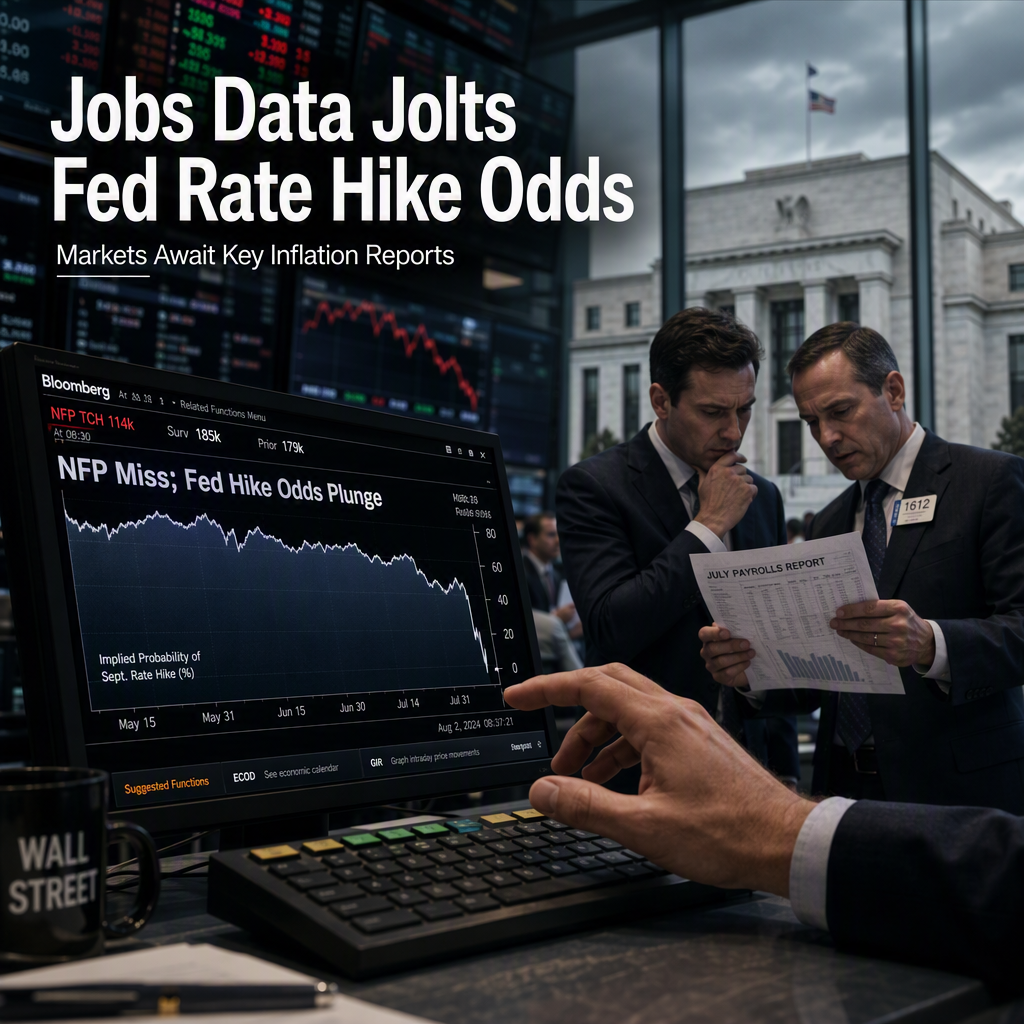
Recent US Nonfarm Payrolls (NFP) data has prompted a significant reassessment of the likelihood of a Federal Reserve rate hike in September. According to Deutsche Bank strategists, Friday’s mixed NFP report led to a notable repricing in futures markets, with the implied probability of a September hike dropping by around 10 percentage points to 44% immediately after the data release [1]. Rabobank’s Bas van Geffen also highlights that the weaker NFP figures and a drop in labor supply have reduced the urgency for another Fed rate hike, though the decision remains data-dependent [2].
The labor market data presented a nuanced picture. Rabobank notes that the headline payrolls number disappointed, showing a -23,000 jobs print and a 37,000 downward revision to the June estimate [2]. While employment growth has been slowing for several months, both dovish and hawkish factions at the Fed can find support in the latest figures: doves point to downside risks, while hawks argue that supply constraints are the main issue [2]. Deutsche Bank’s economists interpret the report as consistent with a broadly stable labor market, rather than a sharp deterioration, and attribute some of the participation challenges to demographic factors [1].
Looking ahead, both sources emphasize the importance of upcoming inflation data in shaping Fed policy expectations. Deutsche Bank forecasts headline CPI to rise by +0.15% month-on-month in July after a -0.42% decline in June, with core CPI expected at +0.26% month-on-month [1]. July’s Producer Price Index (PPI) is anticipated to show a +0.22% month-on-month increase in headline terms and +0.3% for core PPI [1]. Retail sales are expected to rise by +0.3% month-on-month in July, though lower fuel prices may dampen the headline figure [1]. The preliminary University of Michigan consumer sentiment survey is projected to ease to 52.5 in August from 55.2 previously [1]. Rabobank underscores that incoming inflation data and consumer inflation expectations will be crucial, especially given the recent sensitivity of US Treasury yields to inflation surprises [2].
Market participants are closely watching these upcoming data releases, as they could tip the balance for September FOMC pricing and further influence Treasury yields and broader financial conditions [1][2].
CONCLUSION
The latest US jobs report has reduced the perceived urgency for a September Fed rate hike, with futures-implied odds falling to 44%. However, both labor market and inflation data in the coming weeks will be pivotal in determining the Fed’s next move, keeping markets attentive to further economic signals.