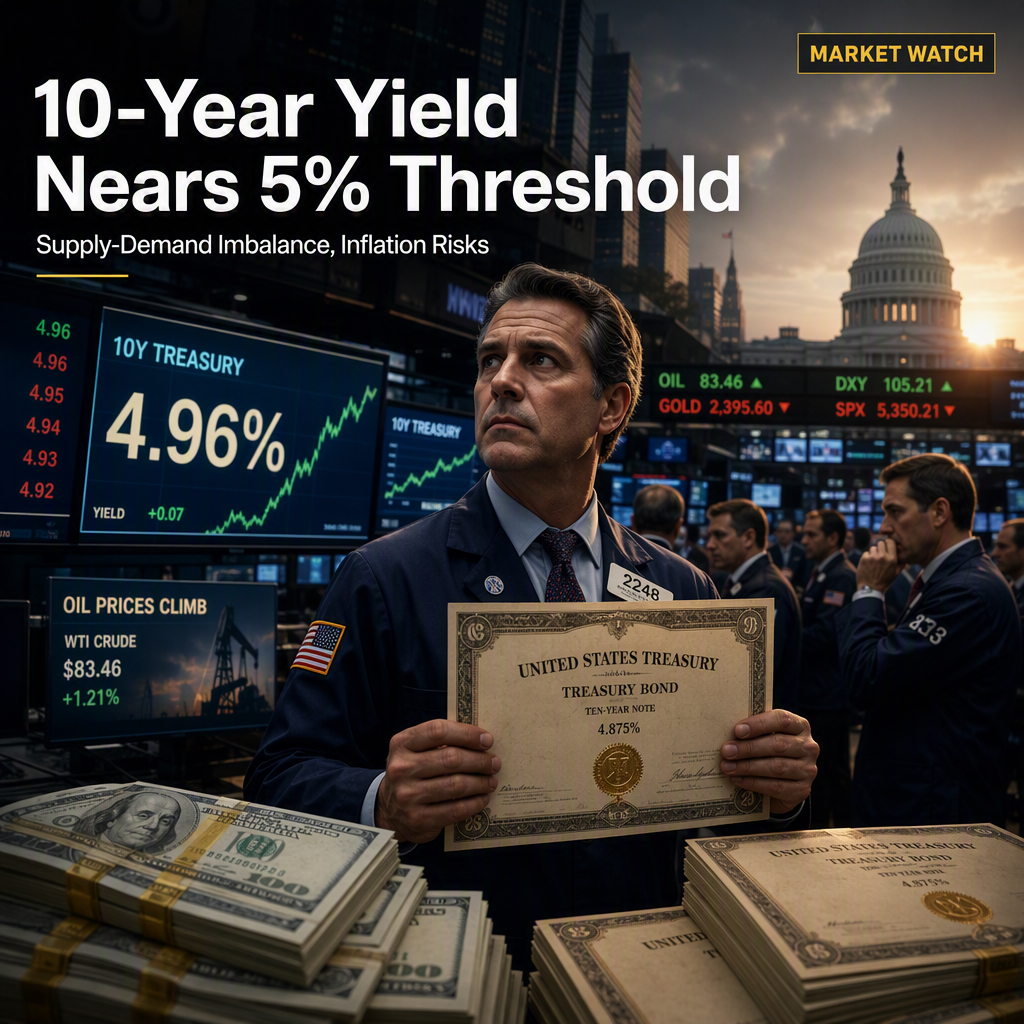
The 10-year Treasury yield is approaching the significant 5% threshold, currently hovering around 4.96%, a level not seen since October 2023 [1]. The recent rise in yields is attributed in part to a supply-demand imbalance, as heavy Treasury and corporate issuance competes for investor capital, according to Jason Ware, chief investment officer at Albion Financial Group [1]. Ware noted that he does not expect markets to break simply because the 10-year moves above 5% [1].
The implications of the 10-year yield crossing 5% depend on the underlying drivers. If the increase is fueled by resilient economic growth, the impact on stocks and the broader economy would differ from a scenario driven by resurgent inflation, fiscal concerns, or market stress [1]. Ware emphasized that higher yields are not necessarily bearish if accompanied by healthy growth, suggesting that stocks may be more vulnerable to a slowdown in consumer spending or artificial intelligence investment than to the yield crossing 5% [1].
Niall O'Sullivan, chief investment officer at Marsh Investments, stated that many companies leading the equity rally are not especially sensitive to higher rates, which limits the immediate threat to stocks [1]. He added that current heavy capital expenditure supports strong economic growth [1]. However, the 5% level could become problematic if investors demand greater compensation for inflation and fiscal risks, with large federal deficits, heavy debt issuance, and persistent inflation contributing to a rising term premium [1]. Additionally, oil prices above $100 a barrel have added further inflationary pressure [1].
Treasury Secretary Scott Bessent has attempted to contain long-end pressure through an expanded buyback program, but BMO Capital Markets strategists argue that such measures may have limited effectiveness against the fundamental drivers pushing yields higher [1]. George Awad, principal at Gibraltar Capital, warned that a disorderly move to 5% could occur if stresses in the Treasury market force leveraged investors to unwind positions simultaneously, particularly those involved in the cash-futures basis trade [1].
CONCLUSION
The 10-year Treasury yield's approach to 5% is driven by a mix of supply-demand imbalances, inflation concerns, and fiscal risks. While some analysts see limited immediate threat to stocks if economic growth remains strong, others warn that market stress or rising term premiums could pose challenges. The market impact is high, with the path to 5% likely to determine the broader financial implications.