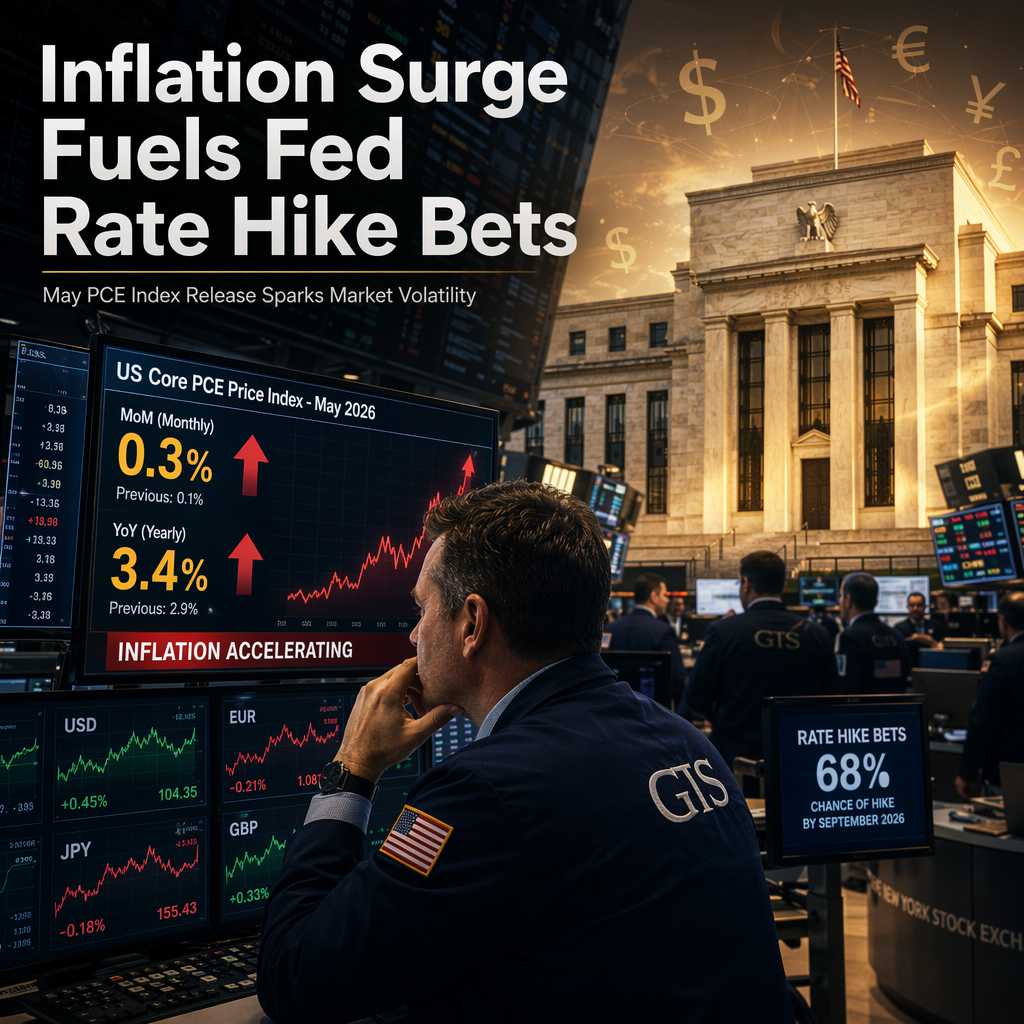
The upcoming release of the US Core Personal Consumption Expenditures (PCE) Price Index for May 2026 is drawing significant market attention, as it is the Federal Reserve's preferred inflation gauge and could influence the central bank's policy outlook [2][3]. The Core PCE Price Index is expected to rise by 0.3% month-over-month in May, up from a 0.2% increase in April, with annual core PCE inflation projected to edge higher to 3.4% [3]. Headline annual PCE inflation is forecast to reach 4%, its highest level since May 2023 [3].
The Federal Open Market Committee (FOMC) has recently adopted a more hawkish tone, expressing concern about persistent inflation [2]. According to the CME FedWatch Tool, markets are currently pricing in a 65% probability that the Fed will raise borrowing costs by at least 25 basis points by September [3]. The revised Summary of Economic Projections (SEP) from the June FOMC meeting forecasts PCE inflation at 3.6% and core PCE inflation at 3.3% by year-end [3].
Analysts expect strong services inflation in May, despite weak goods prices, with headline PCE likely to be higher at 0.49% month-over-month due to energy prices [3]. TD Securities forecasts personal spending to grow 0.5%, but notes this reflects a moderation in real terms to 0.0% [3].
Market participants are bracing for heightened volatility in the US dollar index (DXY) and major currency pairs such as EUR/USD, GBP/USD, and USD/JPY around the data release [2]. Immediate support and resistance levels are identified for these pairs, and traders are advised to monitor technical indicators and price action closely [2]. A stronger-than-expected PCE print could trigger a fresh wave of dollar buying, while a weaker reading may see risk sentiment improve and the dollar retrace recent gains [2].
"The FOMC’s hawkish tone puts extra weight on this inflation report, as markets look for clues to the next policy move," one source notes [2].
CONCLUSION
The May 2026 US Core PCE Price Index release is a pivotal event for financial markets, with expectations of rising inflation reinforcing the Federal Reserve's hawkish stance. Market participants anticipate significant volatility in the US dollar and major currency pairs, as the data will likely shape expectations for future Fed rate hikes. Traders are advised to remain vigilant and adjust strategies accordingly.