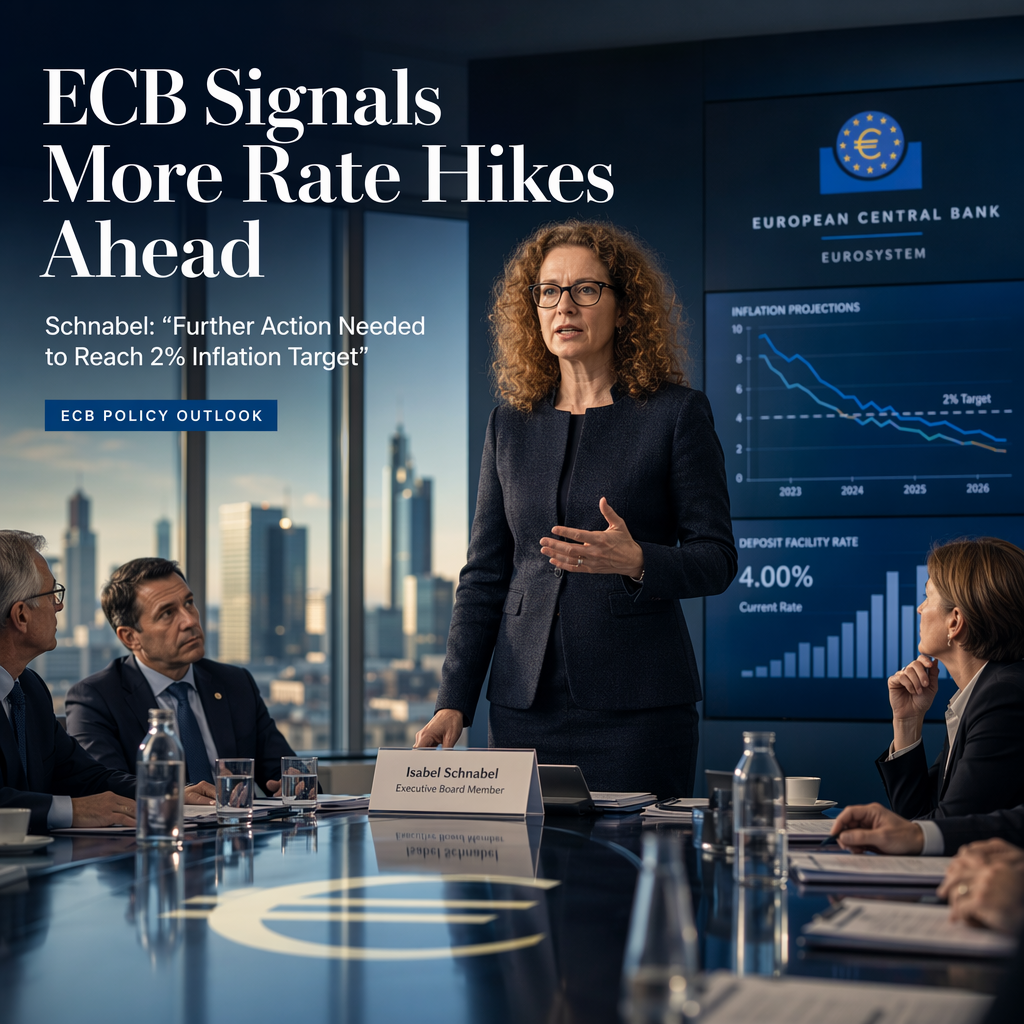
European Central Bank (ECB) policymaker Isabel Schnabel stated that the ECB is not finished with its monetary tightening cycle, emphasizing the need for additional interest rate increases to bring inflation back to the central bank's 2% target over the medium term [1]. Schnabel noted that while the short-term economic situation appears better than previously expected, recent improvements should not prompt monetary policymakers to relax their vigilance. She remarked, 'From today’s perspective, we will need to raise interest rates further in order to bring inflation back to our two percent target over the medium term' [1].
Despite Schnabel's hawkish comments, there was no immediate market reaction. At the time of reporting, the EUR/USD traded slightly lower at around 1.1353, as the US Dollar edged higher [1]. The article also provided context on the ECB's mandate, which is to maintain price stability by keeping inflation at around 2%, primarily through adjusting interest rates. It explained that higher interest rates typically strengthen the Euro, while lower rates weaken it [1].
The article further outlined the ECB's tools, including Quantitative Easing (QE) and Quantitative Tightening (QT). QE involves the ECB purchasing assets to inject liquidity, usually resulting in a weaker Euro, while QT is the process of withdrawing liquidity by stopping asset purchases and reinvestments, which is generally bullish for the Euro [1].
No forward-looking statements or analyst opinions beyond Schnabel's remarks were provided in the article. The ECB Governing Council, which makes monetary policy decisions, meets eight times a year, but no specific upcoming meeting or timeline for rate hikes was mentioned [1].
CONCLUSION
ECB policymaker Isabel Schnabel's comments reinforce the central bank's commitment to further rate hikes to achieve its inflation target. However, her remarks did not trigger an immediate market reaction, with the Euro trading slightly lower against the US Dollar. The market takeaway is that the ECB remains vigilant and is likely to continue tightening monetary policy in the near term.