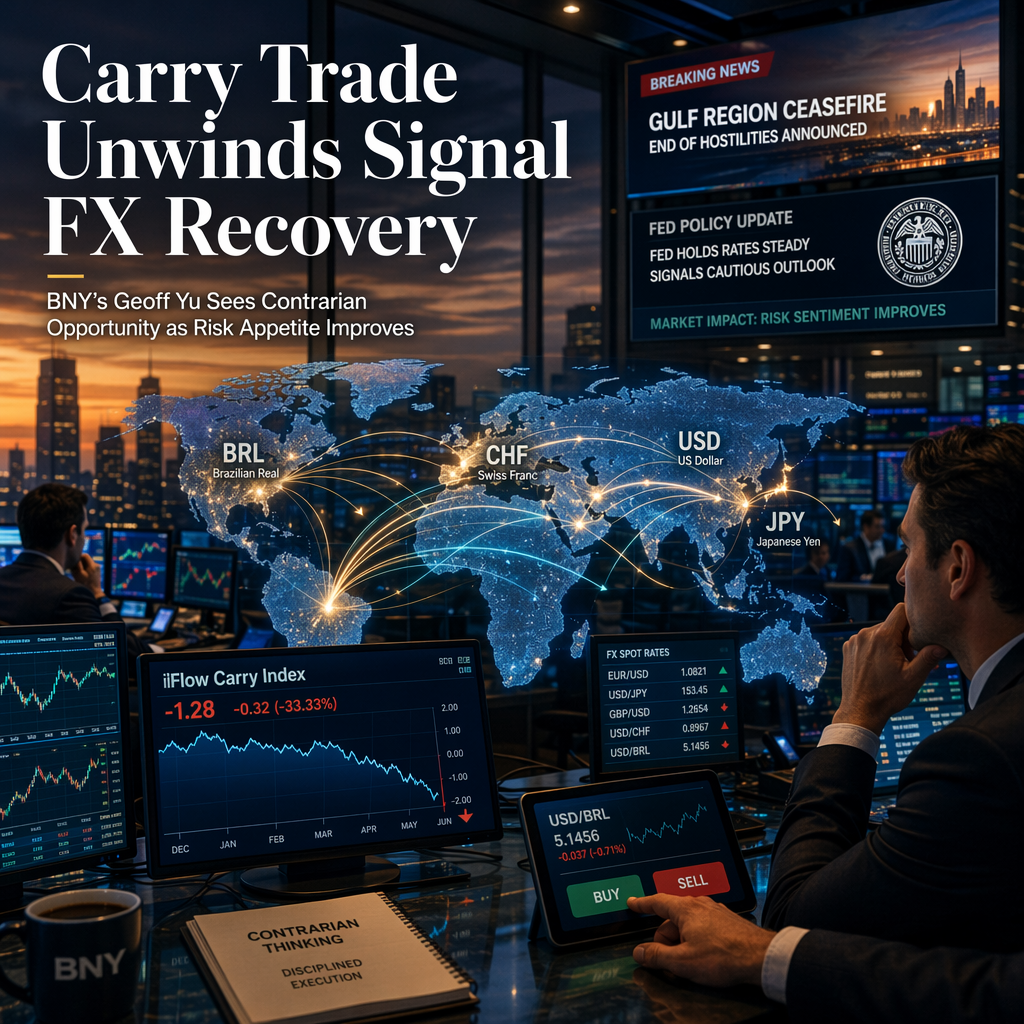
BNY's Geoff Yu reports that the iFlow Carry index has reached negative statistical significance for the first time in 2026, indicating a continued unwinding of carry trades in the foreign exchange (FX) market. The iFlow Carry index, which measures the daily Spearman rank correlation between 32 currency flow indicators and their corresponding local bond yields, now shows that currency flow performance is increasingly negatively aligned with bond yields, a sign that carry trades are being liquidated [1].
Despite this ongoing unwinding, Yu suggests that the current negative alignment could serve as a contrarian signal, pointing to a strong recovery in FX carry trades once the liquidation phase concludes. He attributes the potential for recovery to an improved risk environment, citing factors such as a ceasefire in the Gulf region and a limited hawkish pivot from the Federal Reserve [1].
In terms of specific currencies, BRL (Brazilian Real) longs are highlighted as offering a strong risk-reward profile, being only moderately overheld but the most-sold carry currency over the past month. Other high-yielding currencies remain net long, though with more subdued flow scores. The Swiss Franc (CHF) is also noted as a rare case among funders, having been well-bought recently and now holding a comfortably positive score, despite its zero interest rates and not being considered excessively undervalued like the Japanese Yen (JPY) [1].
Yu observes a shift toward improved risk appetite outside of equity markets and emphasizes the potential for gains in FX carry trades as real yields recover. He also notes the importance of idiosyncratic factors in reconciling U.S. exceptionalism with improved risk-reward opportunities elsewhere [1].
CONCLUSION
BNY's analysis suggests that the current unwinding of carry trades may present a contrarian opportunity for a strong recovery in FX carry positions, particularly as risk appetite improves and real yields rise. BRL and CHF are identified as currencies to watch, with the broader market poised for potential gains once liquidation pressures subside.