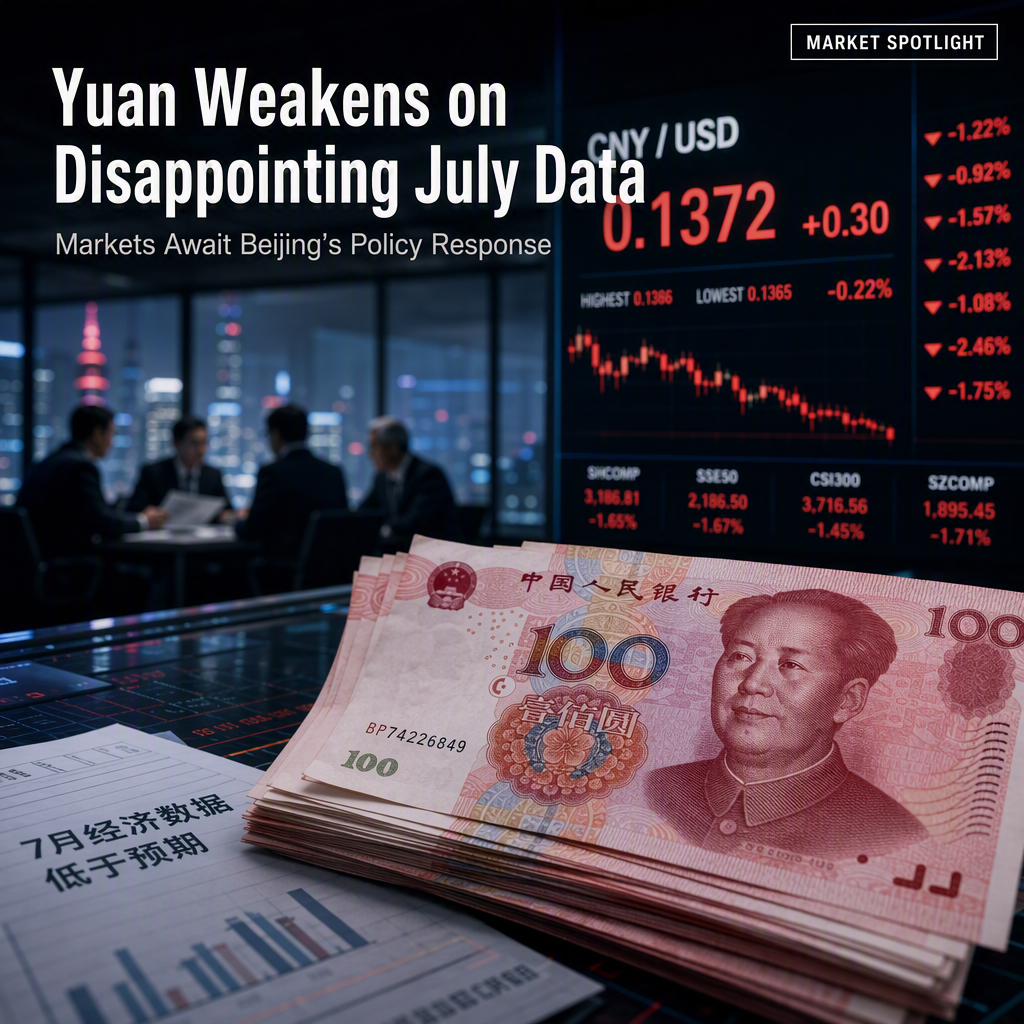
China's economy showed signs of slowing momentum at the start of the third quarter, as July data revealed weaker-than-expected Industrial Production and Retail Sales figures, according to Commerzbank analysts Charlie Lay, Dr. Henry Hao, and Moses Lim [1]. Industrial production expanded by 4.5% year-over-year, marking its first slowdown in three months, while retail sales growth also disappointed, reinforcing concerns about the sustainability of the economic recovery seen in the first half of the year [1].
The lackluster performance in key sectors, with the technology industry unable to offset declines in investment and subdued consumption, has increased pressure on Chinese policymakers to introduce concrete support measures. Premier Li Qiang convened a State Council meeting, urging officials to 'promptly formulate practical and effective incremental policies' to bolster growth. This marks the highest-level acknowledgment so far that July's broad economic shortfalls require a direct policy response [1]. The focus has now shifted from whether Beijing will intervene to the speed and mechanisms of such intervention, with fiscal acceleration—such as faster bond issuance and front-loaded infrastructure spending—identified as the most likely near-term options [1].
In the foreign exchange market, both the onshore USD/CNY and offshore USD/CNH rates rose by 30 pips to 6.74 and 6.75, respectively, reflecting increased vulnerability of the yuan as earlier corporate FX conversion support diminishes [1]. Chinese banks’ net client FX sales dropped sharply in July to an eight-month low of USD25.2 billion, indicating a significant slowdown in the corporate conversion activity that had previously supported the yuan. This reduction in technical support leaves the currency more exposed to negative sentiment regarding China's growth outlook [1].
CONCLUSION
Weaker-than-expected July economic data has heightened concerns about China's growth trajectory, leading to yuan depreciation and increased calls for policy intervention. Market participants are now closely watching for concrete fiscal measures from Beijing to stabilize sentiment and support the currency.