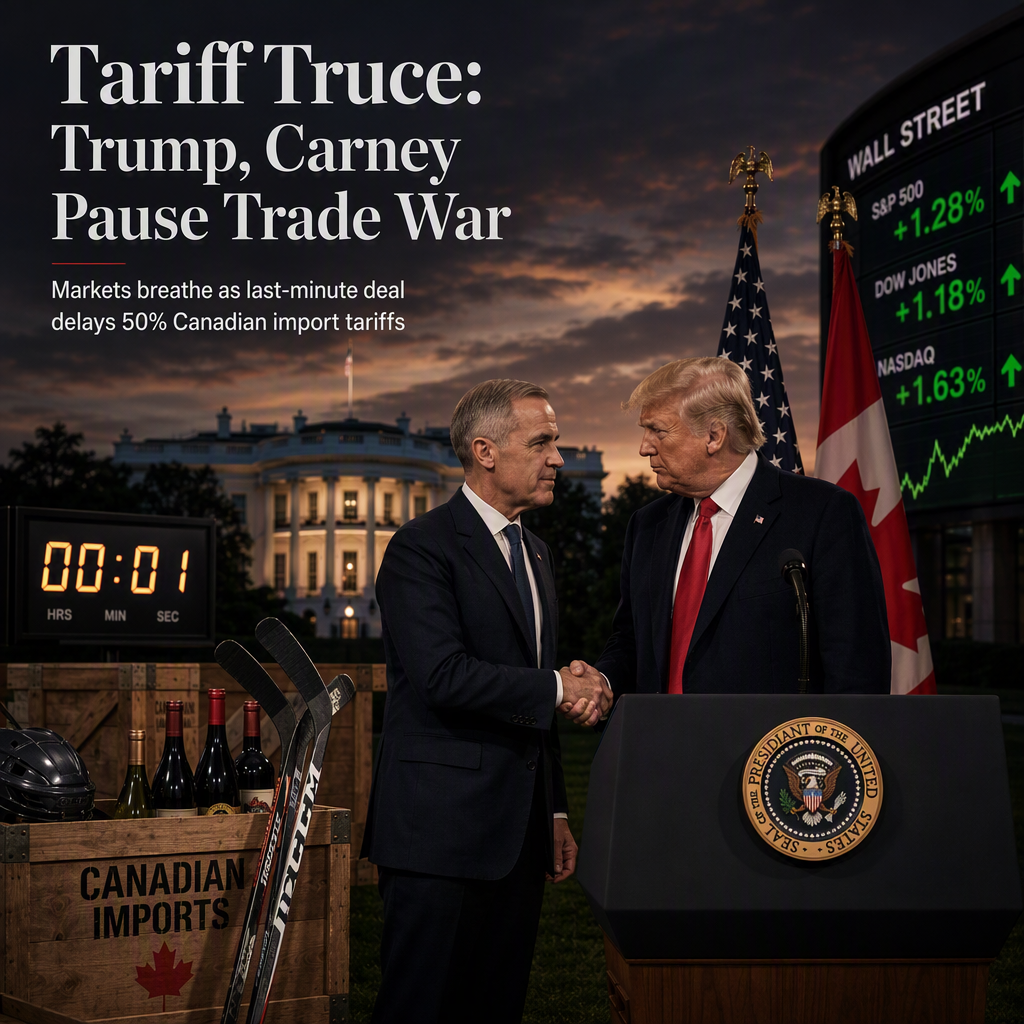
President Donald Trump announced a tentative agreement with Canadian Prime Minister Mark Carney to delay the implementation of planned 50% tariffs on Canadian imports, following what Trump described as 'a good conversation' between the two leaders [1][2]. The tariffs, which were set to take effect at 12:01 a.m. ET on Wednesday and would have impacted approximately $20 billion worth of Canadian goods including wine and hockey sticks, were paused just minutes before the deadline as both sides work toward finalizing a trade deal [1][2].
Trump stated that the delay was based on progress made in negotiations and hinted that the agreement could include provisions such as restarting the Keystone XL pipeline project, which was previously canceled in 2021, as well as potential changes to U.S. tariffs on Canadian autos [2]. However, Canadian Prime Minister Mark Carney was more reserved, noting that 'substantial progress has been made, although there is important work still to be done,' and emphasized the goal of securing favorable terms for Canada's strategic sectors [2].
U.S. Trade Representative Jamieson Greer commented that some of the trade irritants from the past year have been eliminated [2]. Trump also claimed that Canada made multiple concessions, including lowering retaliatory tariffs on U.S. goods, and asserted that Canadian tariffs 'will be non-existent for our farmers,' though he did not specify which duties he was referencing [2].
Market analysts observed that the decision to delay the tariffs eased tensions in North American markets, which had been experiencing volatility due to uncertainty over trade policies [1]. Major indices showed moderate gains following the announcement, with technical analysts highlighting resistance levels near previous highs and warning of potential downside risk if tariffs are reinstated [1]. The ongoing negotiations and the administration's approach to tariffs remain significant factors influencing market sentiment, particularly in sectors dependent on cross-border trade [1].
CONCLUSION
The tentative agreement to delay the 50% tariffs on Canadian imports has provided short-term relief to markets and businesses, with both sides indicating progress but acknowledging that a final deal is not yet complete. Market sentiment has improved moderately, but analysts caution that the situation remains fluid and further developments could significantly impact North American trade and financial markets.