
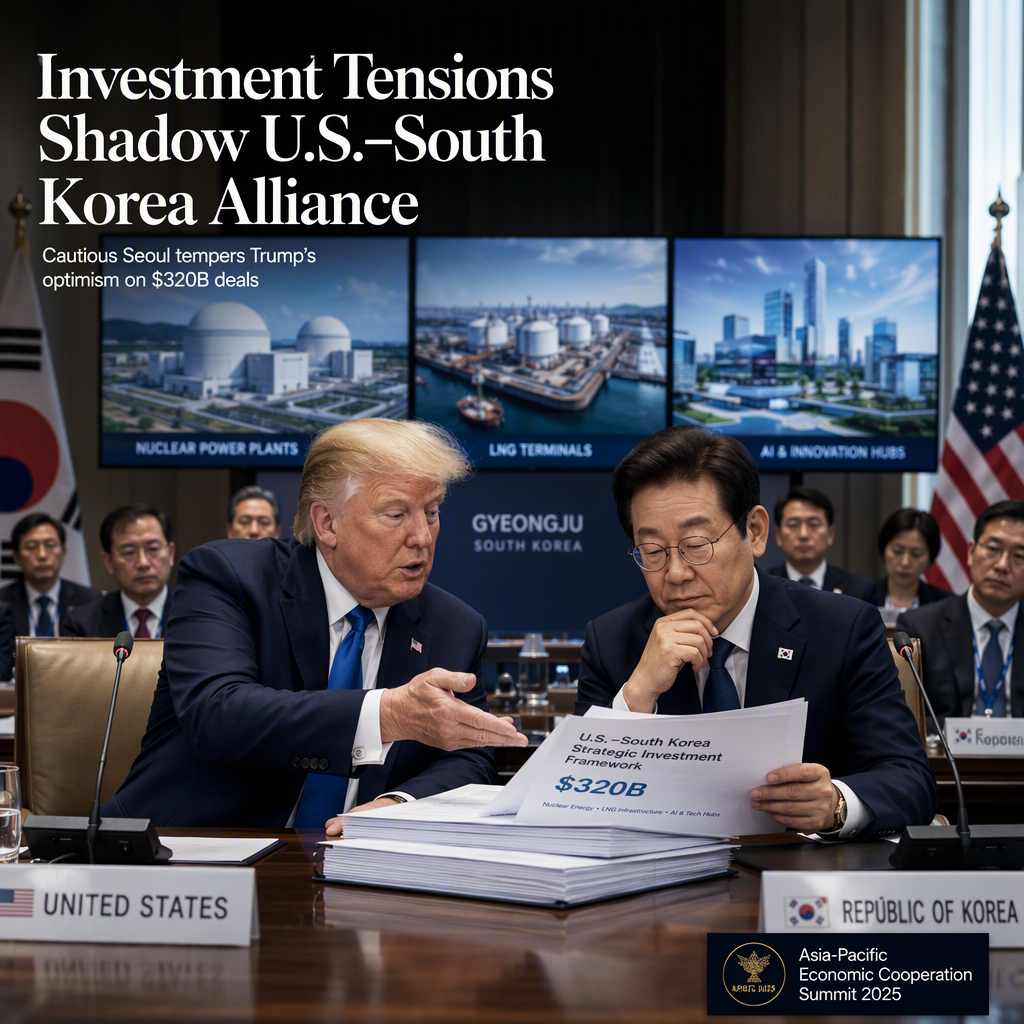
South Korea and the United States are experiencing friction over the terms of South Korean investment in U.S. energy and infrastructure projects, despite public affirmations of their alliance strength. Donald Trump met with South Korean President Lee Jae Myung at the Asia-Pacific Economic Cooperation leaders' summit in Gyeongju, South Korea, on October 29, 2025, where Trump claimed the investment deal 'keeps getting better.' However, South Korean officials have expressed caution regarding the scope and terms of these agreements, indicating that the numbers are not final and are subject to ongoing negotiation [1].
Recent announcements include South Korea's plan to build 8 nuclear power plants in the U.S. and invest up to $120 billion, alongside a separate $200 billion investment in various U.S. projects, such as the Alaska LNG project. Despite these figures, South Korean sources emphasize that the commitments are not finalized, highlighting a disconnect between the Trump administration's public statements and Seoul's more measured approach [1].
The Hyundai group has recently surpassed Honda for the first time in U.S. hybrid vehicle sales, signaling a broader trend of increased South Korean industrial presence in the American market [1]. Nevertheless, the South Korean government remains wary of overcommitting, citing domestic political pressure and uncertainty about the implementation of the deals. President Lee Jae Myung has directed officials to accelerate plans for a $589 billion AI hub, underscoring the need to balance international investments with national priorities [1].
Diplomatic observers note that these investment disagreements are part of a larger pattern of tension on trade and security matters between South Korea and the U.S., even as both sides continue to publicly reaffirm the strength of their alliance [1].
CONCLUSION
While South Korea and the U.S. have announced ambitious investment plans, significant caution and ongoing negotiations persist, particularly from the South Korean side. The disconnect between public statements and actual commitments may impact market confidence and future bilateral cooperation. The broader context of trade and security tensions suggests that these investment deals are unlikely to resolve underlying issues in the alliance.