
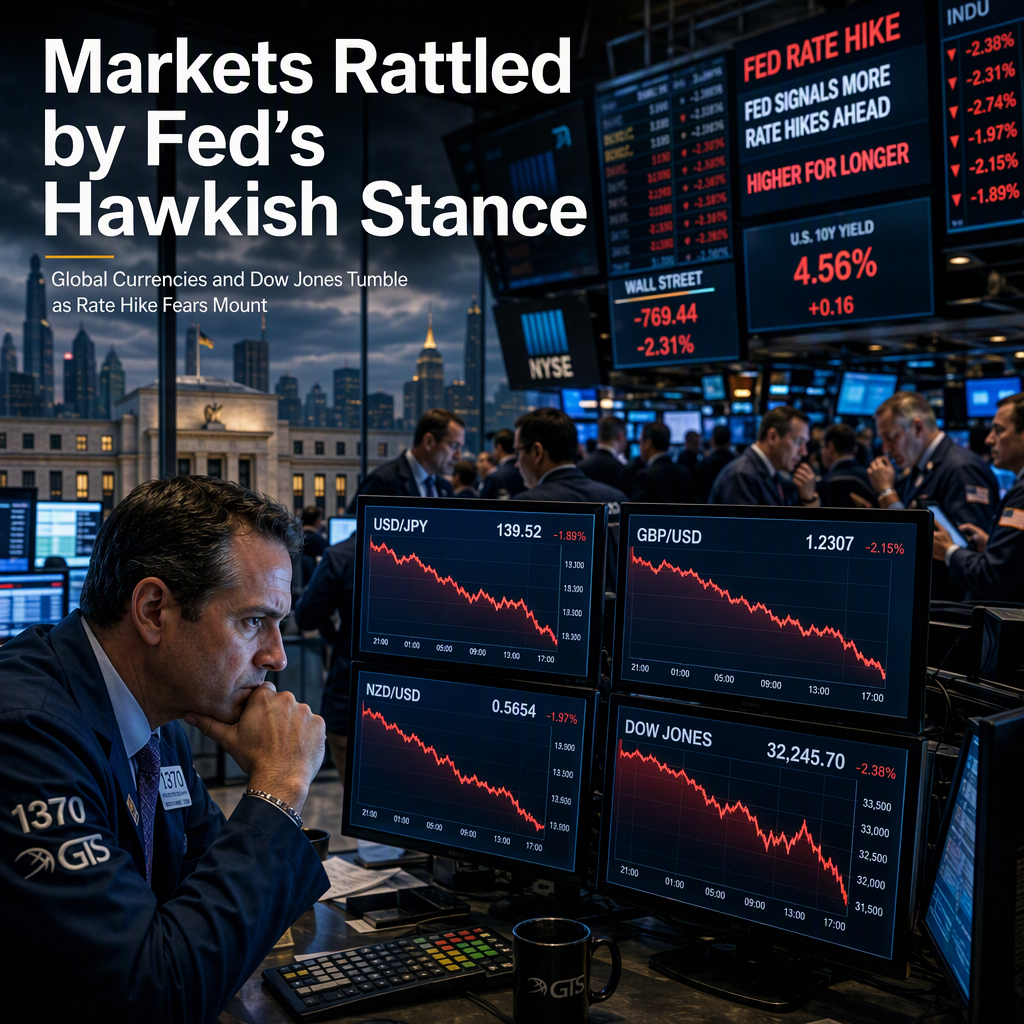
A wave of hawkish commentary from US Federal Reserve officials and rising US Treasury yields have triggered notable declines across major global currencies and pressured the Dow Jones Industrial Average. New York Fed President Williams stated that another rate increase this year looks reasonable, while Philadelphia Fed President Paulson said rates may need to rise a little more, reinforcing expectations of further tightening by the Fed [3][4]. The Fed's policy rate currently stands at a range of 3.75%-4.00% following its September 16 hike, with futures markets leaning toward another quarter-point increase on October 28 [1][2][4].
The Japanese Yen continued its slide, with USD/JPY touching 159.00, its highest since early September, despite the Bank of Japan (BoJ) raising its policy rate to 1.25% on September 18—the highest since 1995. This rate remains 2.5 percentage points below the Fed's floor, and the Yen has weakened even after Japanese authorities checked rates with dealers and repeated warnings about intervention. Finance Minister Katayama reiterated that the principles behind the joint US-Japan intervention of July 31 are still in effect, but declined to comment on specific levels [1].
Similarly, the Pound Sterling fell for a fourth consecutive session, trading just above 1.3200, its lowest in nearly three months, even as Bank of England (BoE) Deputy Governors Lombardelli and Breeden signaled they are moving closer to voting for a rate hike. The BoE held the UK's Bank Rate at 3.75% on September 17 by a 6-3 vote, and markets now price about a 75% chance of a quarter-point hike on November 5. However, the Fed's decision on October 28 is expected to precede the BoE's move, influencing Sterling's trajectory [4].
The New Zealand Dollar also declined, with NZD/USD trading just above 0.5650, its lowest since late June, despite markets now pricing at least a 75% chance that the Reserve Bank of New Zealand (RBNZ) will raise its Official Cash Rate to 3% on October 28. The Kiwi's weakness is attributed to expectations that the Fed will also raise rates on the same day, maintaining the yield gap [2].
On the equity front, the Dow Jones Industrial Average fell for a third consecutive day, closing at its lowest since mid-June after dipping to the 51,100 area. The index has now given back about 70% of its June-to-August rally. The decline was driven by surging long-term yields, with the 30-year Treasury yield touching 5.50%. Sherwin-Williams, Walmart, and IBM were among the Dow's biggest losers. In contrast, the S&P 500 finished flat and the Nasdaq Composite edged higher [3].
Geopolitical developments also played a role, as Reuters reported that US and Iranian negotiators are discussing a phased deal to reopen the Strait of Hormuz. Brent crude finished above $106 a barrel, and energy prices remain a key factor in central bank policy deliberations, particularly for the BoE [3][4].
CONCLUSION
Rising US Treasury yields and hawkish Fed commentary have put significant downward pressure on major global currencies and the Dow Jones Industrial Average. Despite rate hike signals from other central banks, the persistent yield gap with the US and the timing of Fed decisions continue to dominate market sentiment. Investors remain focused on upcoming central bank meetings and key economic data releases for further direction.