
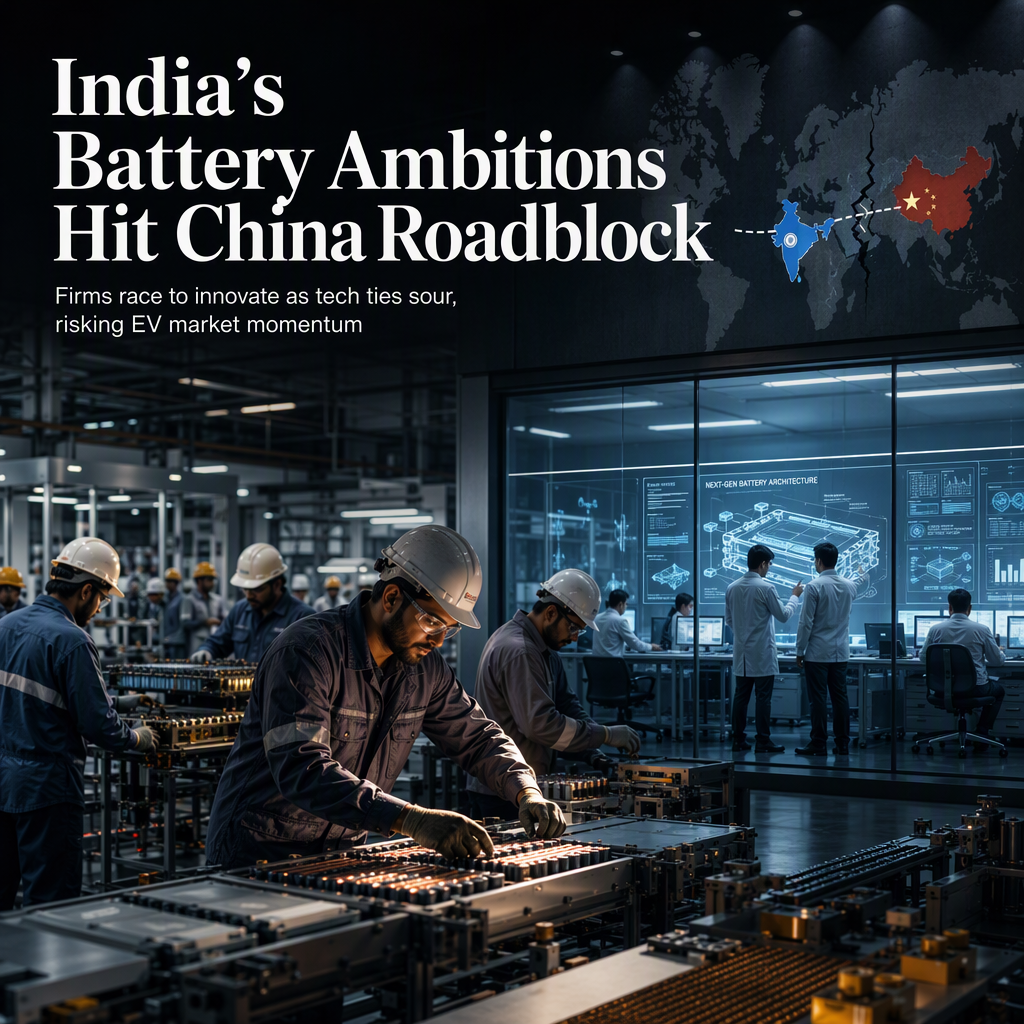
Indian battery cell manufacturers, including conglomerates such as Amara Raja and JSW, are scaling back their ambitions due to Beijing's reluctance to share cutting-edge technologies, which has soured partnerships between Indian and Chinese firms [1]. This development poses a setback to New Delhi's plans to boost domestic battery cell manufacturing in support of its clean energy and electric vehicle goals [1].
Industry experts highlight that while Indian companies possess the capability to build lithium iron phosphate cells independently, the rapid pace of technological advancement in the sector makes timely execution critical [1]. Amara Raja has responded by accelerating its research and development investments to compensate for the loss of knowhow previously accessed through Chinese partnerships [1].
With China tightening controls over technology transfer, Indian firms are compelled to increase domestic R&D spending, which could delay the scaling up of battery cell manufacturing [1]. Market analysts warn that unless Indian companies can quickly catch up with technological advancements, they risk losing competitive ground in the global battery market [1]. The uncertainty surrounding technology transfers also impacts cost structures and could influence the pricing of locally manufactured battery cells in the near term [1].
Despite these challenges, industry experts remain cautiously optimistic, noting that Indian firms, equipped with foundational knowledge and increased R&D efforts, may eventually overcome current obstacles. However, they stress the importance of timely execution to capitalize on the growing demand for advanced battery technologies both domestically and globally [1].
CONCLUSION
Indian battery cell manufacturers face significant challenges as China restricts technology transfers, forcing increased domestic R&D investment and strategic reassessment. While there is cautious optimism about overcoming these hurdles, timely execution is crucial for India to maintain competitiveness in the fast-evolving global battery market. The market impact is medium, with potential implications for cost structures and pricing in the near term.