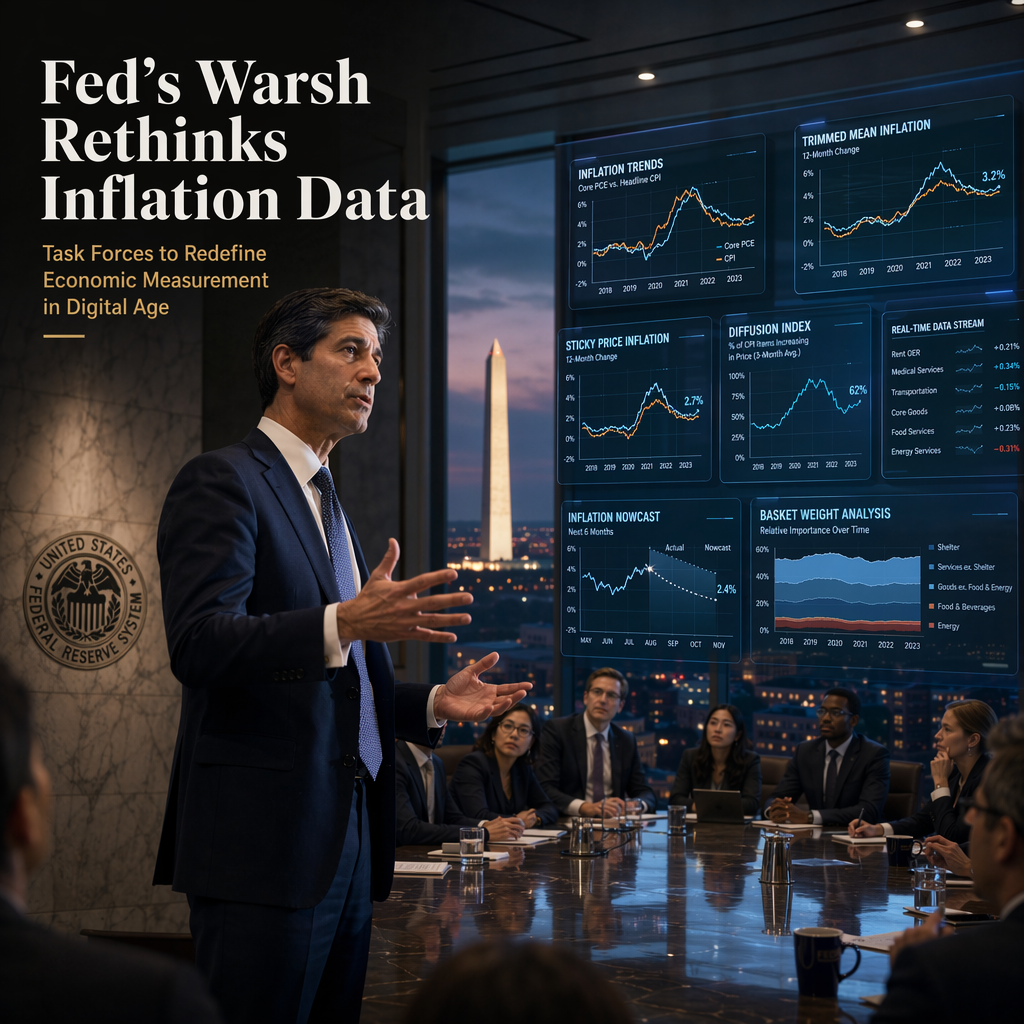
Federal Reserve Chairman Kevin Warsh announced the formation of five task forces aimed at reviewing various Federal Reserve functions, with a particular focus on how inflation is measured and how officials respond to it [1]. Warsh emphasized that inflation is a 'choice' and suggested that the way it is measured is equally important, signaling a potential shift in the Fed's approach to monetary policy [1].
Speaking at the European Central Bank Forum on Monetary Policy in Sintra, Portugal on July 1, 2026, Warsh stated his aspiration for the Fed to utilize new technologies within nine to twelve months to better understand real-time economic conditions, thereby enabling central bankers to make more informed decisions [1]. He highlighted that the review would go beyond the traditional debate between headline and core inflation, aiming instead to incorporate a broader range of data points that more accurately reflect the cost-of-living challenges faced by consumers, especially as inflation has remained elevated for five years [1].
The article notes that the Fed may consider alternative inflation measures, such as the Dallas Fed's 'trimmed mean' inflation, the Atlanta Fed's 'sticky' and 'flexible' inflation metrics, as well as surveys from the University of Michigan and the New York Fed. Private sector measures like the 'Truflation' gauge, which uses advanced technology to provide daily inflation indexes, are also being considered [1]. These various measures often yield differing perspectives on inflation, with some indicating that prices remain high, while others suggest the Fed may be closer to its 2% inflation target than traditional metrics imply [1].
No specific market reactions or analyst opinions were mentioned in the article. The review process is expected to influence the data triggers the Fed uses for implementing monetary policy, but no concrete forward-looking statements regarding policy changes were provided [1].
CONCLUSION
Federal Reserve Chairman Kevin Warsh's initiative to reevaluate inflation measurement signals a potential shift in how the central bank assesses price pressures. By considering a wider array of data sources and new technologies, the Fed aims to gain a more nuanced understanding of inflation, which could impact future monetary policy decisions. Market participants should monitor the outcomes of these task forces for possible changes in the Fed's approach.