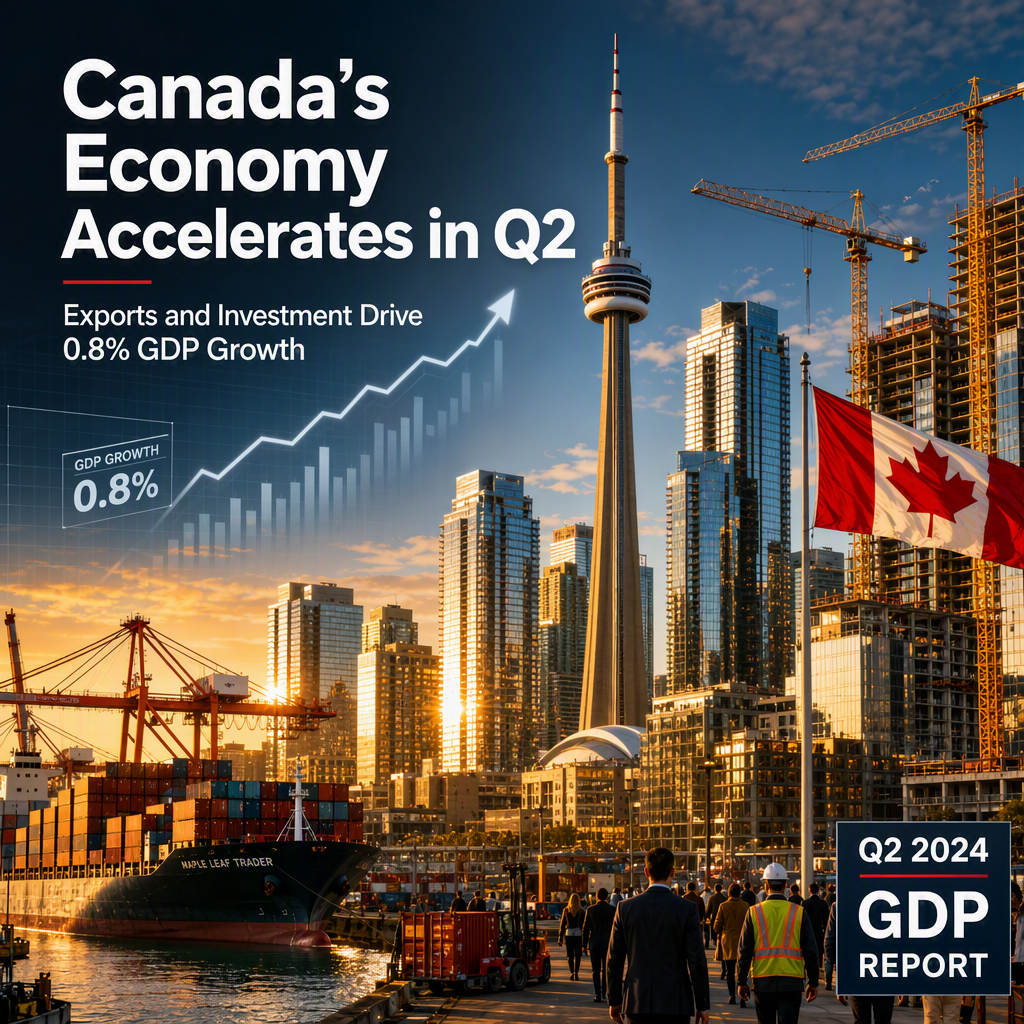
Canada's economy posted a notable acceleration in the second quarter, with Gross Domestic Product (GDP) expanding by 0.8% quarter-on-quarter, according to data released by Statistics Canada on Friday [1]. This marks a significant improvement from the 0.1% growth recorded in the first quarter, which itself was revised upward from an initial estimate of 0% [1]. On an annualized basis, GDP grew by 3.3% in Q2, up from the previous quarter's 0.3% increase, though this figure came in just below market expectations of 3.4% [1].
Monthly data also reflected positive momentum, as GDP rose by 0.3% month-on-month in June, matching May's pace and surpassing expectations for a slowdown to 0.2% [1]. The second-quarter growth was primarily driven by a 3.6% increase in exports—the strongest quarterly rise since Q1 2023—alongside a 0.8% advance in household consumption expenditure and strengthened business investment, particularly in machinery, equipment, and engineering structures [1]. Additionally, real GDP per capita increased by 1%, coinciding with a third consecutive quarterly decline in Canada's population [1].
Despite the robust economic data, the market reaction was muted. The USD/CAD currency pair remained broadly stable, trading around 1.3855 at the time of reporting, as investors awaited further cues from Federal Reserve Chair Kevin Warsh's upcoming speech at Jackson Hole [1].
CONCLUSION
Canada's stronger-than-expected Q2 GDP growth signals underlying economic resilience, driven by exports, consumer spending, and business investment. However, the limited market reaction suggests investors are cautious, awaiting further global monetary policy signals. The data points to a positive outlook for the Canadian economy, though market participants remain watchful.