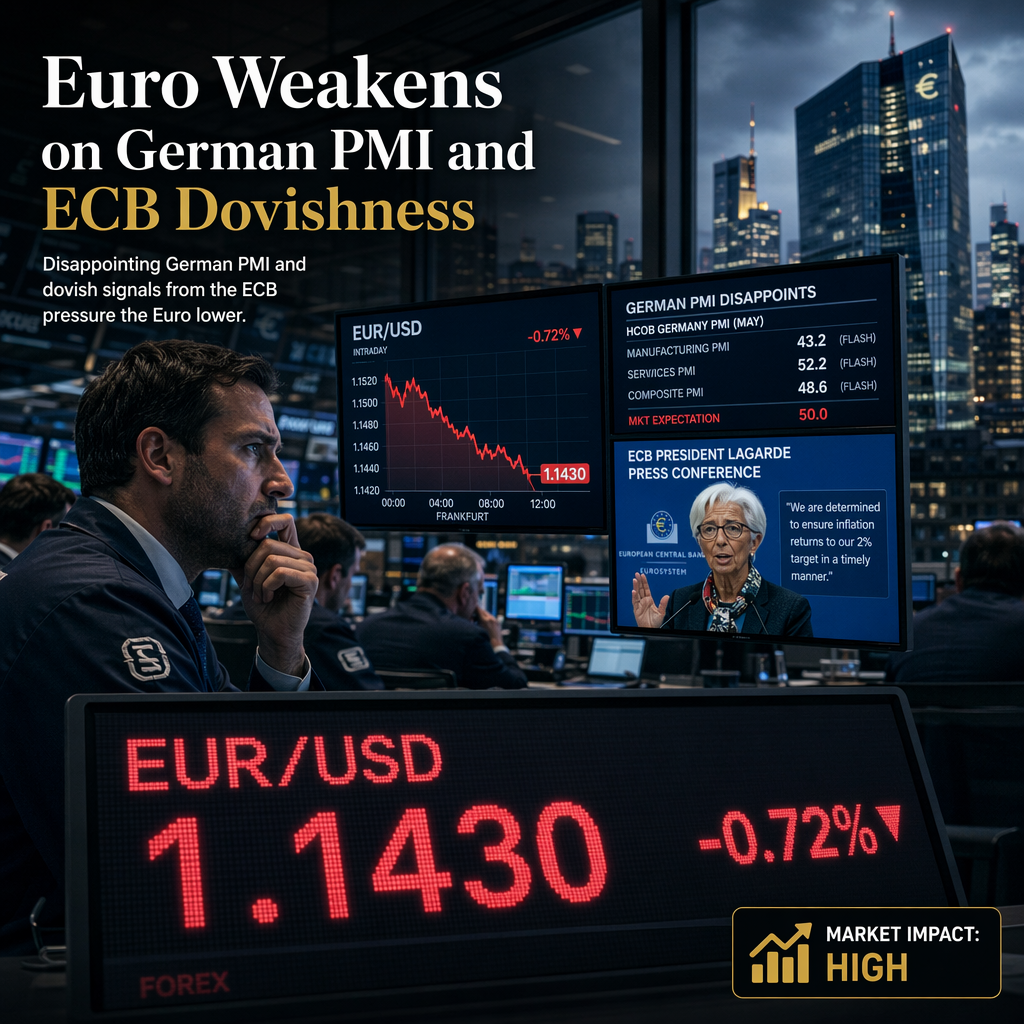
The Euro has come under pressure following the release of softer PMI price data across the Eurozone and disappointing HCOB PMI figures from Germany, with EUR/USD trading around 1.1430 during European hours after modest losses the previous day [2]. Societe Generale analysts, including Kenneth Broux, attribute the Euro's weakness to easing inflationary pressures as indicated by S&P Global's PMI report, which showed input cost inflation slowing to its lowest rate since February, with weaker increases across both manufacturing and services sectors. Output price inflation also slowed in June, particularly among manufacturers [1]. Germany's preliminary HCOB Manufacturing PMI flatlined at 50.0 in June, matching forecasts but marking a slight decline from May's 50.1, while the Services PMI dropped to 46.8 from 48.1, missing the market expectation of 48.7 and signaling contraction in the sector [2].
The dovish tone from ECB President Lagarde, who spoke yesterday, contributed to the Euro's status as the worst performing G10 currency in the last 24 hours and prompted a bull steepening in the Bund curve [1]. Societe Generale notes that the communication from the ECB has raised the bar for a second rate increase, with softening PMI prices reinforcing this view [1]. Technical analysis from Societe Generale highlights support for EUR/USD around 1.1390 and 1.1350, with resistance at 1.1475. The widening 2-year UST/EGB spread, currently attempting a breakout above 160bp (163.7bp), and stretched technicals suggest further downside risk for the Euro against the Dollar, with a retest of the March low at 1.1411 seen as likely if 1.1390 support fails [1].
Market sentiment remains bearish for the Euro, as the US Dollar is buoyed by hawkish expectations surrounding the Federal Reserve. The FOMC Economic Projections report revealed that nine out of 19 policymakers anticipate a rate increase in 2026, and Fed Chair Kevin Warsh's unexpectedly hawkish stance has further strengthened the Dollar [2]. The CME FedWatch tool shows an 85% probability of at least a 25-basis-point rate hike before year-end. Investors are closely monitoring the upcoming May Personal Consumption Expenditure (PCE) Price Index release for further clues on US monetary policy [2].
Societe Generale cautions that while second round effects of inflation may take time to materialize, the recent data and ECB communication have set a higher threshold for additional rate hikes. The momentum in EUR/USD could deflate further towards the 1.1350 area if current support levels are breached [1].
CONCLUSION
The Euro is facing significant downward pressure due to weaker PMI data from Germany and the Eurozone, combined with a dovish ECB stance and strong US Dollar momentum. Technical and fundamental indicators suggest further downside risk for EUR/USD, with market participants closely watching upcoming US inflation data for additional direction. The prevailing sentiment is bearish, and the market impact is high as traders adjust positions in response to these developments.