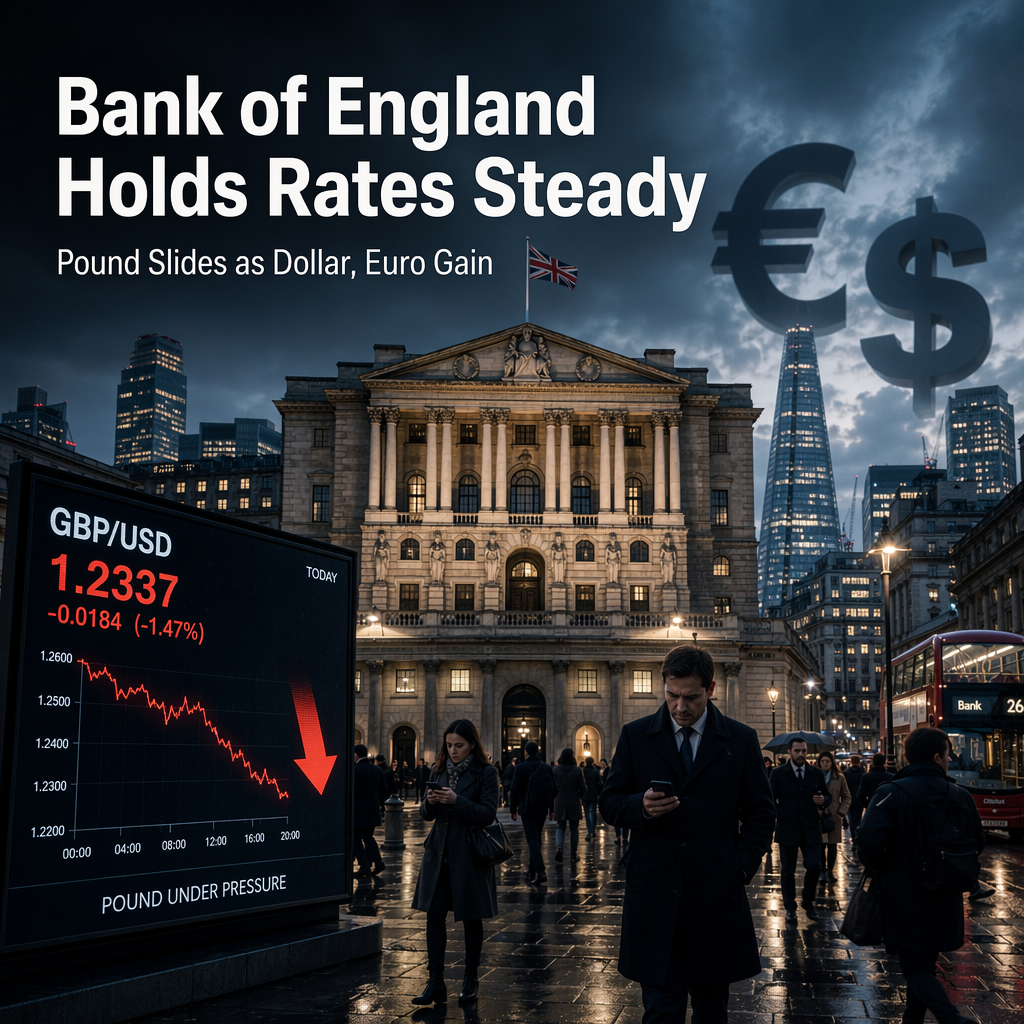
The Bank of England (BoE) left its Bank Rate unchanged at 3.75% during its June 18, 2026 meeting, a decision that was widely anticipated by markets and approved by a 7-2 majority, with Swati Dhingra and Huw Pill voting for a 25-basis-point hike [1][2][4]. The BoE cited moderating inflationary pressures, as reflected in May's data, and revised down its inflation forecasts for the year while upgrading underlying growth projections compared to April's estimates [1][4]. Despite the steady policy, the Monetary Policy Committee (MPC) maintained a hawkish bias and emphasized flexibility, with Deutsche Bank's Sanjay Raja noting a stronger consensus to hold rates and expectations for the Bank Rate to remain on hold through 2024, with cuts possibly resuming from spring 2025 [2].
The British Pound weakened following the announcement, hitting fresh two-month lows near 1.3200 against the US Dollar (USD) and falling against the Euro, with EUR/GBP breaking above 0.8655 and reaching three-week highs at 0.8670 [1][4]. The market reaction was compounded by the US Federal Reserve's hawkish hold, which strengthened the USD and pressured the GBP further [4][6]. The Fed left its benchmark rate in the 3.50%-3.75% range, removed language hinting at an easing bias, and indicated that nearly half of board members foresee a rate hike before year-end [4].
UK economic data released the same day showed the Unemployment Rate declined to 4.9% in the three months to April, down from 5% and better than market expectations, while 100,000 jobs were created—above the 80,000 consensus but below the previous 148,000 increase [1][4]. Wages continued to grow robustly, with Average Earnings Excluding Bonus steady at 3.4% (vs. 3.2% expected) and total pay including bonuses rising 4.4% year-on-year [1][4].
Across Europe, the BoE's decision to hold rates was in line with other central banks such as the Swiss National Bank, Norges Bank, and Riksbank, which also kept policy unchanged, while the European Central Bank (ECB) remains the exception with recent hikes [3]. However, analysts at Rabobank and BNY highlight that regional inflation concerns are largely domestic and downside growth risks persist in the Euro area, with Rabobank maintaining below-consensus EUR/USD forecasts and projecting a 3-month target of 1.16 [3][5].
Looking ahead, the BoE retains full optionality for future meetings, with Deutsche Bank expecting no rate changes through 2024 and possible cuts from spring 2025 [2]. The broader market context remains cautious, with the Dollar Index testing 12-month highs as the Fed signals a less dovish stance and European growth forecasts face potential downward revisions [5][6].
CONCLUSION
The Bank of England's decision to keep rates steady at 3.75% was widely expected but led to a notable weakening of the British Pound against both the Euro and US Dollar. While UK economic data showed some improvement, the BoE's cautious stance and the Fed's hawkish tone have shifted market sentiment in favor of the USD and EUR. Analysts anticipate the BoE will maintain its current policy through 2024, with the possibility of rate cuts only from spring 2025.