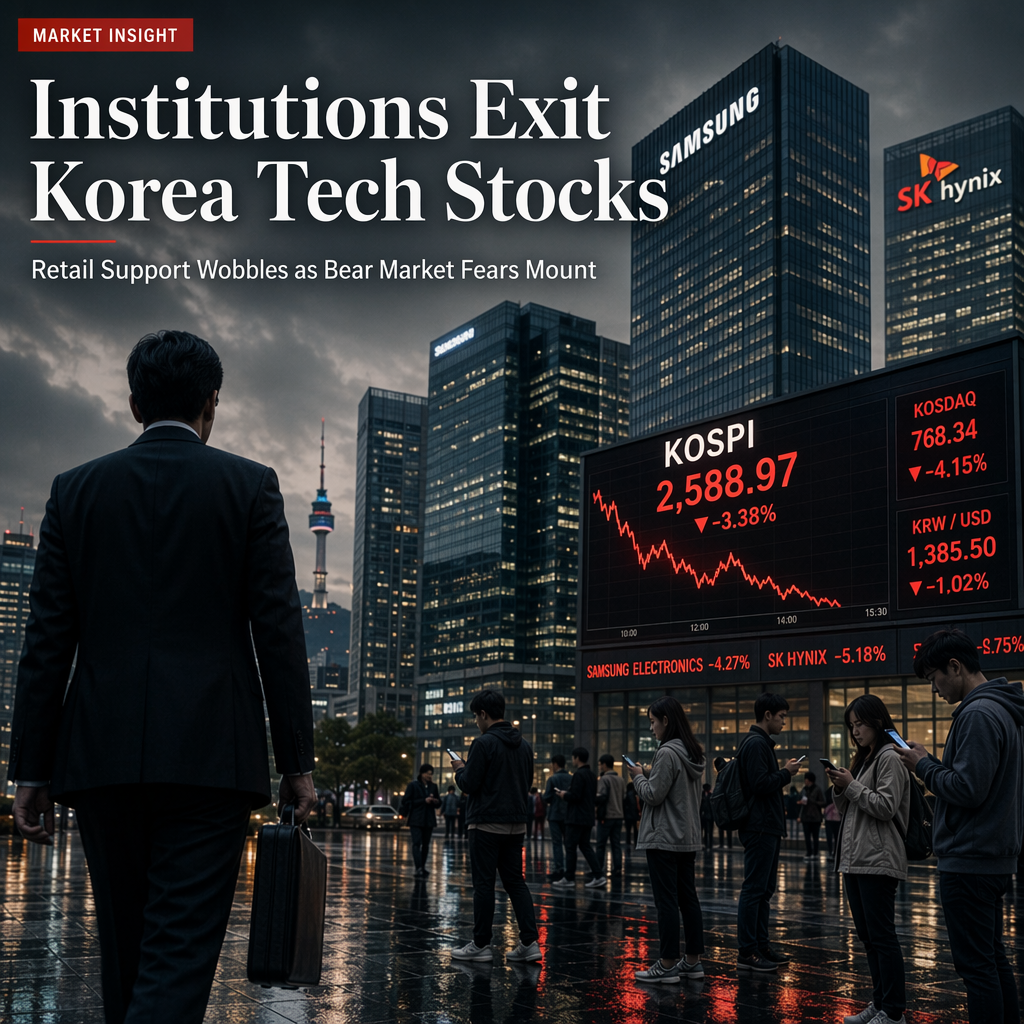
According to BNY’s Geoff Yu, institutional investors are exiting South Korean equities in large numbers, which has contributed to the KOSPI’s brief move into bear market territory overnight [1]. Despite this, retail investors continue to support the market, but there are growing concerns about the sustainability of this retail-driven support [1]. The sell-off in South Korea has been particularly pronounced in the technology sector, with significant declines in Samsung Electronics and SK Hynix, even though Samsung recently indicated a sharp quarterly profit rebound [1]. This suggests that the market’s reaction is driven more by positioning, index concentration, and high expectations linked to AI, rather than weak current fundamentals [1].
The report highlights that single-stock ownership limits for active managers remain a technical constraint, but if institutional selling continues beyond what these constraints would explain, it could indicate a broader behavioral shift among investors [1]. In contrast, Taiwanese equities, which have also benefited from the AI and semiconductor narrative, have seen more measured liquidation and relative resilience in index performance [1]. Meanwhile, interest in Chinese equities remains strong, even as indices like the HSCEI entered bear market territory a few weeks ago [1].
Regionally, Denmark, Hungary, and India have attracted the strongest inflows, while equities in the U.S., U.K., South Korea, and Thailand remain under selling pressure [1]. The report notes that it is too early to call this a rotation away from growth markets like Taiwan and South Korea into value segments elsewhere in Asia, but some funds within region-specific mandates are searching for new investment destinations, which could lead to greater dispersion in return profiles this quarter [1].
CONCLUSION
Institutional outflows are pressuring South Korean equities, especially in the tech sector, while retail investors’ support is increasingly questioned. The market’s reaction appears driven by positioning and concentration risks rather than fundamentals, and ongoing selling pressure could signal a broader shift in investor behavior. Regional flows suggest a search for new opportunities, with inflows favoring Denmark, Hungary, and India.