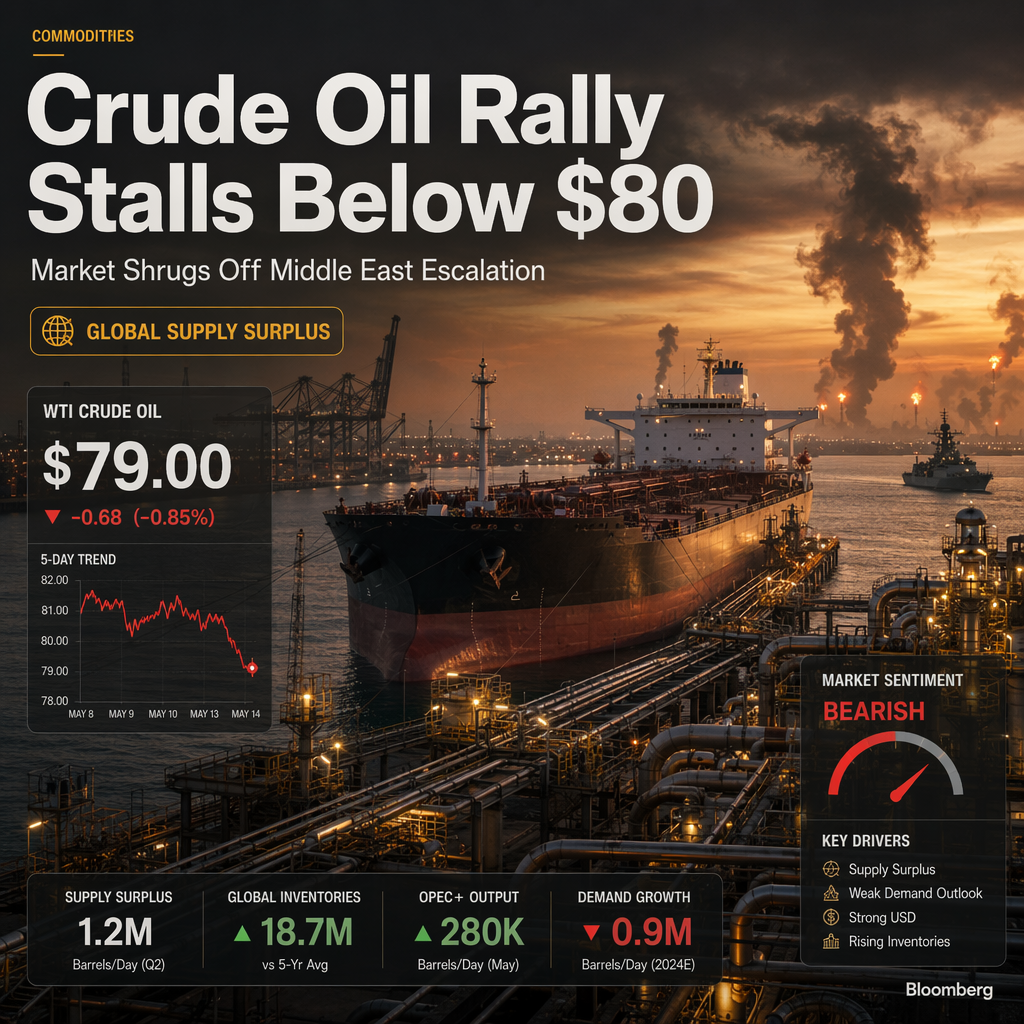
West Texas Intermediate (WTI) Crude Oil prices declined by about one percent to just below $79.00 after failing for the third consecutive time to break above the $80.00 level, which aligns with the 50-day Exponential Moving Average acting as resistance [1]. Despite significant geopolitical escalation—including US forces striking a tanker near Iran's main export terminal, the reimposition of a naval blockade on Iranian ports, and Tehran retaliating by firing at American bases in Kuwait and Jordan—crude prices have not sustained a rally above $80.00 [1]. Washington has responded by proposing a 20% transit toll for protected cargo through the Strait of Hormuz and revoking waivers that previously allowed Iran to export crude oil and petrochemicals [1].
Historically, such developments would have commanded a substantial risk premium; for example, a similar escalation in February would have added $30.00 to prices [1]. However, the market appears desensitized, with traders recalling that WTI spent the spring above $107.00 when the Strait was previously threatened, only to fall back to $67.00 after a peace framework reopened the waterway [1]. The June average price dropped by more than $20.00 from May as tanker traffic resumed [1]. Now, traders are demanding evidence of actual supply disruptions before pricing in another premium, as headlines alone are insufficient [1].
The muted price reaction is attributed to a loosening supply picture. US crude production is near a record 13.5 million barrels per day, with additional output growth from Brazil, Guyana, and Canada [1]. Forecasting agencies project a supply surplus extending into late 2026, even as demand grows by about 1.2 million barrels per day [1]. Iranian output had increased during the ceasefire weeks due to sanctions relief, allowing buyers to stock up before the blockade was reinstated, meaning the barrels now lost were already accounted for in the market [1].
OPEC's ability to manage the market is diminished, with the United Arab Emirates leaving the group in April and remaining members lobbying to restore quotas and recover lost sales during the ceasefire [1]. Production discipline is described as the loosest in decades, and record spare capacity in Saudi Arabia and Gulf neighbors is capping every rally [1]. Demand remains firm despite elevated energy prices, contributing to persistent inflation and hawkish central bank stances, but overall, growing supply continues to outweigh demand, resulting in a surplus [1].
CONCLUSION
Despite heightened geopolitical risks and renewed supply disruptions, WTI crude oil prices remain capped below $80.00 due to robust global supply and market skepticism toward headline-driven risk premiums. The market is prioritizing evidence of actual supply losses over fear, keeping price rallies in check.