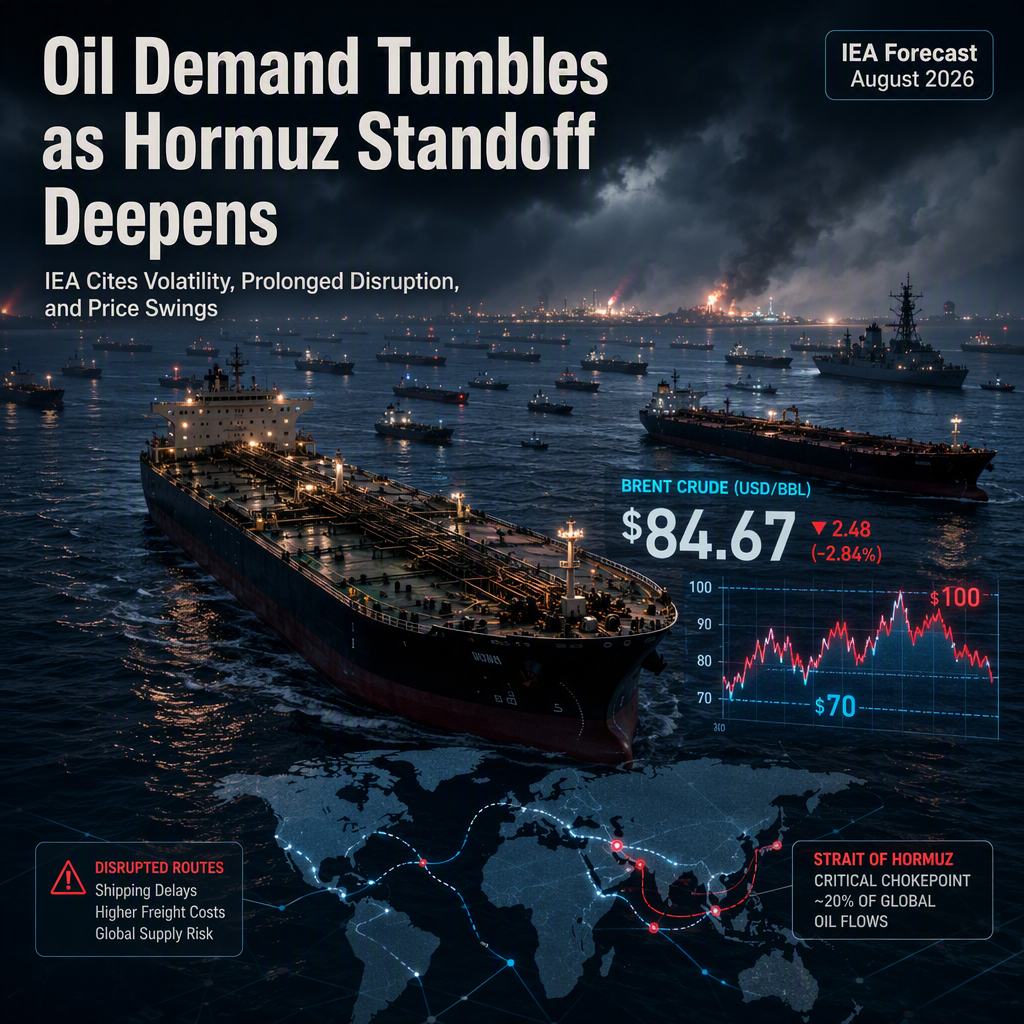
The International Energy Agency (IEA) announced on August 12, 2026, that global oil demand is projected to fall by 1.6 million barrels a day in 2026, a decrease that is 510,000 barrels a day larger than its previous monthly forecast in July [1]. This revision comes as the closure of the Strait of Hormuz continues to disrupt the global economy and intensify oil demand destruction [1]. The IEA attributes the decline to persistently high fuel prices, which are expected to weigh on consumption throughout the year. However, the agency anticipates that demand will recover and return to growth in the final quarter of 2026 [1].
The situation in the Strait of Hormuz remains unresolved, with no agreement between Washington and Tehran to reopen the critical waterway. Both sides continue to publicly issue demands, and "renewed hostilities and maritime disruptions" are undermining efforts to restore global oil supply [1]. As a result, global oil supply in July was 6.3 million barrels a day lower year-on-year [1].
These supply disruptions have led to significant volatility in crude oil prices. The international benchmark Brent crude surpassed $100 a barrel last month, but also dropped near $70 a barrel, and was most recently trading just under $90 a barrel [1]. According to Goldman Sachs analyst Daan Struyven, risks to the base case for Brent crude are skewed to the upside, as attacks in the Red Sea and Gulf of Oman further heighten supply concerns [1].
CONCLUSION
The IEA's revised forecast highlights the severe impact of the Hormuz closure on global oil demand and supply, driving heightened price volatility and upside risk for Brent crude. Persistent geopolitical tensions and maritime disruptions are expected to keep the oil market under pressure, with demand recovery anticipated only in the final quarter of 2026. Market participants should remain alert to further supply shocks and price swings.