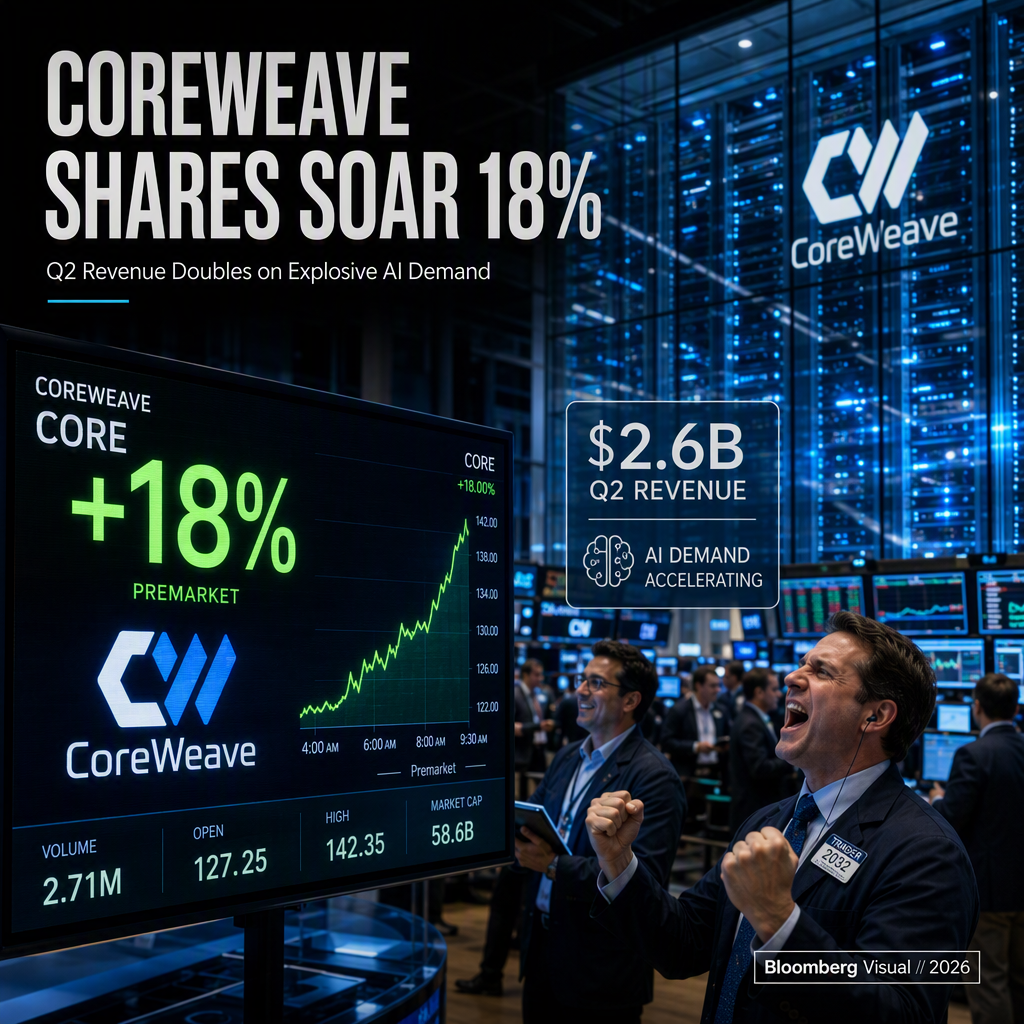
CoreWeave shares jumped 18% in premarket trading following the company's announcement that its second-quarter revenue doubled year-on-year, reaching $2.6 billion, up 112% from $1.2 billion in the same period of 2025. This surge was attributed to increased demand from hyperscalers for AI compute capacity, as CoreWeave continues to expand its infrastructure to meet enterprise adoption of AI technologies [1].
Despite the impressive revenue growth, CoreWeave remains unprofitable, with operating expenses also more than doubling to $2.6 billion, resulting in an operating loss of $49 million compared to an operating income of $19 million a year earlier. The company’s revenue backlog stood at $104 billion as of June 30, excluding $25 billion in new customer commitments for the third quarter. For the third quarter, CoreWeave is guiding revenue between $3.4 billion and $3.6 billion, and for the full year, it forecasts revenue of $12.4 billion to $13.2 billion with adjusted operating income of $960 million to $1.15 billion [1].
Key customer wins in the quarter included Bentley Systems, Grammarly, Isomorphic Labs, and Sunday Robotics. CoreWeave also deepened commercial partnerships, notably with Jane Street, which committed $1 billion in strategic investments, and Meta, which announced an additional $21 billion in spending with CoreWeave during the quarter [1].
Citi analysts described the quarter as "one of the cleaner quarters" since CoreWeave went public, highlighting robust AI demand, stronger pricing power, growing demand for its software and tokens business, and better-than-expected margins. The analysts expressed confidence in the company's execution and improving profitability, noting upward revisions to profitability guidance and positive updates on customer and revenue diversification [1].
CONCLUSION
CoreWeave's strong Q2 results and optimistic guidance have driven significant investor enthusiasm, as reflected in the 18% premarket share surge. While the company remains unprofitable due to high operating expenses, robust AI demand and major customer commitments point to continued growth and improving profitability prospects.