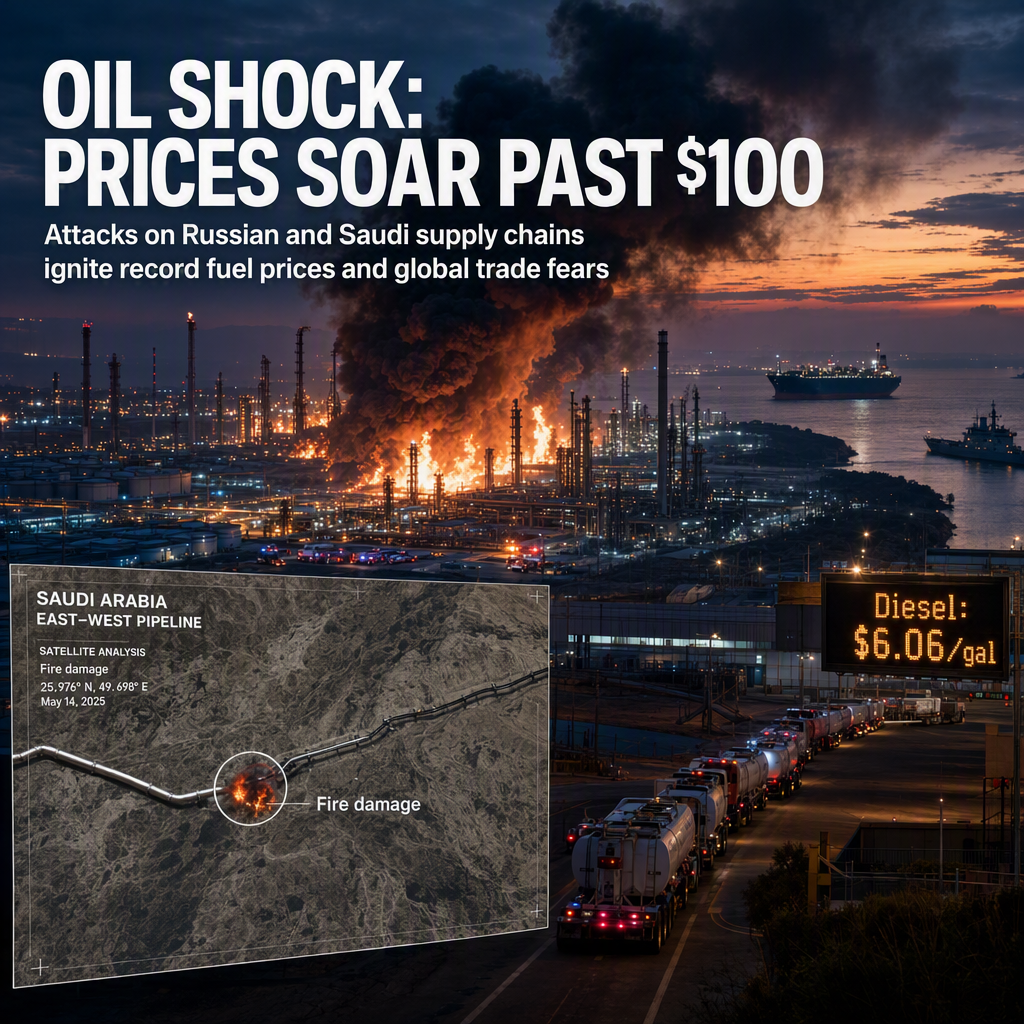
Recent attacks on oil infrastructure have significantly disrupted global energy markets, driving oil and diesel prices to record highs. U.S. President Donald Trump urged Ukrainian President Volodymyr Zelenskyy to halt strikes on Russian oil refineries, citing their role in exacerbating a diesel shortage. Ukraine's attacks have impaired Russia's refining capacity, prompting Moscow to extend a ban on diesel exports through the end of September to stabilize domestic supplies. As a result, U.S. diesel prices surpassed $6 per gallon for the first time ever, with the national average reaching $6.06 per gallon, marking a 63% increase compared to the previous year. Truckers and farmers are facing significantly higher costs to operate their vehicles and equipment [1].
Simultaneously, satellite images reveal extensive fire damage to Saudi Arabia’s East-West oil pipeline, a strategic route bypassing the Strait of Hormuz, following drone attacks launched from Iraq. Saudi Arabia temporarily shut the 750-mile pipeline, known as Petroline, after multiple attacks injured several people and damaged pumping stations in the Riyadh and Medina regions. The pipeline, with a design capacity of 7 million barrels per day, is crucial for redirecting crude exports away from the vulnerable Strait of Hormuz, especially as fighting between the U.S. and Iran intensifies. The closure comes amid increased attacks by Yemen's Iran-backed Houthis, who are also advancing toward the Bab el-Mandeb Strait, raising concerns about further disruptions to global energy trade [2].
Oil prices have responded sharply to these supply disruptions. International benchmark Brent crude futures for November expiry rose 2.1% to $106.69 per barrel on Monday morning, according to one source [1], while another reported a 3.4% increase to $108.17 per barrel [2]. U.S. West Texas Intermediate futures for October expiry traded 2.1% higher at $102.15 [1], and 3% higher at $103.07 [2]. Both contracts have surged over 20% in the past month, with WTI surpassing $100 for the first time since May last week [1][2].
There are mounting concerns about the broader implications for energy markets and global trade, particularly if attacks on key oil infrastructure and shipping routes continue. Trump emphasized the global impact of Ukraine's actions, stating, "He's causing a shortage of diesel. This isn't done by the Middle East; this is done by what's happening with Russia and Ukraine" [1]. Meanwhile, the Houthis' advance toward the Bab el-Mandeb Strait could further threaten Red Sea shipping and energy flows [2].
CONCLUSION
Attacks on Russian and Saudi oil infrastructure have triggered record diesel prices and a sharp rally in crude oil futures, underscoring heightened supply risks. With key pipelines disrupted and export bans extended, energy markets face significant volatility and uncertainty. Ongoing geopolitical tensions and militant advances threaten to further destabilize global oil supply and trade.