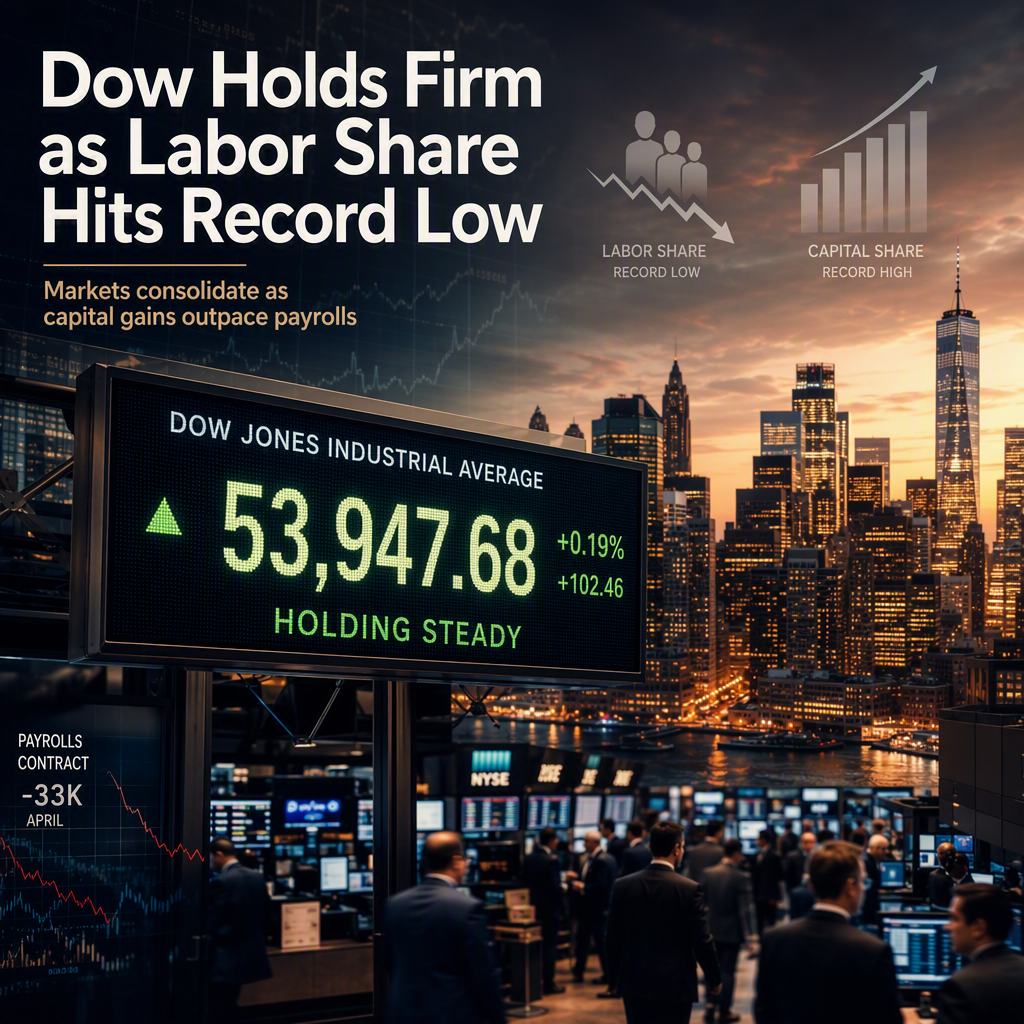
The Dow Jones Industrial Average traded near 54,000 on Monday, declining by a tenth of a percent within a narrow 200-point range, marking the tightest daily movement in weeks. The index's price action remained entirely within Friday's range, which itself was inside Thursday's, indicating a period of consolidation as markets await Wednesday's developments [1]. Despite a contraction in payrolls reported on Friday, the Dow did not relinquish last week's record highs, reflecting a market dynamic where equity values are tied to the expanding share of output accruing to capital rather than labor [1].
A notable data point from Thursday's second-quarter productivity report was the labor share of output, which fell to 52.9%, the lowest since the series began in 1947. In contrast, unit non-labor payments surged 14% at an annual rate. Output per hour increased by 1.4% for the quarter and 2.2% year-over-year, with the current cycle's productivity growth matching the long-term average of 2.1% annually. Hourly compensation rose 2.7% but declined 3.1% after adjusting for consumer prices. Unit labor costs increased by 1.3%, while the value-added price deflator was near 7% at an annual rate, suggesting that inflationary pressures are not primarily wage-driven but may be attributed to factors such as energy, tariffs, and margins [1].
In terms of individual stocks, Intel (INTC) fell 3% after announcing a $15 billion common stock sale, though this move did not impact the Dow Jones as Intel is not a component of the index. The session's largest single-name moves have recently come from companies outside the Dow, further insulating the index from broader market volatility [1].
Commodities saw more pronounced movement, with West Texas Intermediate Crude Oil rising roughly 3% to trade near $81, and Brent crude moving above $86. This increase occurred against a backdrop of geopolitical tension, as Iran's foreign minister ruled out restarting talks with the U.S. until certain conditions are met, and the U.S. administration maintained economic pressure on Iran [1].
CONCLUSION
The Dow Jones Industrial Average remained resilient despite negative payroll data and a record-low labor share, reflecting a market focus on capital's expanding output share. Inflationary pressures appear disconnected from wage growth, with energy and other factors driving price increases. Investors are awaiting further developments, particularly Wednesday's anticipated events.