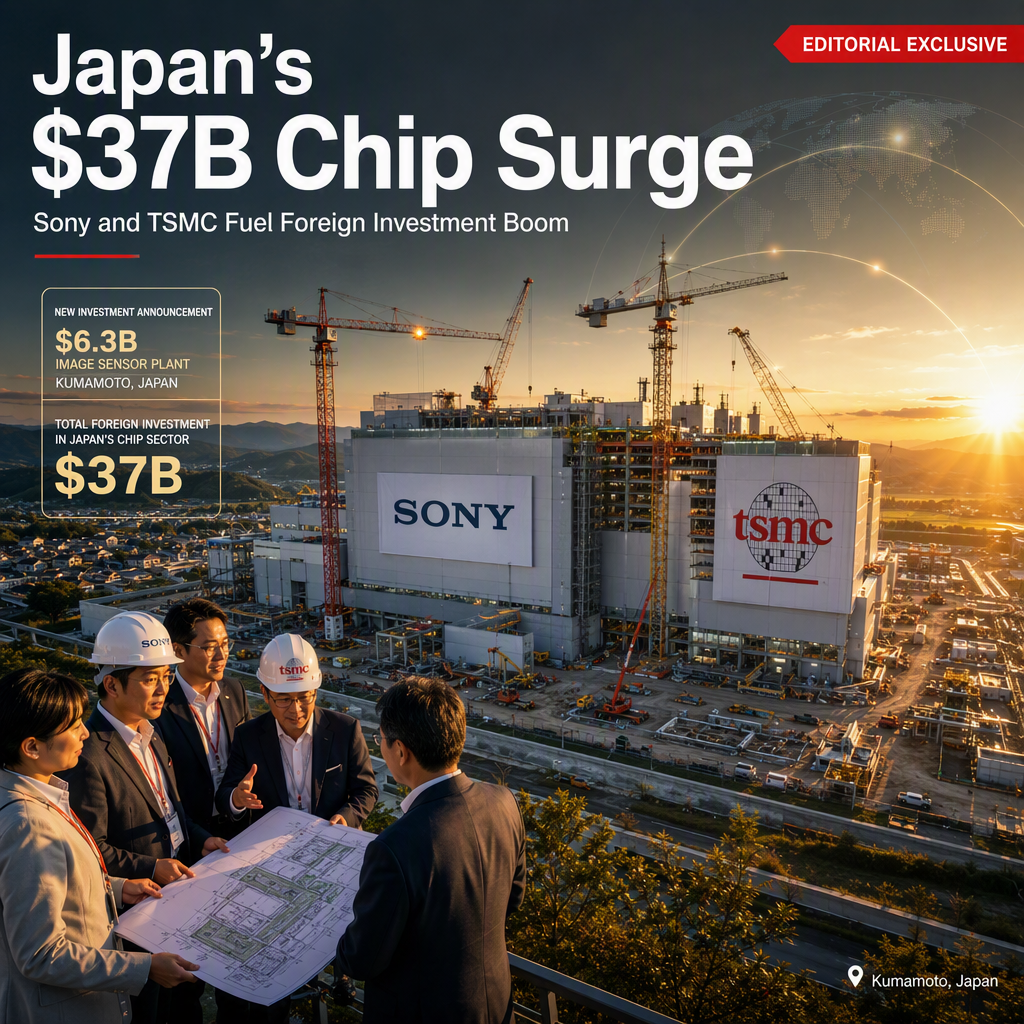
Sony Group and Taiwan Semiconductor Manufacturing Co. (TSMC) have announced a joint venture to build an advanced image sensor plant in Kumamoto, Japan, with a total investment of $6.3 billion. This deal marks a significant milestone, bringing total overseas investment in Japan's chip industry by foreign companies to 6 trillion yen ($37 billion) [1]. TSMC has already invested 3 trillion yen in two Japanese foundries, including facilities in Kumamoto prefecture [1]. The Japanese government's subsidies have played a crucial role in attracting these investments, while demand from U.S. tech and AI giants has further fueled foreign capital inflows into Japan’s semiconductor sector [1].
The new Sony-TSMC plant is expected to strengthen Japan's position in the global chipmaking industry by introducing cutting-edge manufacturing capabilities and enhancing supply chain resilience [1]. This strategic partnership comes as competition intensifies in the semiconductor sector, with rivals such as Samsung and Chinese companies increasing their presence [1]. The move also reflects a broader trend of industry developments, including Foxconn's response to rising AI server competition and Compal's expansion in Taiwan, Vietnam, and the U.S. for AI server markets [1].
The semiconductor sector in Japan is experiencing significant growth, as evidenced by Kioxia's forecast of a 31-fold profit surge and the overall swing in tech shares [1]. Additionally, U.S. tariffs, such as the 15% tariff on polysilicon, are impacting supply dynamics and pricing in the sector [1]. Despite U.S. curbs, Applied Materials projects continued revenue growth from China in 2026, indicating ongoing demand and resilience in the Asian semiconductor market [1].
The influx of foreign investment and strategic partnerships, such as the Sony-TSMC deal, underscores Japan's emergence as a hub for advanced chipmaking. This is driven by government incentives, robust industry collaborations, and the global demand for next-generation semiconductors [1].
CONCLUSION
The Sony-TSMC joint venture marks a pivotal moment for Japan's semiconductor industry, elevating total foreign investment to $37 billion and reinforcing the country's role in advanced chip manufacturing. Government incentives and global demand for semiconductors are driving this growth, positioning Japan as a key player in the evolving global tech landscape. The market response is positive, with expectations for further innovation and supply chain resilience.