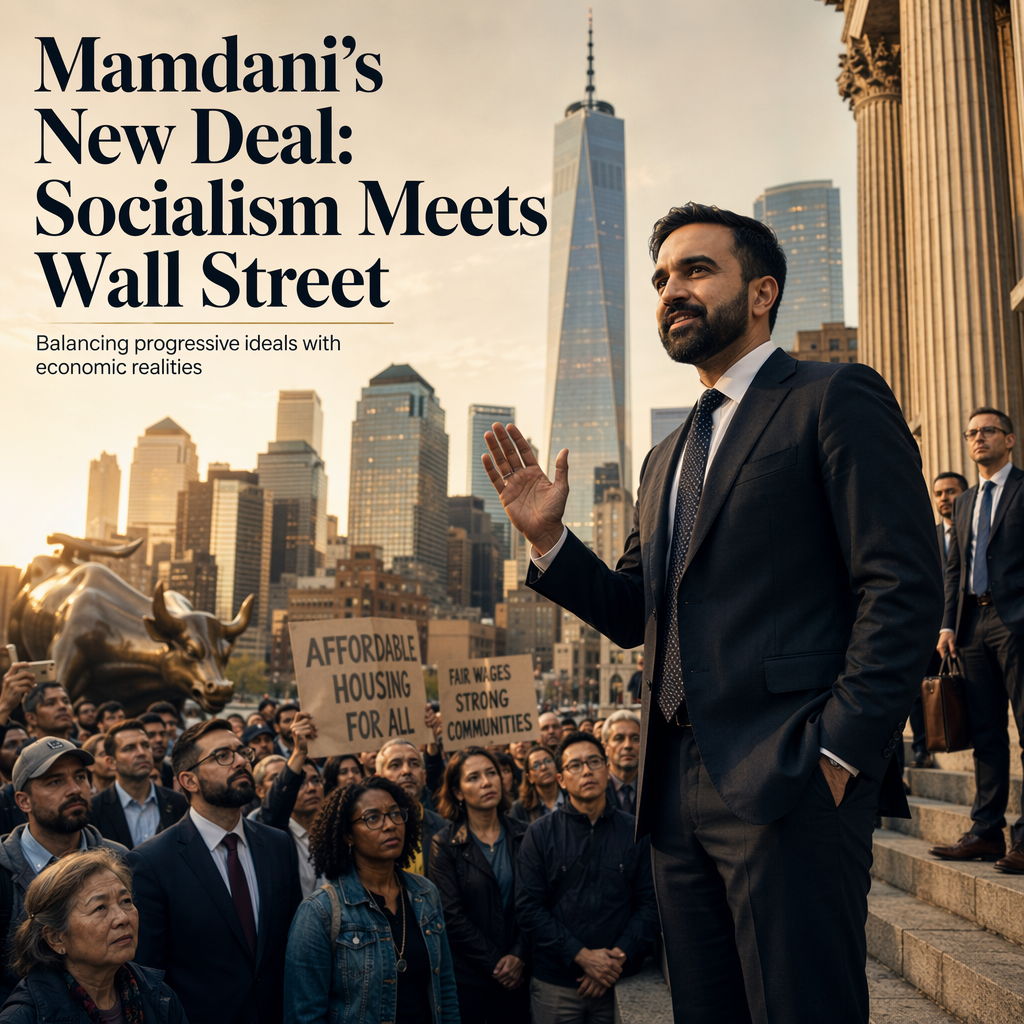
New York City Mayor Zohran Mamdani has publicly reaffirmed his commitment to Democratic Socialism, positioning the movement as a modern continuation of Franklin D. Roosevelt's New Deal legacy. In a recent interview, Mamdani argued that Democratic Socialism reflects the core values of the Democratic Party's past, referencing the Four Freedoms and the New Deal as foundational principles that should be revived in contemporary governance [1].
Despite his progressive stance, Mamdani emphasized that his administration is open to collaboration with Wall Street, finance, and real estate leaders. He stated that while he supports raising taxes on the city's wealthiest residents, he believes in the shared goal of maintaining New York City's vitality and economic strength. Mamdani cited American Express' decision to establish its new headquarters at Two World Trade Center as evidence that major corporations remain committed to investing in New York, suggesting that business leaders are motivated by more than just financial considerations—they are also invested in the city's broader identity and future [1].
Mamdani rejected the notion that Democratic Socialism is incompatible with economic growth, asserting his support for continued corporate investment and his intention to ensure that more New Yorkers benefit from such growth. However, he faces challenges highlighted by a Citizens Budget Commission analysis, which found that New York's share of the nation's millionaires declined from 12.7% in 2010 to 8.7% in 2022. This represents the steepest drop of any state and has resulted in an estimated $10.7 billion loss in potential tax revenue [1].
The mayor's remarks and the underlying data point to a complex relationship between progressive fiscal policies and the retention of high-net-worth individuals, raising questions about the long-term implications for the city's tax base and economic competitiveness.
CONCLUSION
Mayor Mamdani is doubling down on Democratic Socialism while actively courting private investment and reassuring business leaders of his administration's openness. However, the significant decline in New York's millionaire population and associated tax revenue highlights ongoing challenges for the city's fiscal health. The market is likely to view Mamdani's approach with cautious optimism, balancing progressive ambitions with the need to retain and attract major corporate stakeholders.