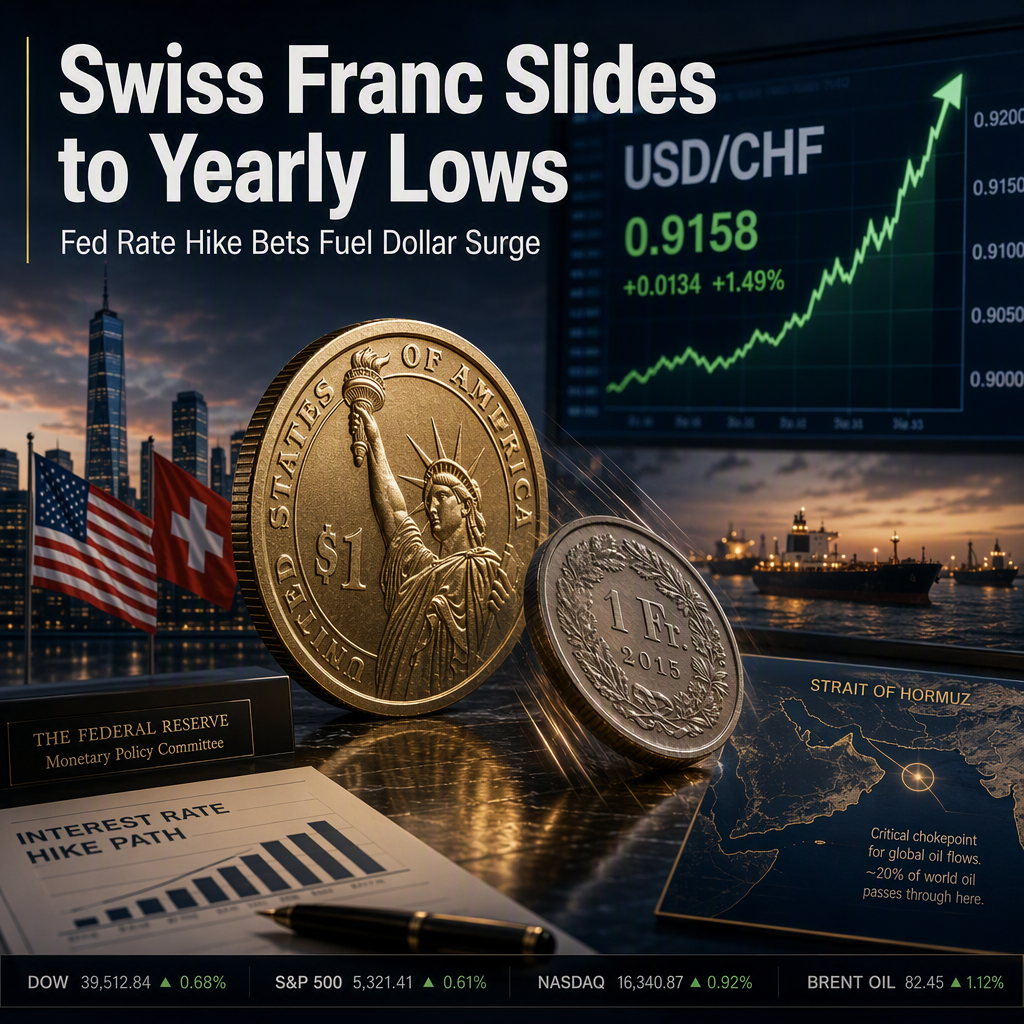
The Swiss Franc (CHF) continued its decline against the US Dollar (USD) on Monday, with the USD/CHF pair appreciating for the seventh consecutive day and reaching session highs at 0.8195, just below the 15-month peak of 0.8207 recorded in late July [1]. This downward pressure on the Swiss Franc is primarily driven by heightened expectations of a quarter-point interest rate hike by the Federal Reserve (Fed) later in the week, as well as the possibility of another hike in December. Futures markets are currently pricing in a nearly 90% chance of a Fed hike on Wednesday and over 70% odds of at least one more increase before year-end, according to CME's FedWatch Tool [1].
The divergence in monetary policy between the Fed and the Swiss National Bank (SNB) is a key factor, with the SNB widely expected to keep its benchmark interest rate at 0% at least until mid-2027. This interest rate differential is likely to continue weighing on the Swiss Franc, as investors favor the higher-yielding US Dollar [1].
Additionally, elevated oil prices are exerting further pressure on the Swiss economy, which is a net oil importer. Brent Crude is trading just below $105.00, and the closure of the Strait of Hormuz, along with threats to the Strait of Bab el-Mandeb due to regional conflicts, is complicating oil supply routes and supporting higher crude prices [1].
On the domestic front, Switzerland's Producer and Import Prices Index (PPI) accelerated to 0.7% growth in August, surpassing expectations of a 0.1% increase and rebounding from a 0.1% contraction in July. However, year-over-year, producer prices fell by 0.7%, following a 2.1% decline in July. These inflation data have had negligible impact on the CHF, as they do not alter the prevailing view of a steady SNB policy [1].
CONCLUSION
The Swiss Franc's slide to yearly lows is being driven by expectations of further Fed tightening and a widening interest rate gap with the SNB, compounded by rising oil prices. With the SNB expected to maintain its current policy stance, the CHF is likely to remain under pressure in the near term.