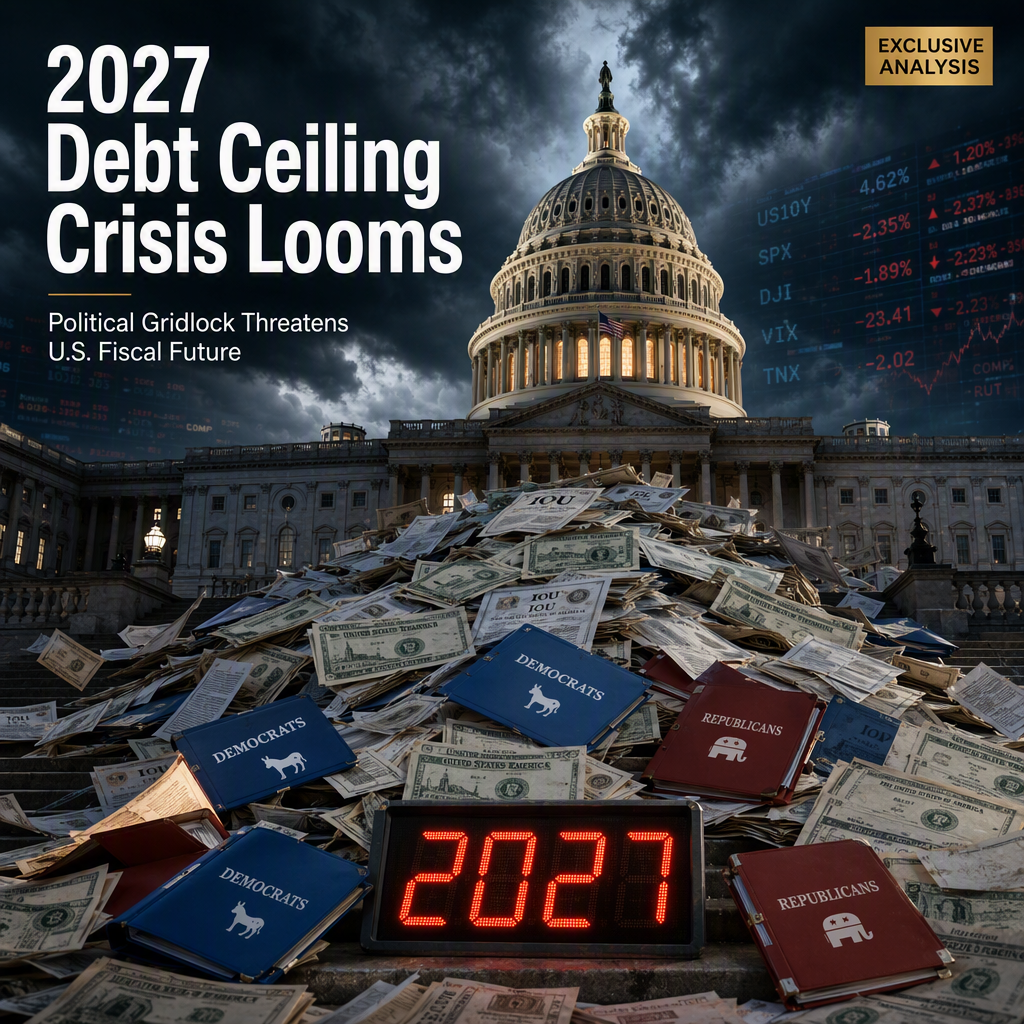
Analysts project that the United States will breach its $41.1 trillion debt ceiling at some point in 2027, necessitating Congressional action to raise or suspend the limit before the Treasury Department exhausts its 'extraordinary measures' to avoid a catastrophic default [1]. The situation is complicated by the upcoming midterm elections: if Democrats win one or both chambers of Congress, it could set the stage for a political standoff, as the party may seek policy concessions from Republican President Donald Trump in exchange for averting a fiscal crisis [1].
Republican hopes to address the debt ceiling issue while still in control of Congress may be dashed if Democrats prevail in November, especially as some GOP members are already rejecting the idea of raising the debt ceiling without significant spending cuts [1]. The national debt has surpassed $40 trillion, a record high, intensifying calls from conservative lawmakers for fiscal restraint [1]. Representative Eric Burlison (R-Mo.) has proposed a constitutional amendment to require a balanced federal budget and advocated for capping future federal borrowing, stating, 'a blanket raise is not going to get my vote' [1].
Other conservative lawmakers, such as Rep. Chip Roy (R-Texas) of the House Freedom Caucus, echoed these sentiments, insisting on 'massive spending restraint and reforms' as prerequisites for supporting any debt ceiling increase [1]. The recent rise in Treasury yields has been cited as further justification for spending cuts rather than approving additional borrowing authority [1].
Some Republicans have floated the idea of raising the debt ceiling during the lame-duck session after the election to preempt potential brinkmanship, but this approach faces resistance within the party [1]. Additionally, President Trump recently proposed a $5,000 dividend for every American if Republicans win the midterms, a move that could accelerate the timeline for reaching the debt ceiling [1].
CONCLUSION
The U.S. is approaching a critical fiscal juncture, with the debt ceiling projected to be breached in 2027 and political divisions threatening to complicate a resolution. Rising Treasury yields and record-high national debt are fueling demands for spending cuts, increasing the risk of a protracted standoff. Market participants should prepare for heightened volatility as the debt ceiling deadline approaches and political negotiations intensify.