
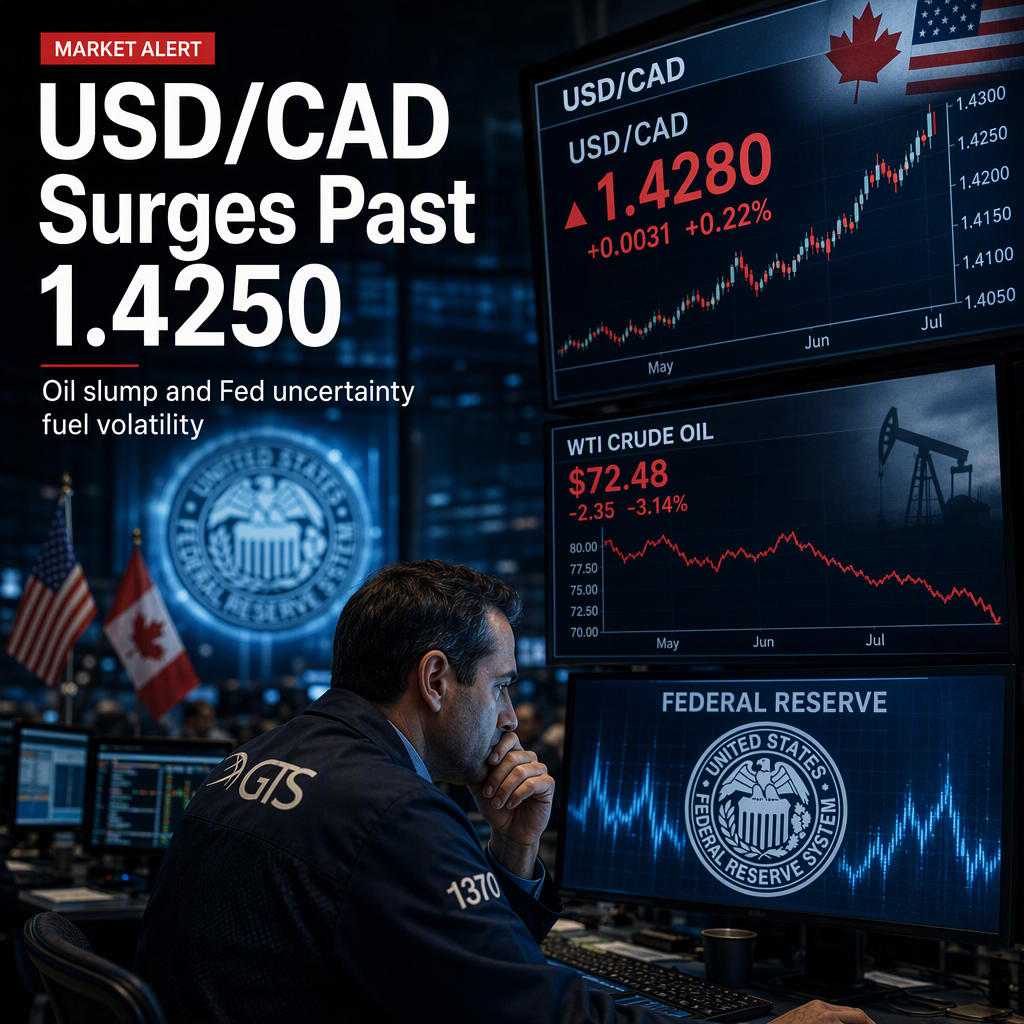
The USD/CAD currency pair strengthened to around 1.4280 during early European trading hours on Monday, maintaining a bullish trend but entering overbought territory according to technical analysis [1]. The Canadian Dollar (CAD) faced downward pressure as oil prices declined, driven by increased crude exports from the Middle East and the G7 nations' release of oil reserves, which expanded global supply. Since Canada is a major oil exporter, lower crude prices typically weigh on the CAD against the US Dollar (USD) [1].
On the US economic front, recent data from the Bureau of Labor Statistics showed that Nonfarm Payrolls rose by only 29,000 in September, a significant drop from the revised 133,000 increase in August and well below the market expectation of 90,000. This weaker-than-expected jobs report sharply reduced market expectations for a Federal Reserve rate hike in October, with the CME FedWatch Tool indicating a 22.1% probability of a hike this month, down from about 70% earlier in the week [1].
In Canadian fixed income markets, TD Securities noted that the mid-curve was under heavy pressure, with the 10-year yield peaking above 4% and the 2s10s curve steepening to early-September levels. The 10-year Canadian yield is near a two-year high, while the Canada-US 10-year spread is at a one-year low, highlighting significant market dislocation. TD Securities expects yields to moderate by 10-15 basis points into year-end and suggests that cross-market moves, particularly in the 10- to 50-year sector, should be closely watched for positioning [1].
Meanwhile, Federal Reserve official Logan delivered a notably hawkish speech, scoring 9.2/10 on the FXS Speechtracker, above the historical average of 8.1/10. Logan emphasized that higher yields may reflect increased term premiums, potentially reducing the need for further tightening, but also called for several more rate hikes and a policy rate increase of 50 basis points or more to secure the 2% inflation target. This reinforced a narrative of persistent restrictive policy ambitions and supported the US Dollar. The FXS Fed Sentiment Index rose by 1.68 points to 136.59, remaining firmly in hawkish territory [1].
CONCLUSION
The USD/CAD pair's rise above 1.4250 reflects a combination of weaker Canadian Dollar sentiment due to falling oil prices and mixed signals from US monetary policy. While softer US jobs data has reduced expectations for an imminent Fed rate hike, hawkish commentary from Fed officials continues to underpin the Dollar. Market participants are advised to monitor cross-market yield movements and central bank communications for further direction.