
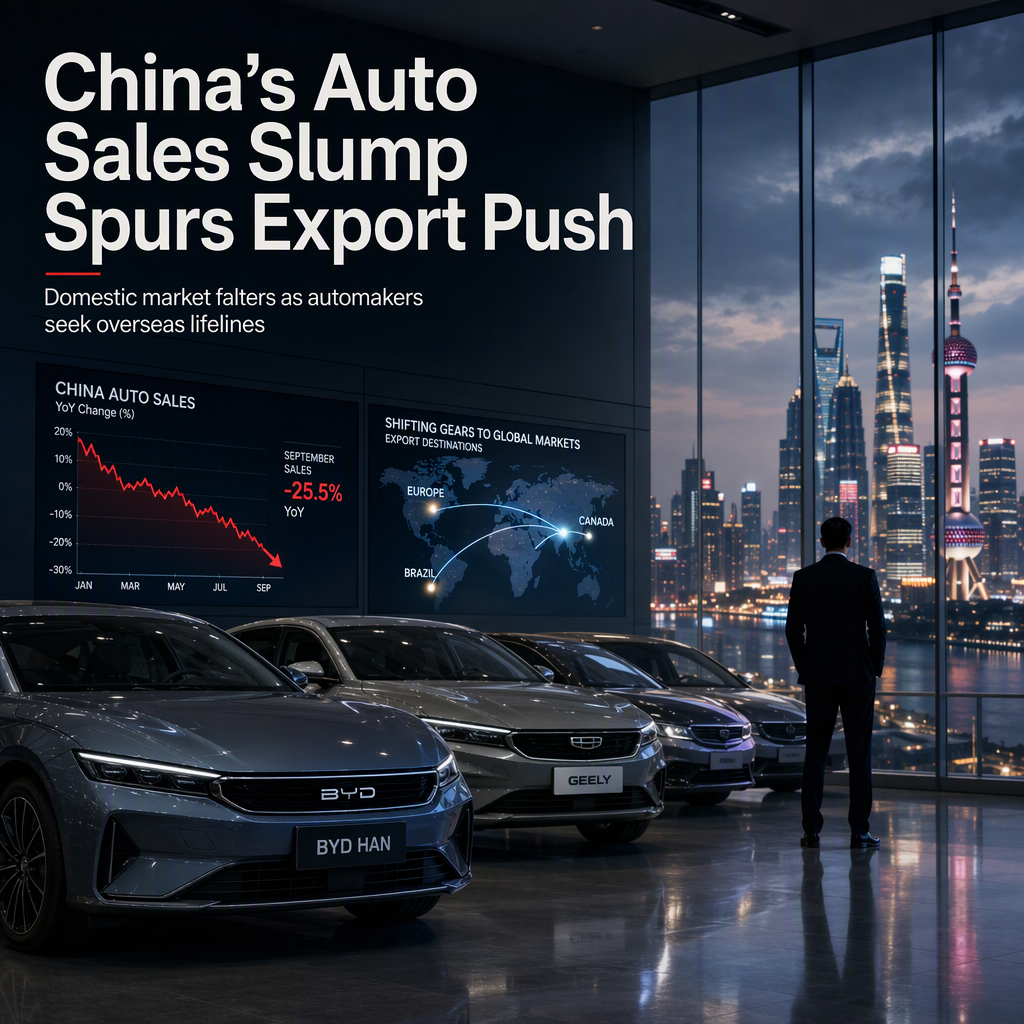
China's passenger car market experienced its sharpest monthly sales drop of the year in September, undermining expectations for a revival during the traditional 'Golden September' peak shopping season [1]. This downturn marks a significant setback for domestic automakers, including industry leaders BYD and Geely, who had anticipated pent-up demand following a sluggish first half [1]. The decline is attributed to overcapacity, intense competition, and faltering consumer confidence, with market data and chart descriptions highlighting a pronounced downward trend in monthly sales figures [1].
In response to stagnating domestic sales, Chinese automakers are increasingly relying on exports to sustain growth. BYD has set an ambitious target of reaching 2 million overseas sales in 2026, following strong performances in Brazil and Europe [1]. Geely has also raised its export targets, with its founder warning about the impact of 'deglobalization' on global industry dynamics [1]. Efforts to diversify include Geely's expansion into Canada and other joint ventures, as major international players like Volkswagen and Ford also face declining sales in China [1].
Market sentiment has turned cautious, with analysts forecasting further consolidation within China's auto sector as smaller players struggle to maintain profitability [1]. Technical indicators suggest resistance at key price levels for leading Chinese auto stocks, with limited upside expected unless domestic sales recover or export momentum accelerates [1]. Industry executives emphasize the urgency of the situation, stating that exports have become a lifeline rather than a supplement for many Chinese brands [1].
Looking ahead, automakers are bracing for continued volatility, shifting focus towards international markets and partnerships to sustain growth [1]. Analysts note that technical support for the sector may be re-tested if domestic demand fails to revive in the fourth quarter [1].
CONCLUSION
China's auto sector is facing significant challenges as domestic sales plummet, prompting a strategic pivot towards export markets. Market sentiment remains cautious, with analysts predicting further consolidation and limited upside for auto stocks unless export growth accelerates or domestic demand rebounds. The industry's future hinges on its ability to capture overseas opportunities amid ongoing volatility.