
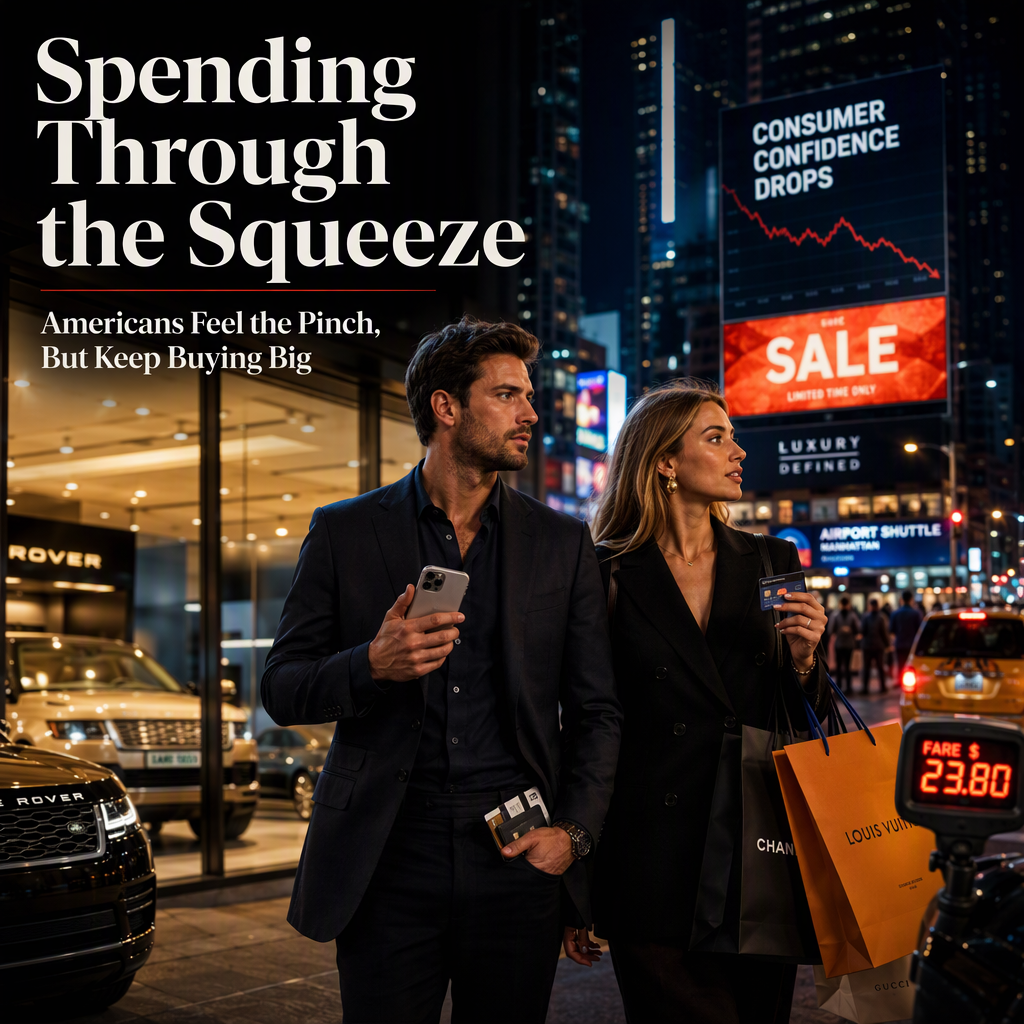
The article discusses a paradox in American consumer behavior: despite widespread claims of financial hardship, consumer spending remains strong. The author notes that while many Americans express concerns about affordability—citing examples such as expensive groceries—there is still significant discretionary spending, as evidenced by packed restaurants, crowded airports, and purchases of high-priced items like $1,500 iPhones and $90,000 SUVs [1].
Concrete data points include the Conference Board's Consumer Confidence Index, which fell to 81.9 in September, indicating low consumer confidence. However, this decline in sentiment has not translated into reduced spending; instead, consumer credit and debit card spending per household increased by 6.2% compared to the previous year [1].
The article attributes this disconnect to psychological and social factors, such as the influence of social media, which amplifies the desire to 'keep up with the Joneses' on a much larger scale. Additionally, the prevalence of financing options and 'buy now, pay later' schemes has made it easier for consumers to make expensive purchases by spreading payments over time, sometimes leading to a lack of awareness about cumulative debt obligations [1].
The author also highlights that there are two distinct groups of American consumers: higher-income individuals who have benefited from rising asset prices and can afford luxury spending, and others who are stretching their paychecks to maintain their lifestyles. Some of the observed spending growth is also attributed to higher prices for necessities, not just discretionary purchases [1].
CONCLUSION
Despite declining consumer confidence, Americans continue to spend at elevated levels, driven by social pressures and accessible financing options. The data suggests a disconnect between economic sentiment and actual spending behavior, with implications for both consumer debt levels and broader economic trends.