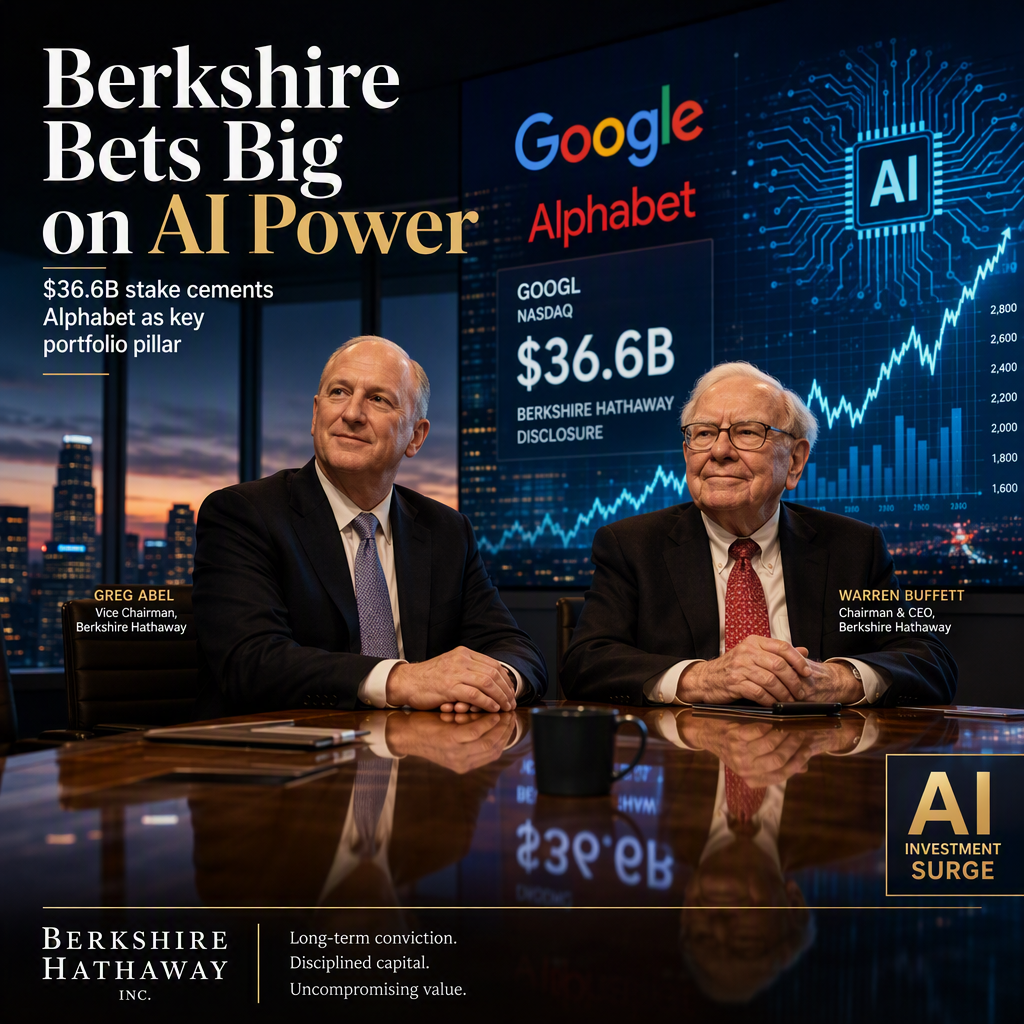
Berkshire Hathaway CEO Greg Abel revealed that the conglomerate has significantly increased its investment in Alphabet, the parent company of Google, citing the tech giant's strong position in artificial intelligence (AI) as a key factor. Abel described Alphabet as a 'significant player' in AI and noted that Berkshire's internal visibility into AI's impact across its portfolio companies contributed to the decision to expand the stake [1].
Berkshire initially took a $10 billion stake in Alphabet 15 months ago at a 6.5% discount, following discussions between Abel and Warren Buffett regarding the size and terms of the investment. In the second quarter, Berkshire added a total of $17 billion in Alphabet shares, making it the third largest holding in Berkshire Hathaway's equity portfolio, according to the company's Q2 SEC filing in August. As of the latest filing, Berkshire owns approximately 106 million of Alphabet's Class A and Class C shares, valued at around $36.6 billion. The Alphabet purchases represented the largest addition to Berkshire's portfolio for the quarter. Additionally, Berkshire increased its position in Delta Air Lines by 44%, or roughly $1.6 billion [1].
Alphabet is identified as one of the five major 'hyperscalers'—alongside Microsoft, Meta, Amazon, and Oracle—making substantial capital expenditures to expand computing power for AI. Goldman Sachs estimates global hyperscaler capex for 2026 could reach around $1 trillion, though there is significant variance in estimates. The commonly cited forecast of $794 billion for hyperscaler capex may understate global AI capex by about $200 billion, while potentially overstating US investment in AI by the same amount, according to Goldman Sachs research [1].
The market is closely watching whether these large investments in AI infrastructure will yield significant returns and over what time frame. Goldman Sachs analysts noted that a prolonged training-dominant phase in AI development could extend the return on investment timeline, as capital expenditures and R&D continue to be deployed ahead of broad monetization [1].
CONCLUSION
Berkshire Hathaway's substantial increase in its Alphabet stake underscores confidence in Google's leadership in AI and the broader trend of massive capital investment in the sector. While the long-term payoff of these investments remains uncertain, the move signals strong institutional belief in AI's transformative potential. Market participants are likely to monitor the ROI timeline closely as AI infrastructure spending accelerates.