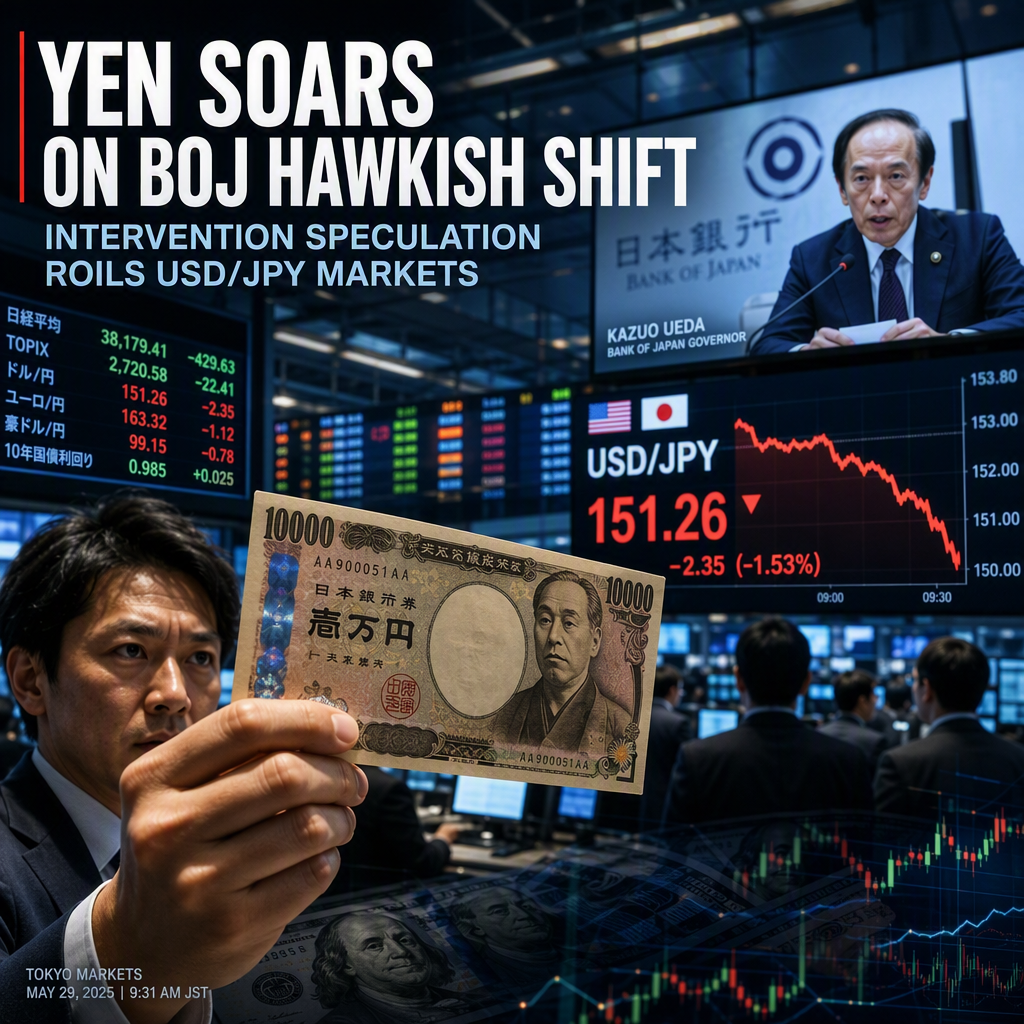
The Japanese Yen (JPY) experienced a sharp appreciation on Wednesday, hitting a one-week high against the US Dollar (USD) as the USD/JPY pair fell nearly 0.90% on the day, trading around 158.75, its lowest level since August 24 [1]. This move followed the pair briefly climbing above the 160 threshold, which triggered speculation that Japanese authorities may have intervened in the foreign exchange market, although there was no official confirmation of such action [1]. The Yen's strength was further supported by hawkish signals from Bank of Japan (BoJ) officials. BoJ board member Hajime Takata advocated for a 'more nimble approach with rate hikes' and left the door open for a 50–75 basis point move at the September 17-18 meeting, as well as the possibility of back-to-back hikes [1][2]. Takata's comments, along with Governor Kazuo Ueda's statement that the BoJ will discuss raising rates at the upcoming meeting due to inflation risks, fueled expectations of a potential 'jumbo' hike [1][2].
Brown Brothers Harriman’s Elias Haddad noted that a forceful BoJ move could anchor inflation expectations, cap long-end yields, and ultimately support the Yen, even though market pricing remains low, with swaps indicating just a 5% chance of a 50bps hike on September 18 [2]. The Yen's rally spilled over into the broader FX market, putting selling pressure on the US Dollar and aiding recoveries in other major currencies [1]. The US Dollar Index (DXY) traded around 99.55 after reaching 99.86 earlier in the day, its highest since August 14 [1].
Meanwhile, the US Dollar remained supported by hawkish Federal Reserve (Fed) expectations and rising US Treasury yields, with the 2-year yield hitting a year-to-date high of 4.41% [3]. Market participants are pricing in 17bps of Fed hikes for the September 16 FOMC meeting, and the probability of a rate hike at the September 15-16 meeting stands at around 70%, up from 36% a week ago, according to the CME FedWatch tool [3][4]. However, weaker-than-expected US labor data, with the ADP report showing only 38K private jobs added in August versus a 47K forecast, and a modest pullback in Treasury yields, limited the Dollar's advance [1][4].
Despite the Yen's sharp move, its upside could be capped by Japan's macroeconomic headwinds, including expansionary fiscal policy, a heavy debt burden, and relatively low interest rates [1]. On the US side, support for the Dollar from higher yields and energy prices has not yet fully materialized due to policy risk premium and buyback-related debasement fears [3].
Looking ahead, traders are focused on the upcoming US Nonfarm Payrolls report and the BoJ's September meeting, where a significant rate hike remains a possibility but is not fully priced in by markets [1][2][3][4].
CONCLUSION
The Japanese Yen's sharp appreciation was driven by hawkish BoJ commentary and speculation of possible intervention, while the US Dollar remained resilient on Fed rate hike expectations. Market participants are now closely watching the BoJ's September meeting and US labor data for further direction. The event has introduced heightened volatility and uncertainty in major currency pairs, particularly USD/JPY.