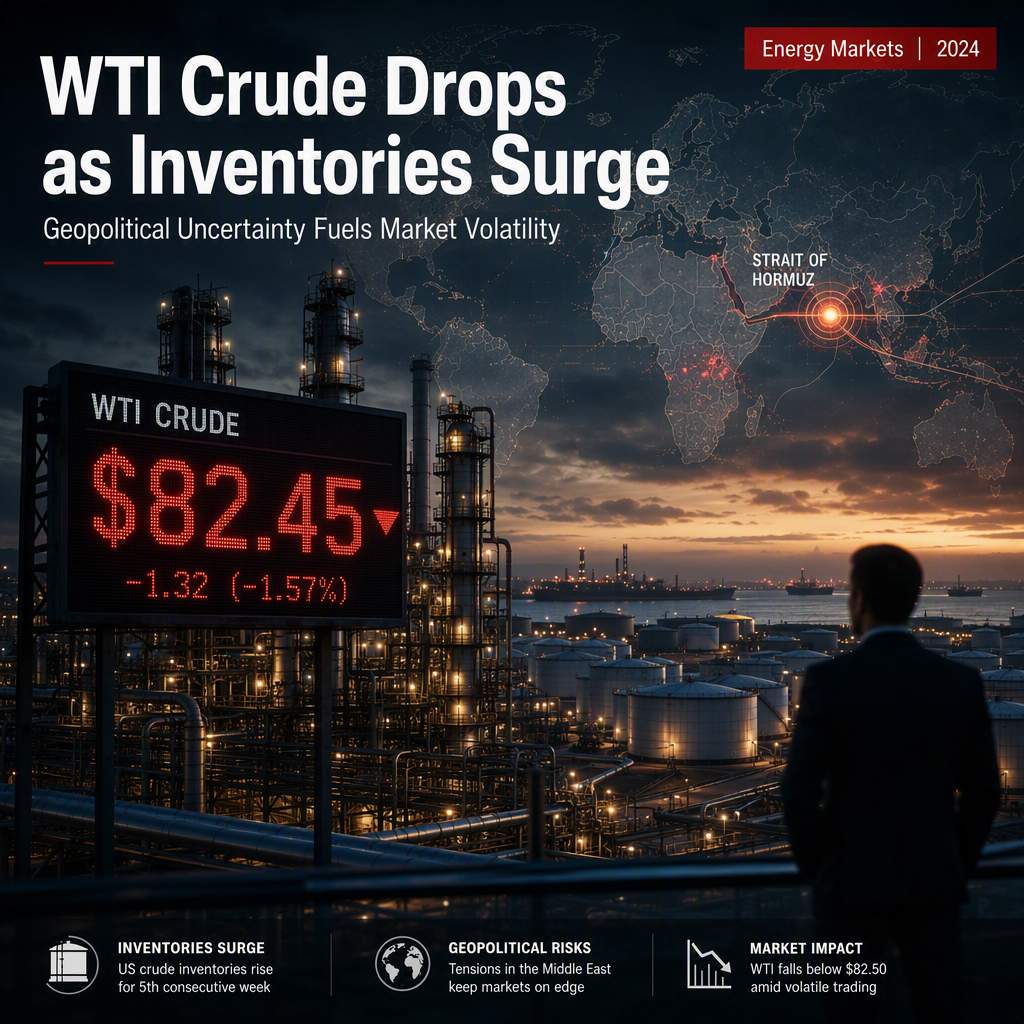
West Texas Intermediate (WTI), the US crude oil benchmark, declined to around $82.45 during early Asian trading hours on Thursday, pressured by a significantly larger-than-expected build in US crude oil inventories [1]. According to the US Energy Information Administration (EIA), US crude oil stockpiles for the week ending August 7 surged by 17.422 million barrels, a sharp contrast to the previous week's increase of 2.479 million barrels and market expectations for a decline of 1.4 million barrels [1].
Geopolitical tensions continue to influence market sentiment, with traders closely monitoring US-Iran talks and the status of the Strait of Hormuz. A senior Iranian official stated that there has been no progress in talks to revive the interim deal agreed in June, and no time frame has been set for its implementation [1]. US President Donald Trump asserted that Washington has 'total control' over the Strait of Hormuz, but Iran countered by insisting the waterway remains blocked, fueling fears of potential oil supply disruptions that could impact WTI prices in the near term [1].
Rabobank's energy strategists expressed skepticism about the prospects for a lasting diplomatic solution to shipping disruptions in the Strait of Hormuz. They noted that a short-term deal is unlikely due to limited common ground between the parties and warned that any agreement would likely only provide a temporary 60-day window for free transits, leaving geopolitical risks as a persistent driver of volatility for both Brent and WTI crude [1].
From a technical perspective, WTI US Oil trades at $81.55, with a bearish near-term outlook as prices remain capped below the 100-day Simple Moving Average (SMA) at $86.67 and the Bollinger Bands’ 20-day middle band at $81.67. The Relative Strength Index (14) at 52.55 indicates neutral momentum, suggesting a consolidative market rather than a strong directional move [1].
CONCLUSION
WTI crude prices have come under pressure due to a substantial and unexpected rise in US oil inventories, while ongoing geopolitical tensions around the Strait of Hormuz add further uncertainty. Market sentiment remains cautious, with technical indicators pointing to a bearish outlook and analysts warning that volatility is likely to persist.