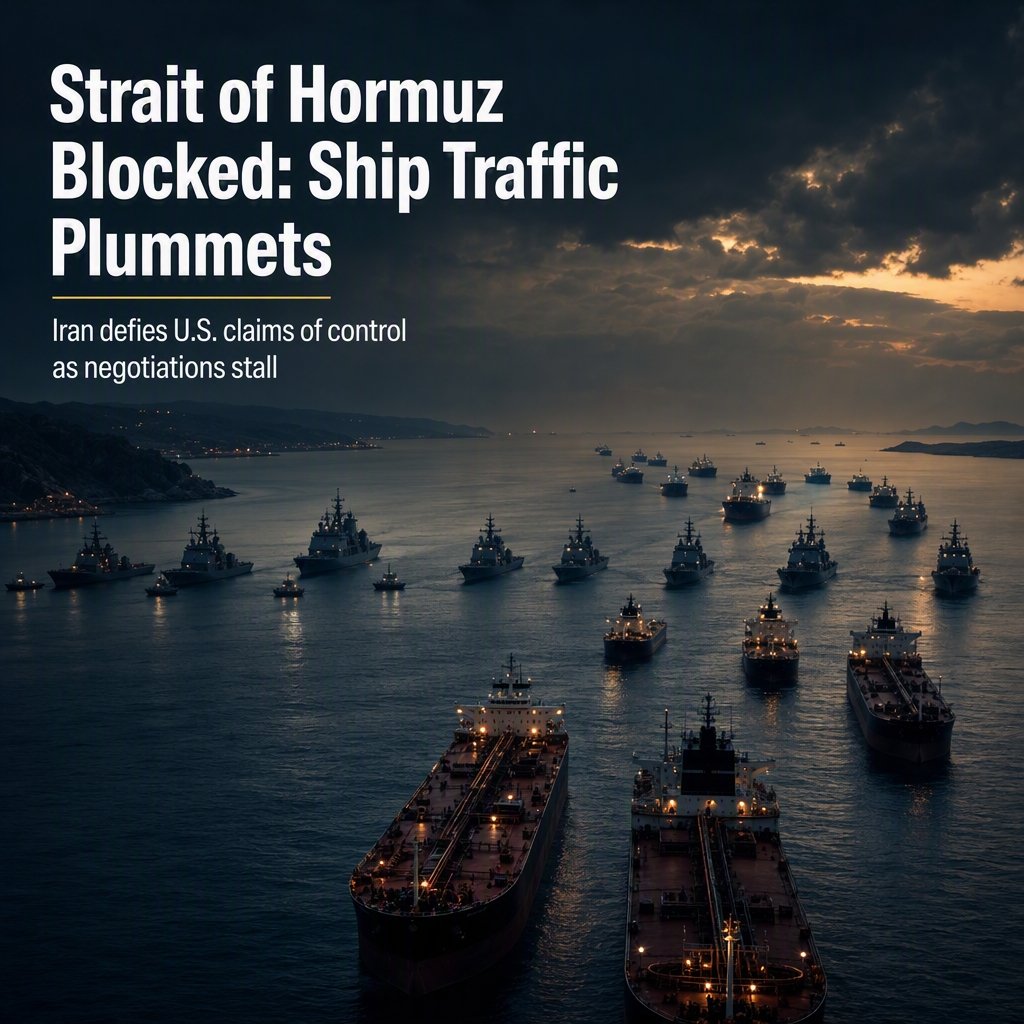
The Persian Strait Gulf Authority announced that the Strait of Hormuz remains blocked and will not be reopened until Iran's conditions are accepted, directly disputing U.S. President Donald Trump's assertion that the U.S. has 'total control' over the strategic waterway [1]. Iranian authorities reiterated that repeated claims by U.S. officials do not change the reality on the ground, emphasizing their stance in a post on X [1]. Trump had previously posted on Truth Social, 'The U.S.A. has total control over the Strait of Hormuz. I THINK WE WILL KEEP IT!' [1].
Despite these conflicting statements, vessel traffic through the Strait of Hormuz has dropped sharply. Data from trade intelligence firm Kpler shows that the 5-day average of ship transits was around 13 on Tuesday, marking nearly the lowest level since May 12. This figure is approximately 90% lower than the daily average of 130 ships that transited Hormuz before the U.S. and Israel attacked Iran on February 28 [1]. The traffic data includes all types of ships, from cargo vessels to oil tankers [1].
Negotiations between Washington and Tehran have stalled, with both sides hardening their positions and demanding reparations. Iran's Supreme National Security Council outlined broad demands for reopening the Strait, including ending the U.S. naval blockade, sanctions relief, American troop withdrawals, and war reparations [1].
Mohammad Reza Naqdi, a top advisor to the commander of Iran's Islamic Revolutionary Guard Corps (IRGC), stated in a PBS interview that 'victory is on our side' and described the American military as weaker than previously perceived. Naqdi cited Washington's shifting objectives during the conflict and claimed Iran's strategy is to attain deterrence, potentially by prolonging the conflict to impose costs on any aggressor [1].
CONCLUSION
The ongoing blockade of the Strait of Hormuz by Iran has led to a dramatic reduction in vessel traffic, with significant implications for global trade and energy markets. Despite U.S. claims of control, Iran remains firm in its demands, and negotiations show no signs of progress. Market sentiment is negative, reflecting heightened geopolitical risk and uncertainty.