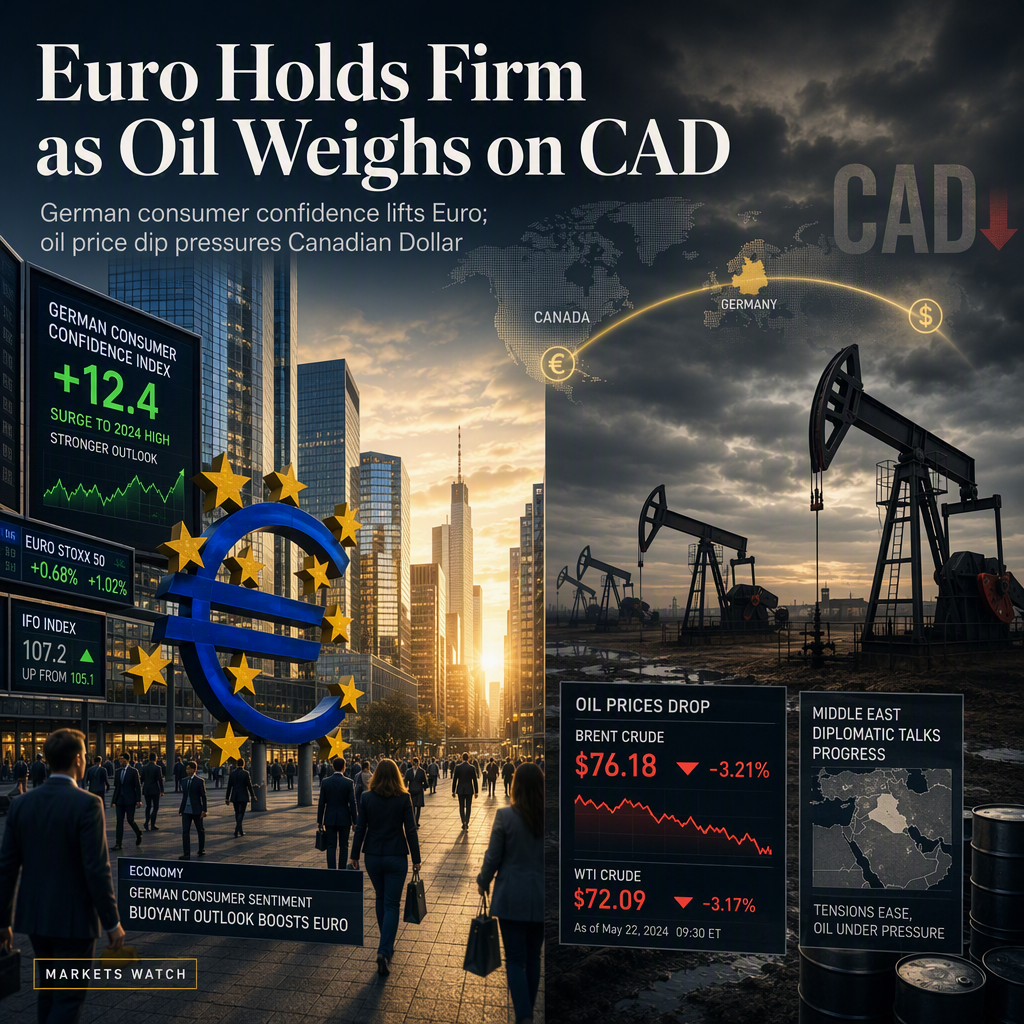
The Euro (EUR) maintained its position against the Canadian Dollar (CAD) after three consecutive days of gains, with the EUR/CAD pair trading around 1.6170 during European hours on Thursday [1]. This stability followed the release of the September GfK Consumer Confidence Survey from Germany, which showed a significant improvement to -26.6, up from -29.4 in August and surpassing market expectations of -29.6 [1]. The stronger-than-expected consumer confidence data provided support for the Euro, as higher consumer confidence is generally viewed as bullish for the currency [1].
Meanwhile, the Canadian Dollar faced headwinds due to declining oil prices, with West Texas Intermediate (WTI) crude trading near $81.10 per barrel at the time of reporting [1]. The drop in oil prices was attributed to diplomatic progress in the Middle East, specifically an agreement between Iran and Oman regarding the Strait of Hormuz, although Iran indicated that reopening the waterway would require further agreements [1]. Additionally, US President Donald Trump stated that 10 million barrels of oil had passed through Hormuz on Tuesday, and claimed that mines in the waterway had been cleared [1].
Strategists at Rabobank highlighted that ongoing geopolitical tensions, including Ukrainian strikes on Russian energy infrastructure and Moscow's extension of a diesel export ban through September, are intensifying stress in the energy markets [1]. They cautioned that these supply shocks, combined with disruptions from the Iran war, could lead to more persistent tightness in oil and refined product markets if the outages and bans continue [1].
Looking ahead, market participants are awaiting the release of the European Central Bank’s (ECB) Monetary Policy Meeting Accounts later in the day, which are expected to provide further insights into the Eurozone's interest rate outlook [1].
CONCLUSION
The Euro's resilience against the Canadian Dollar was underpinned by stronger German consumer confidence data, while the CAD was pressured by lower oil prices amid ongoing geopolitical tensions. Market participants are now focused on the upcoming ECB meeting accounts for further direction on Eurozone monetary policy.