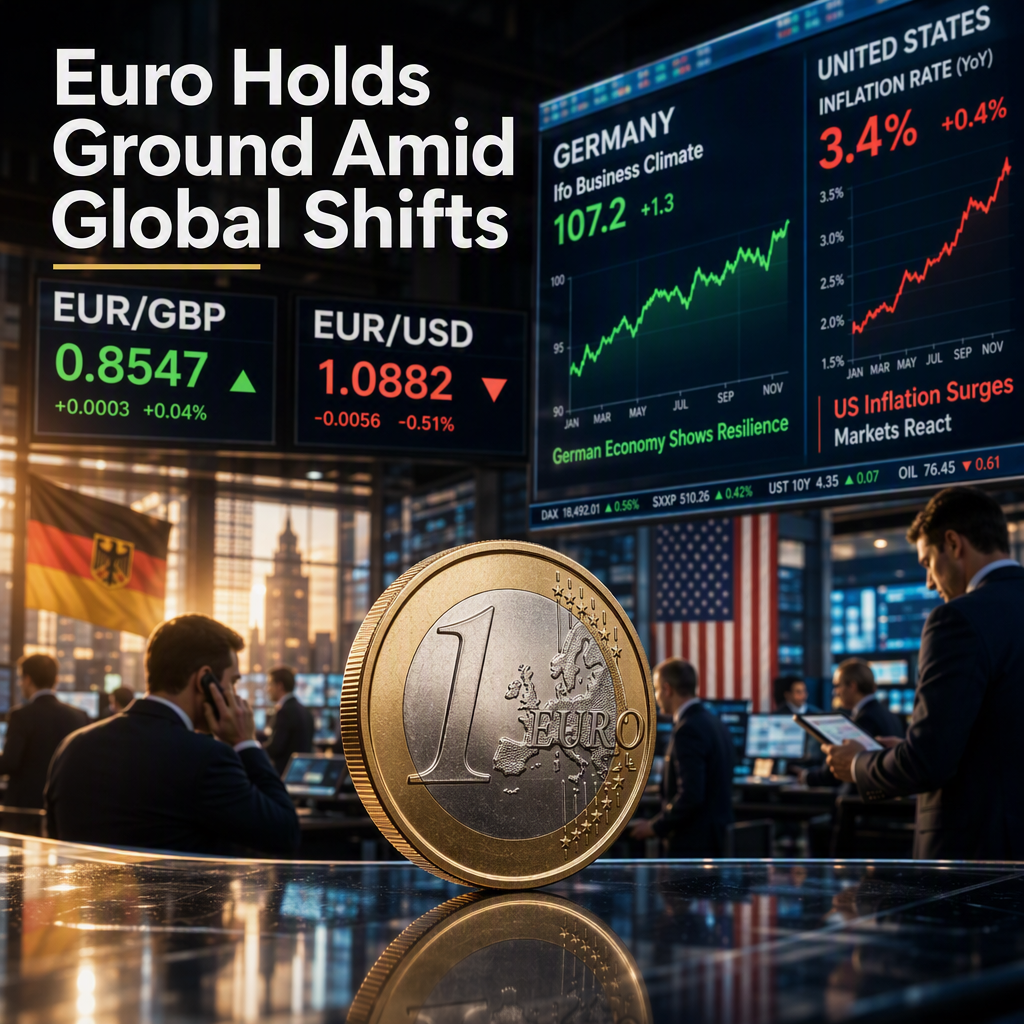
The Euro (EUR) showed mixed performance on Thursday, trading virtually unchanged against the British Pound (GBP) at around 0.8575, with a modest gain of 0.05% [1]. This stability came despite a series of upbeat German economic releases, including an improvement in the GfK Consumer Confidence Index to -26.6 for September from -29.4 in August, surpassing expectations of -29.6 [1][2]. German GDP growth was also revised higher to 0.3% quarter-on-quarter and 1% year-on-year, up from the previously estimated 0.9% [1]. The German IFO Business Climate Index reached its highest level in 12 months, with both current assessment and expectations components exceeding forecasts [1][2].
Despite these positive German data points, the Euro failed to gain significant traction against the US Dollar (USD), retreating below 1.1650 and extending its decline from three-month highs above 1.1700 earlier in the week [2]. The US Dollar was buoyed by strong US Personal Consumption Expenditures (PCE) Price Index data released on Wednesday, which reinforced expectations for further Federal Reserve (Fed) rate hikes in the coming months [2]. However, the probability of a September rate hike remained steady at 36%, according to CME Group’s FedWatch Tool [2].
Market participants are now awaiting the European Central Bank’s (ECB) Monetary Policy Meeting Accounts, due later on Thursday, for further clues on the Eurozone interest rate outlook [1][2]. Danske Bank analysts expect the minutes to show a bias for a rate hike in September, which is already fully priced in by markets, but anticipate limited signals beyond September, suggesting the publication is unlikely to be a market mover [2].
Strategists at Societe Generale noted that EUR/GBP has rebounded from a July low near 0.8450 but stalled near 0.8585, with the cross consolidating in a narrow range [1]. They identified 0.8588 as the next resistance and 0.8530 as short-term support, while Rabobank’s FX team expects further range-bound trading with a mild upside bias for EUR/GBP later in the year [1].
In contrast, the British Pound lacked clear domestic catalysts due to a quiet UK economic calendar, leaving EUR/GBP broadly stable as traders weighed improving German fundamentals against the absence of fresh UK drivers [1].
CONCLUSION
Despite robust German economic data, the Euro remained stable against the Pound and retreated versus the US Dollar, as strong US inflation data shifted focus to potential Fed rate hikes. Market attention now turns to the ECB’s meeting minutes, though analysts expect limited new signals. Overall, the Euro’s performance reflects a balance between improving Eurozone fundamentals and external monetary policy pressures.