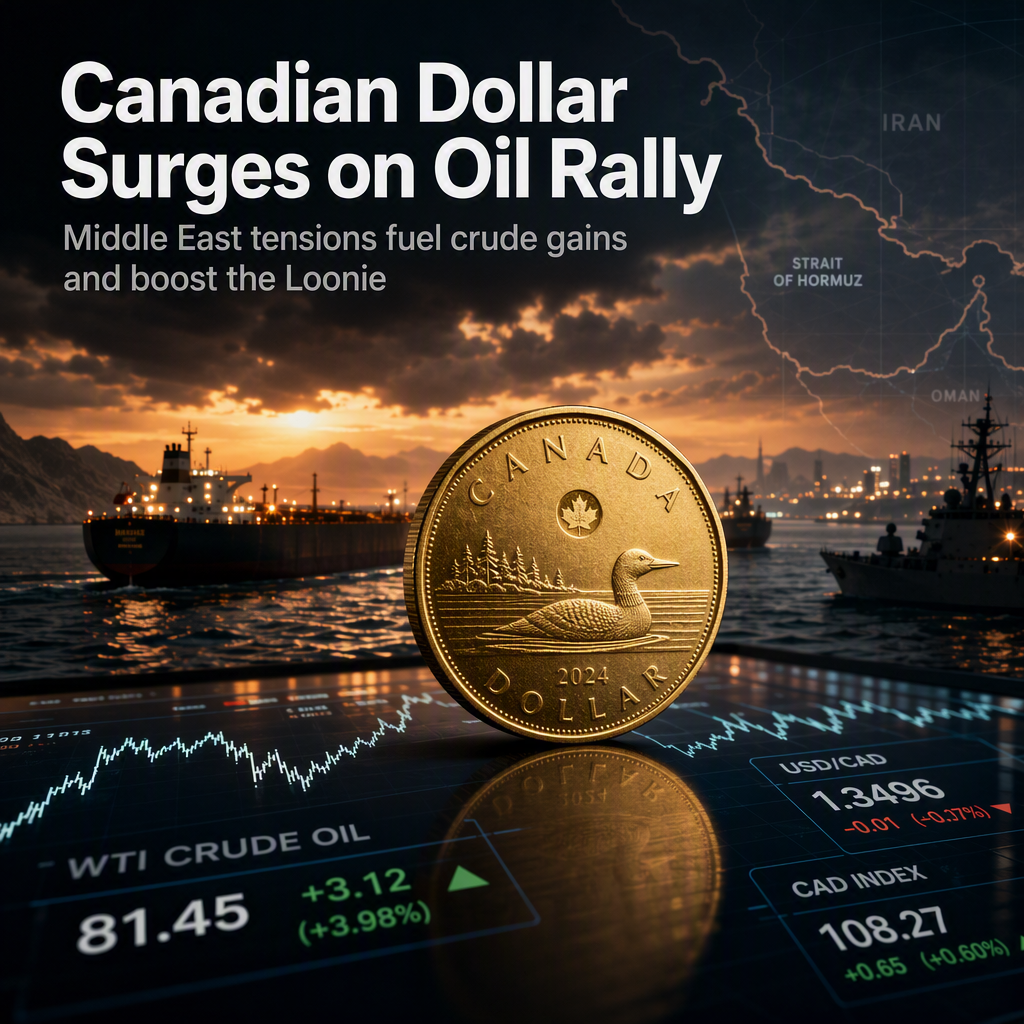
The Canadian Dollar (CAD) remains near its two-month highs against the US Dollar (USD), with USD/CAD trading around 1.3935 on Tuesday, reflecting a modest 0.03% decline on the day and staying close to its lowest level in two months [1]. This strength in the CAD is attributed to rising crude oil prices, which are being supported by ongoing supply concerns in the Middle East. Specifically, the standoff between the United States and Iran is dampening hopes for a swift reopening of the Strait of Hormuz, while disruptions continue in shipping traffic through the Bab el-Mandeb Strait. These geopolitical tensions are fueling concerns about global oil supply and supporting oil prices, a positive factor for the Canadian Dollar due to the significant role of energy in Canada's exports [1].
Further supporting the CAD is recent Canadian employment data released on Friday, which, combined with higher oil prices, has allowed the Loonie to maintain an advantage over the Greenback and keep USD/CAD under pressure near its recent lows [1]. However, the downside for USD/CAD is limited by the resilience of the US Dollar. Despite a disappointing Nonfarm Payrolls (NFP) report on Friday, investors are still pricing in the possibility that the Federal Reserve could raise interest rates at least once by the end of the year. Elevated volatility in oil prices is also raising concerns about renewed inflationary pressures, which could encourage the Fed to maintain a more restrictive policy stance [1].
Geopolitical uncertainty is also supporting safe-haven demand for the US Dollar, preventing USD/CAD from extending its decline for now. Investors are now focused on upcoming US inflation data, with the Consumer Price Index (CPI) due on Wednesday and the Producer Price Index (PPI) on Thursday. These releases are expected to provide fresh clues about the Fed's monetary policy outlook and could determine the next directional move for the US Dollar and USD/CAD. Additionally, developments in the Middle East and their impact on oil prices are likely to remain central to market attention [1].
From a technical perspective, USD/CAD is trading at 1.3934 on the one-hour chart, maintaining a bearish near-term tone as it remains below the 100-period simple moving average (SMA) at 1.3992 and the 200-period SMA at 1.4015. A descending trend-line resistance from 1.3964, currently near 1.3961, continues to cap intraday gains [1].
CONCLUSION
The Canadian Dollar's strength is being driven by higher oil prices and solid domestic employment data, while the US Dollar's resilience and geopolitical uncertainty are limiting further declines in USD/CAD. Market participants are closely watching upcoming US inflation data and ongoing Middle East developments for further direction. The interplay between oil prices, Fed policy expectations, and geopolitical risks will likely continue to shape USD/CAD movements in the near term.