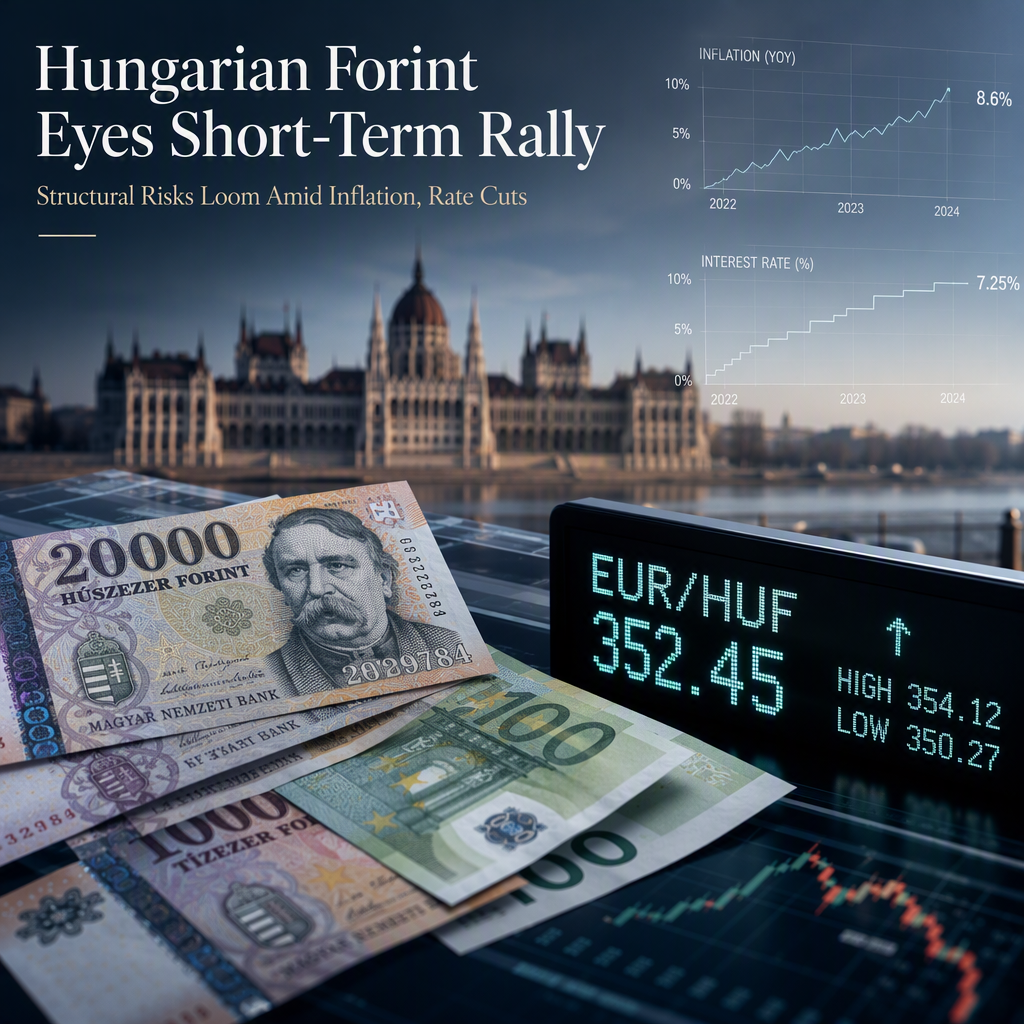
Commerzbank analyst Tatha Ghose characterizes the recent weakness in the Hungarian Forint (HUF) as a high-beta correction, noting that it only partially erases the currency's post-election outperformance following the April regime change [1]. Ghose emphasizes that the regime-change narrative remains intact, with Tisza’s ratings holding strong and Peter Magyar advancing reforms across multiple areas [1].
Ghose suggests that if global risk sentiment improves, the Forint could recover some of its recent losses, with the EUR/HUF exchange rate potentially moving back to the 350–355 range [1]. However, he cautions that this recovery may be short-lived, as structural factors such as accelerating core inflation and narrowing real interest rates—driven by continued rate cuts from Hungary’s central bank (MNB)—are likely to exert renewed pressure on the currency [1]. July CPI data indicated that underlying core inflation measures are accelerating, further complicating the outlook for the Forint [1].
Ghose warns that as MNB continues to cut rates and inflation momentum remains elevated, Hungary’s real interest rate is expected to narrow, which could limit the durability of any interim recovery in the Forint [1].
CONCLUSION
Commerzbank expects the Hungarian Forint to see near-term gains against the Euro if global risk sentiment improves, but warns that structural headwinds such as rising core inflation and narrowing real interest rates will likely weigh on the currency in the longer term. The market takeaway is cautiously optimistic for short-term recovery, tempered by concerns about sustainability.