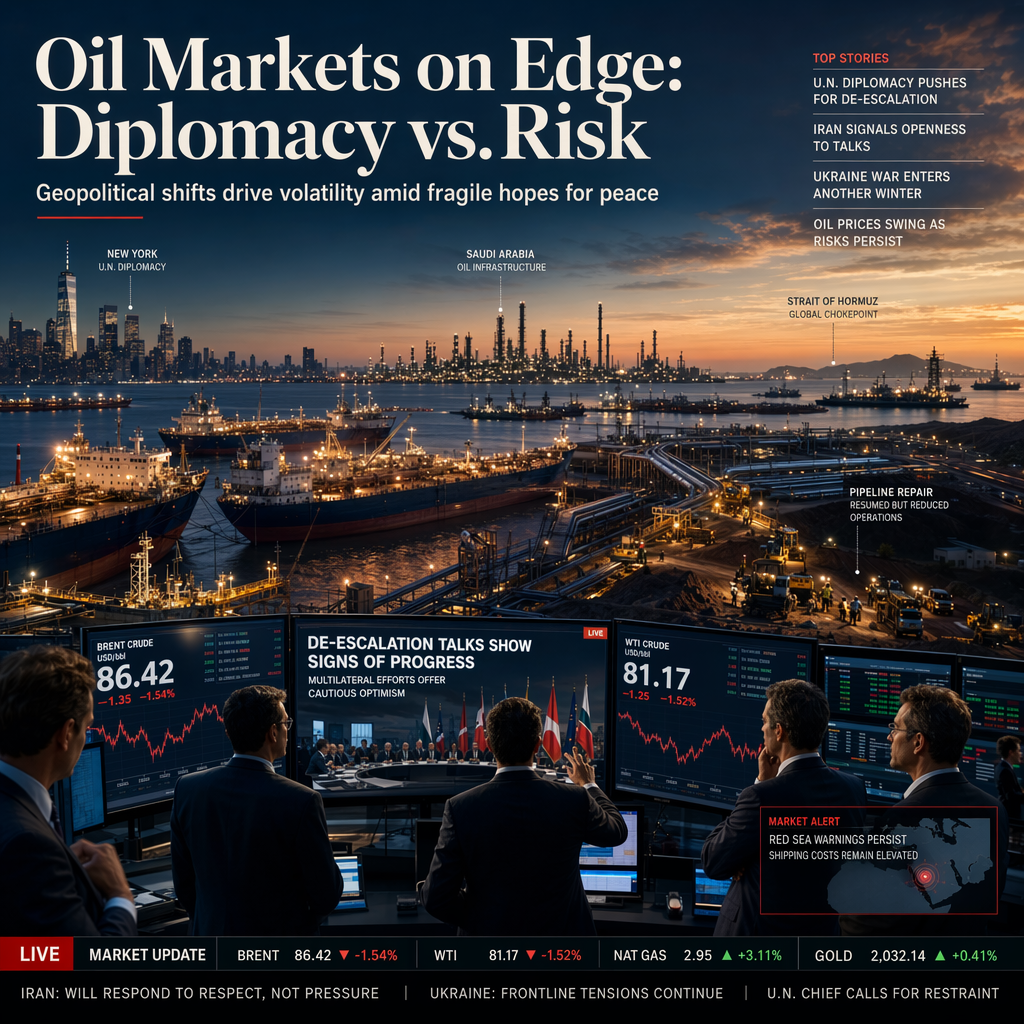
Oil prices are currently lower, driven by hopes for de-escalation in several global conflicts, according to Rabobank strategist Michael Every. Key developments include the Saudi east-west pipeline resuming operations at reduced capacity, China issuing warnings to the Houthis against blocking the Red Sea, and a 'very productive' three-hour meeting between Trump negotiators and Iranian officials in New York. Additionally, Iran has indicated it may reopen the Strait of Hormuz within seven days if the US lifts its blockade, while Ukraine's President Zelenskyy stated that Kyiv and Washington aim to end the conflict 'before winter' and are prepared for an 'energy ceasefire' [1].
Despite these positive signals, Every highlights ongoing risks, noting that Iran has hardened its demands for ending the war, and Trump has publicly threatened Iran with 'annihilation,' followed by meetings with Arab states that could potentially join an attack on Tehran if hostilities escalate. In Russia, two additional oil refineries have been targeted, and bomb shelters in Moscow and St Petersburg are reportedly being modernized [1].
Every emphasizes that oil prices remain highly sensitive to geopolitical developments. If certain deals are reached or if hostilities escalate in key regions, energy prices could change dramatically. Such shifts could prompt central bankers to alter their policy stances, potentially catching market participants off guard if they focus solely on monetary policy rather than broader geopolitical and geoeconomic factors [1].
CONCLUSION
Oil prices are currently subdued on hopes for de-escalation in several conflict zones, but significant geopolitical risks remain. Market participants are cautioned to monitor geopolitical developments closely, as energy prices could shift rapidly if the situation changes.