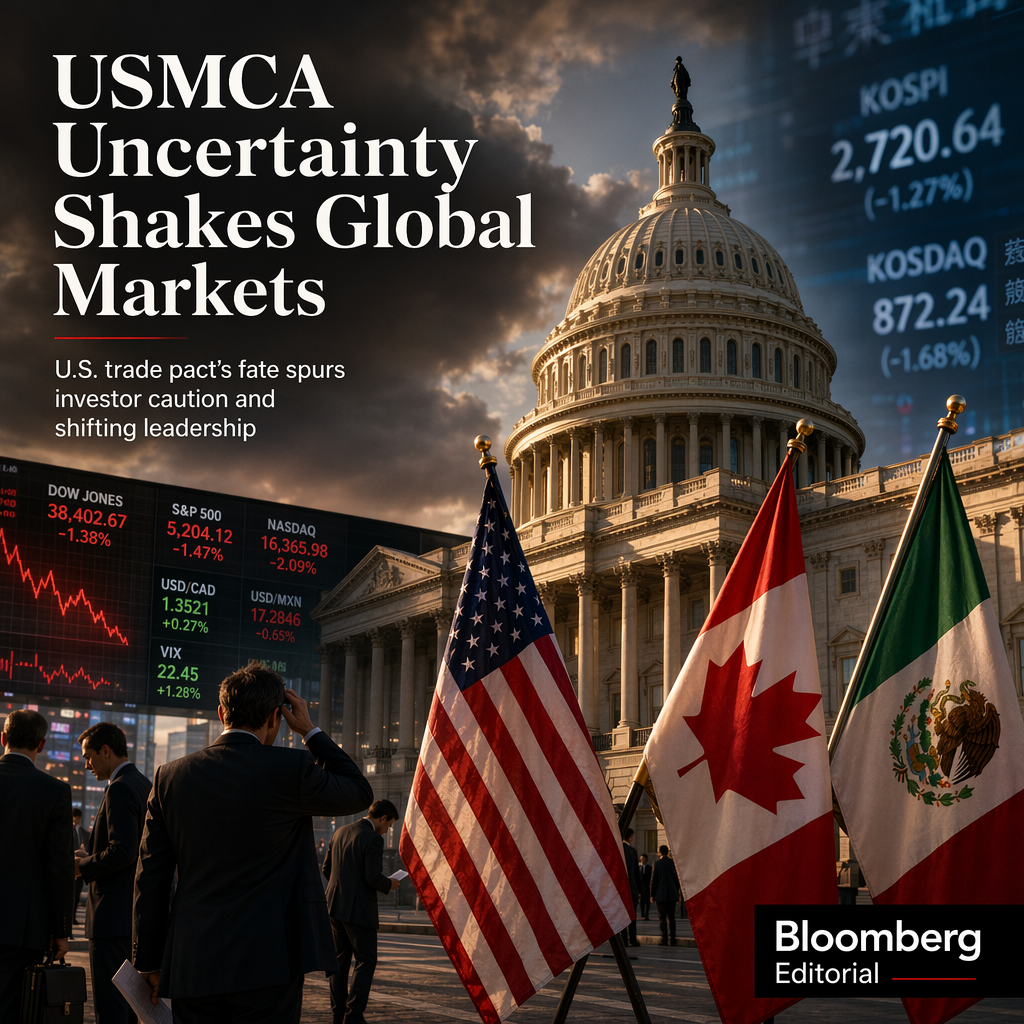
The United States has decided not to renew the United States-Mexico-Canada Agreement (USMCA), a trade pact previously described by President Donald Trump as 'the best agreement we've ever made' [1]. Instead of a straightforward renewal, the U.S. will conduct annual reviews of the agreement, with an administration official stating that Trump 'chose not to rubber stamp a USMCA renewal without addressing existing issues' [1]. Chief among these issues for Trump are the trade deficits with Canada and Mexico. In June, President Trump remarked, 'We don't need anything that Canada has. We don't need anything that Mexico has, but they need everything that we have. And they have to treat us better' [1].
This move signals to markets and America's trading partners that even established agreements may be subject to revision under the current administration [1]. The article also notes that South Korea could face additional scrutiny after a House Judiciary Committee report found that Seoul acted in a discriminatory manner toward certain U.S. companies, including Coupang, potentially violating provisions of the trade deal renegotiated in 2025 as part of Trump's global tariff agenda [1].
On the economic front, Federal Reserve Chairman Kevin Warsh declined to provide guidance on the central bank's next steps, though he acknowledged that inflation remains too high [1]. Fresh economic data showed U.S. private payrolls grew by a seasonally adjusted 98,000 in June, below the Dow Jones consensus forecast of 110,000 and a slowdown from May's unrevised increase of 122,000, indicating a cooling labor market [1].
Market reactions were mixed. U.S. markets slipped as investors reduced positions in technology stocks, though Meta stood out with a nearly 9% gain after announcing a new cloud business aimed at recouping AI infrastructure investments [1]. Emerging markets, led by South Korea's Kospi, outperformed in the first half of the year, marking an unexpected geographic shift in market leadership [1].
CONCLUSION
The U.S. decision not to renew the USMCA introduces uncertainty for North American trade relations and signals a willingness to revisit established agreements. This, combined with mixed economic data and shifting market leadership, suggests heightened volatility and caution among investors.