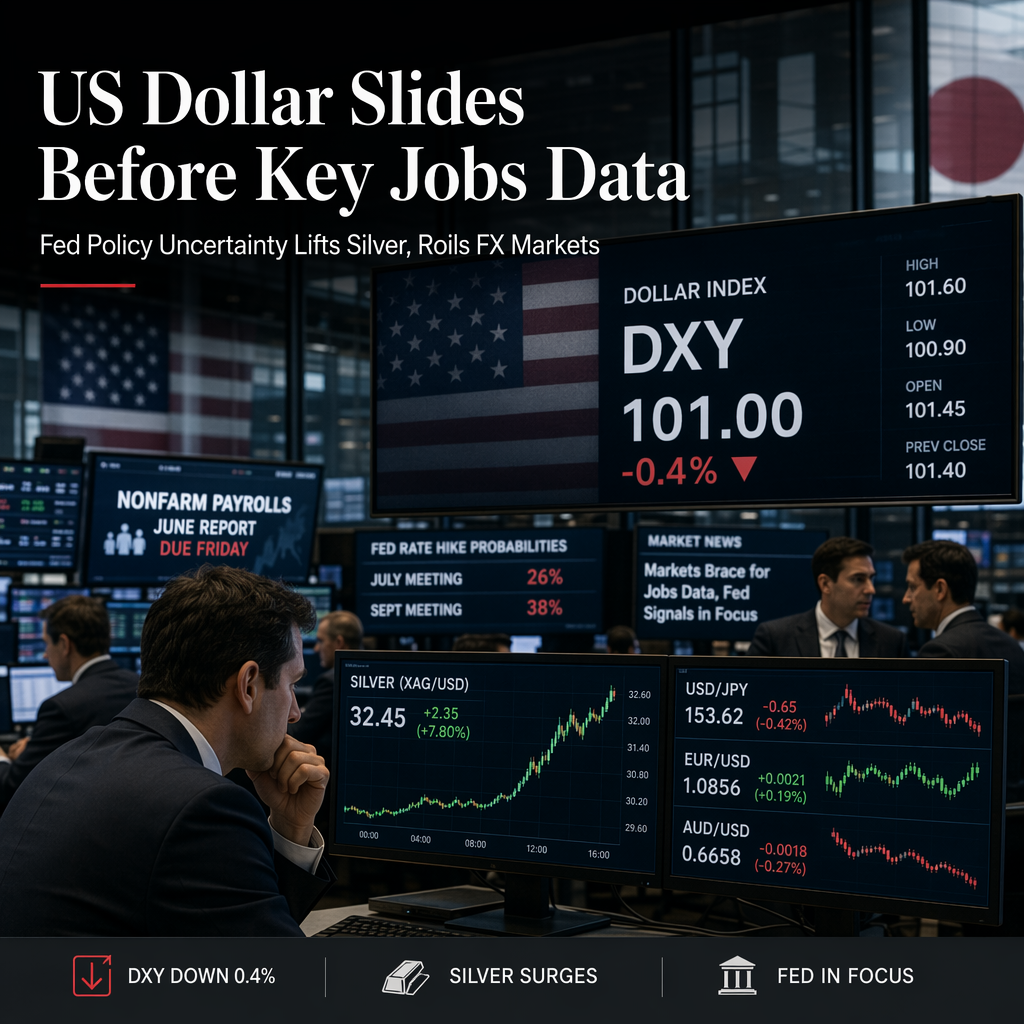
The US Dollar experienced notable weakness ahead of the release of June's Nonfarm Payrolls (NFP) data, with the US Dollar Index (DXY) falling 0.4% to near 101.00 during the European session on Thursday [3]. This decline contributed to a 0.9% rise in silver prices (XAG/USD), which traded near $59.65 [3]. The US Dollar was the weakest against the Japanese Yen, declining 0.85%, and also posted losses against other major currencies including the Euro (-0.34%) and the Australian Dollar (-0.17%) [3].
Market participants are closely watching the June NFP report, which is expected to show the creation of 110,000 new jobs, down from 172,000 in May, with the unemployment rate anticipated to remain steady at 4.3% [3]. According to Source 2, any reading above 100,000 would reinforce expectations of Federal Reserve tightening in the near term and likely provide additional support to the Greenback [2]. The CME FedWatch tool indicates that traders see an almost 85% chance of at least one Fed rate hike this year [3].
Recent US economic data has been mixed. The ADP Employment Change report showed the private sector added 98,000 jobs in June, below the forecast of 113,000, while the ISM Manufacturing PMI came in at 53.3, underperforming the expected 54.0 [3]. Despite these softer indicators, the narrative of US economic exceptionalism and ongoing foreign investment, particularly driven by the AI sector, has continued to bolster the US Dollar in recent weeks [2].
Commerzbank’s Volkmar Baur notes that the significance of the NFP release for the US Dollar has diminished, as the Federal Reserve's focus has shifted more toward inflation than employment data [1]. Baur highlights that recent JOLTS data point to improving hiring and fewer layoffs, suggesting a positive job market, but he cautions that higher payroll volatility and the current Fed stance mean today's NFP figures may not have the decisive market impact seen in the past [1].
Fed Chairman Kevin Warsh, speaking at the ECB forum in Sintra, Portugal, acknowledged easing price risks but reaffirmed the Fed's commitment to achieving its 2% inflation target, supporting expectations for a possible rate hike in September [2].
CONCLUSION
The US Dollar's decline ahead of the June NFP report has boosted silver prices and kept currency markets on edge, with traders closely watching for signals on future Fed policy. While expectations for job growth remain modest, the Fed's focus on inflation over employment data may temper the immediate market impact of the NFP release. Nevertheless, any upside surprise in job creation could quickly shift sentiment back in favor of the Greenback.