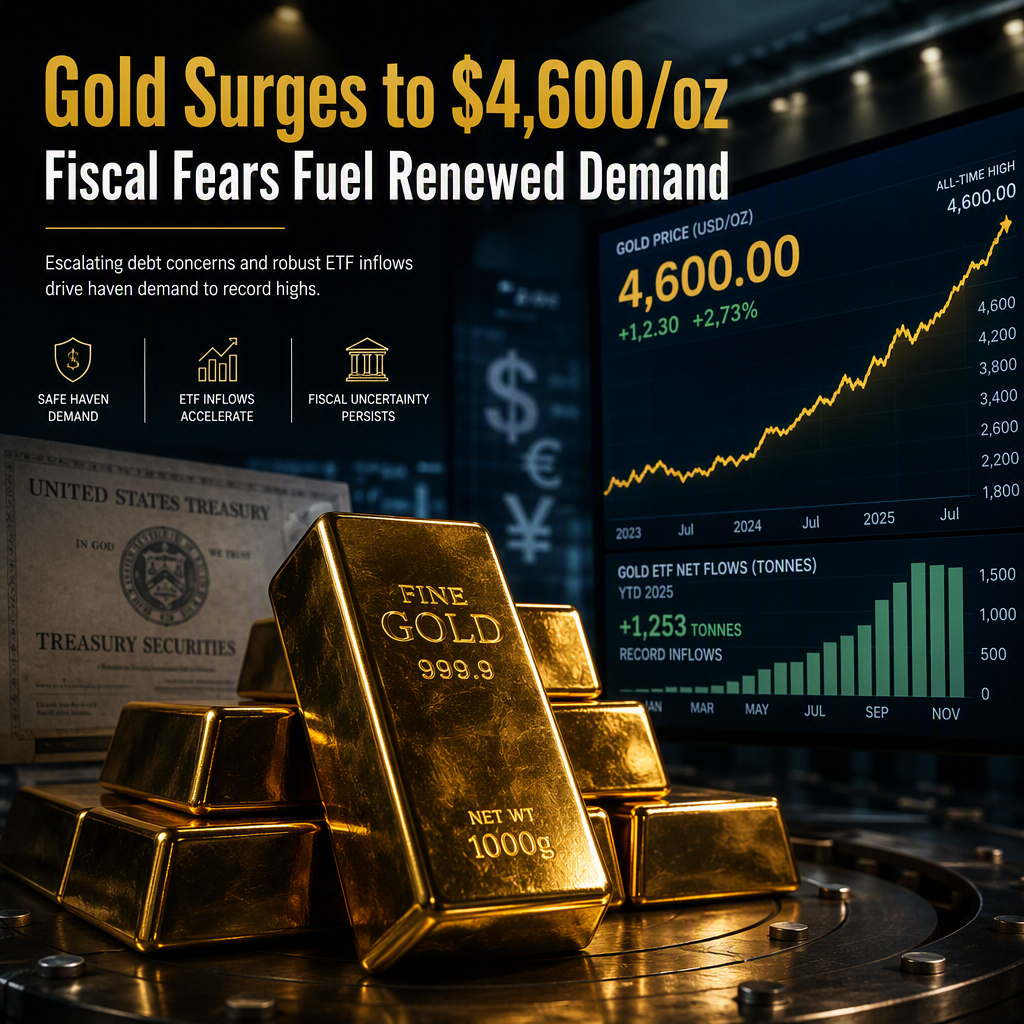
Gold prices have rebounded significantly from their July lows near $4,000/oz to approximately $4,600/oz, reaching levels last observed in May, according to ING Commodities Strategist Ewa Manthey [1]. This rally has been driven by renewed investment demand, a weaker US dollar, and growing concerns over the US fiscal outlook [1]. Manthey emphasizes that gold's resilience is not solely a reaction to lower yields; instead, the prospect of larger Treasury buybacks has shifted market focus toward government borrowing and fiscal credibility, heightening worries about currency debasement and reinforcing gold's role as a store of value [1].
Supporting this upward movement, global gold-backed ETFs attracted $3 billion in July, increasing their holdings by 23 tonnes, as reported by the World Gold Council [1]. Central banks have also played a significant role, with net purchases reaching 51 tonnes in June and totaling 102 tonnes in the first half of the year, led by Poland and China [1]. ING expects official-sector buying to continue supporting the market, though further gains will depend on sustained interest from Western investors [1].
Despite these positive factors, Manthey notes that persistent US inflation and the potential for further Federal Reserve tightening remain key headwinds for gold [1]. ING's forecast for the fourth quarter is an average price of $4,150/oz, based on the assumption that ongoing inflation will keep US monetary policy restrictive and prevent a sustained decline in yields [1]. However, the combination of renewed ETF buying, a weaker dollar, and mounting fiscal concerns presents clear upside risks to this outlook [1].
Market implications discussed in the article suggest that while official-sector and ETF demand are currently supporting gold prices, the trajectory will increasingly depend on Western investor sentiment and the evolution of US fiscal and monetary policy [1].
CONCLUSION
Gold has experienced a robust rebound, fueled by investment demand, central bank purchases, and fiscal concerns, but faces headwinds from persistent inflation and potential Fed tightening. ING sees upside risks to its $4,150/oz Q4 forecast if current supportive trends persist. The market's direction will hinge on Western investor behavior and US policy developments.