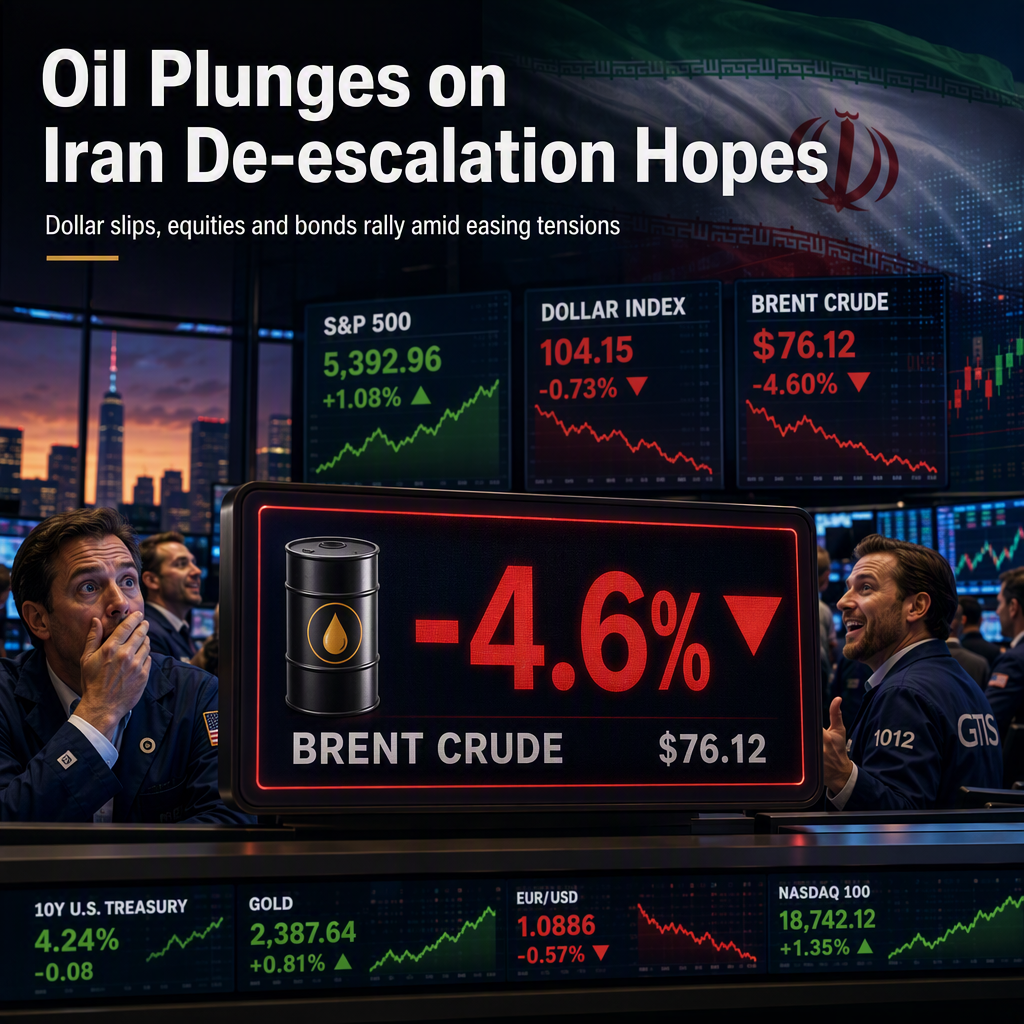
On August 25, 2026, crude oil prices dropped sharply by approximately 4.6% amid hopes for de-escalation in Iran, following reports that Pakistan’s army chief delivered a de-escalation proposal to Tehran. This significant decline in oil prices set the tone for the session, overshadowing other asset classes and driving a risk-on sentiment across global markets [1].
The U.S. dollar underperformed against major currencies, while U.S. Treasury yields fell and equities rallied. The S&P 500 posted a modest gain of around 0.2%, closing near 7,675. Most of the equity gains occurred during the London session as oil prices declined and risk sentiment improved, though some gains were pared after the U.S. open due to a weaker-than-expected U.S. consumer confidence reading. The index then edged higher through the afternoon [1].
Key economic data released included the U.S. CB Consumer Confidence for August at 89.4 (below the 90.9 forecast and 90.8 previous), U.S. New Home Sales for July down 10.5% month-over-month (versus a -1.3% forecast and 1.6% previous), and the U.S. Richmond Fed Manufacturing Index for August at 4.0 (below the 6.0 forecast and 5.0 previous). Other notable data points were the Japan Leading Indicators Index for June at 116.5 (above the 114.0 forecast), Germany’s Q2 GDP growth rate at 0.3% quarter-over-quarter, and Germany’s Ifo Business Climate for August at 88.8 (above the 87.0 forecast) [1].
Federal Reserve Bank of Boston President Collins stated support for holding interest rates steady but emphasized the need for further progress toward the 2% inflation target. Additionally, Canada announced 50% counter-tariffs on U.S. steel, aluminum, dairy, and other goods, impacting roughly $20 billion in annual U.S. exports, with the tariffs set to take effect on September 8 [1].
Gold ended the day slightly higher near $4,667 after a volatile session, while Bitcoin and other assets were less impacted compared to the dramatic moves in oil and equities [1].
CONCLUSION
The session was dominated by a sharp decline in oil prices on Iran de-escalation hopes, which boosted equities and bonds while pressuring the U.S. dollar. Weaker U.S. consumer confidence and new home sales data tempered some of the risk-on sentiment, but overall, markets responded positively to the prospect of reduced geopolitical tensions and steady monetary policy signals.