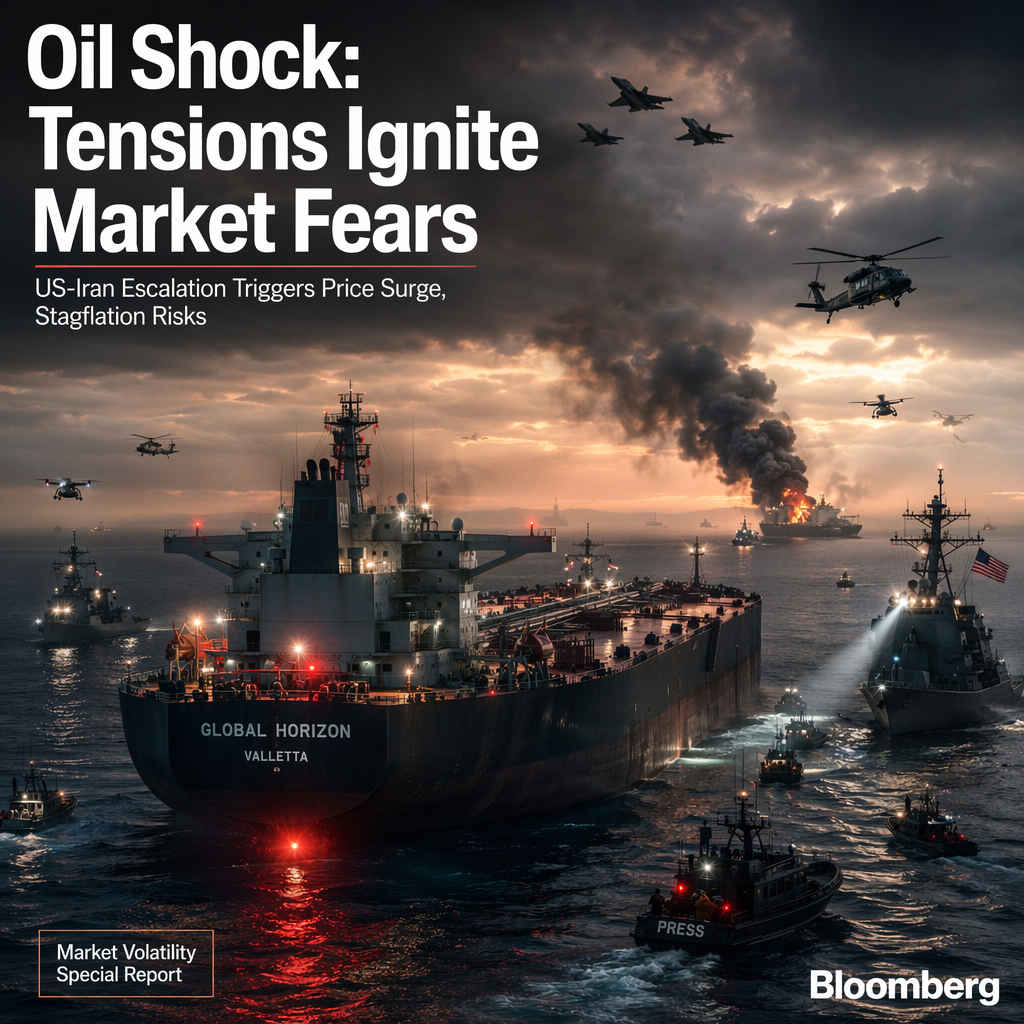
A sharp escalation in US-Iran tensions has triggered a significant spike in oil prices, with Brent crude surging 9.59% to a four-week high of $83.30 per barrel, marking its largest daily rise since March 2020 [1]. West Texas Intermediate (WTI) futures also climbed, last seen at $80.36 per barrel, up 2.84% on the day [7]. The surge follows US Central Command's precision strikes against Iranian military targets and Iran's retaliatory attacks on US military sites and oil supertankers in the Strait of Hormuz, including confirmed strikes on UAE tankers Mombasa and Al Bahiyah [4][5]. President Donald Trump has reinstated a maritime blockade on Iranian shipping and announced a 20% safe-passage fee for all other commercial traffic through the Strait, a move that has unsettled global markets [4][5][7].
The geopolitical turmoil has revived stagflation concerns, pushing global bond yields higher and weighing on equity markets [1][2][6][7]. The US 10-year Treasury yield rose to 4.6278%, while the 2-year yield increased to 4.2900% and the 30-year to 5.1093% [7]. Equity markets struggled as energy costs and geopolitical risks dampened sentiment [1][2]. The US Dollar strengthened amid the risk-off environment, with the USD Index closing in positive territory and outperforming major currencies such as the Swiss Franc [2][5].
The oil price spike has also reignited inflation fears, with strategists from Deutsche Bank and Société Générale warning of renewed pressure on inflation expectations and the risk of 'price stickiness' in key consumer sectors [1][6]. Gasoline prices, which had recently declined, have started to rise again, up 8 cents in the past week to $3.79 per gallon [6]. The upcoming US Consumer Price Index (CPI) data for June is highly anticipated, with consensus forecasts expecting annual inflation to ease to 3.8% from 4.2% in May, and core inflation to remain steady at 2.9% [5][6][7].
Federal Reserve policy is in sharp focus, as Governor Christopher Waller signaled the possibility of near-term rate hikes if core inflation remains elevated [2][3][5]. Traders have increased their expectations for a July 29 rate hike to 42.2%, up from 26.7% a week ago, and see a 33.6% chance of another hike by April next year [7]. Fed Chair Kevin Warsh's upcoming testimony before Congress is also being closely watched for further policy signals [2][3][5][7].
The market turbulence has pressured gold prices, which fell toward $4000 per ounce as higher oil and yields reinforced expectations of Fed tightening [3]. OCBC strategists note that gold's near-term outlook remains challenging unless oil prices retreat or US CPI surprises to the downside [3].
According to [1], the specter of new tolls and blockades in the Strait of Hormuz is making markets and customers nervous, while [4] and [5] confirm the imposition of a 20% fee and the US's renewed role as 'guardian' of the strategic waterway. However, [6] notes that some economists expect only a muted decline in inflation due to persistent price pressures in sectors like airline fares and delivery services.
CONCLUSION
The escalation in US-Iran tensions has driven oil prices sharply higher, reigniting inflation and stagflation concerns, and prompting a risk-off move across global markets. Rising yields, a stronger US Dollar, and increased expectations for Fed rate hikes underscore the high market impact. Investors are now focused on upcoming US inflation data and Fed Chair Warsh's testimony for further direction.