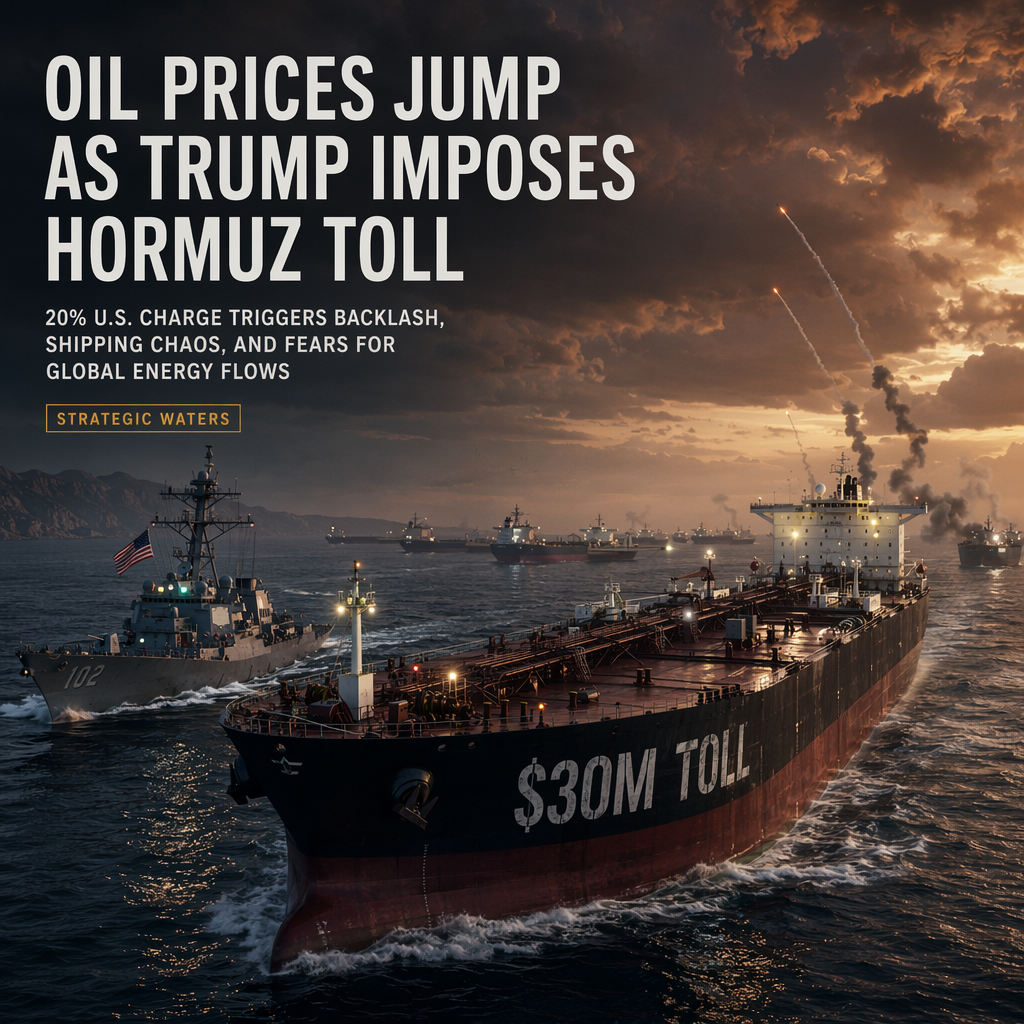
Oil prices experienced a significant rally, with a 9% jump followed by an additional 2.5% increase to reach $85, marking the largest move since 2020. This surge occurred ahead of the United States Consumer Price Index (CPI) release and Fed Chair Warsh’s testimony, and is attributed to escalating tensions around the Strait of Hormuz, new U.S.-imposed toll proposals, Iranian attacks on tankers, and renewed Houthi strikes threatening key east–west oil flows [1].
President Donald Trump announced that vessels using the Strait of Hormuz would now be required to pay 20% of the value of their cargo as compensation to the U.S., which he described as the strait’s new guardian. Bloomberg estimates these fees at $30 million per supertanker, equating to $8 per barrel of oil and $177 per ton of LNG [1]. This policy marks a shift from previous U.S. opposition to tolls in the strait, as the Trump administration had previously threatened sanctions against Oman for assisting Iran in establishing a tolling system [2].
The shipping industry has voiced strong opposition to the toll plan. Hapag-Lloyd stated that charging tolls for passage through international waters is "fundamentally wrong," distinguishing it from infrastructure-based tolls like those for the Suez or Panama Canals [2]. The Baltic and International Maritime Council (BIMCO) warned that the proposed tariffs could further reduce already dwindling traffic through the Strait of Hormuz, which had dropped to just 14 ships (including four crude tankers) on Sunday, compared to 37 vessels a week earlier, according to Kpler data [2]. BIMCO’s chief safety and security officer, Jakob P. Larsen, noted that while the levy is innovative, it could only be justified if it significantly reduced the threat from Iran [2].
The situation is further complicated by renewed hostilities between the U.S. and Iran, with the temporary ceasefire deal signed in mid-June appearing increasingly fractured after three consecutive days of exchanged hostilities [2]. Additionally, the Yemeni government, with Saudi approval and following Trump’s endorsement, bombed a runway in Houthi-occupied Sanaa to prevent an Iranian plane from landing, prompting the Houthis to resume attacks on Saudi targets for the first time in years, thereby endangering vital oil flows via Yanbu on the Red Sea [1].
CONCLUSION
The introduction of a 20% U.S. toll on ships transiting the Strait of Hormuz has triggered a sharp rally in oil prices and drawn strong criticism from the global shipping industry, which warns of further declines in traffic through the vital waterway. The policy shift, combined with renewed regional hostilities, has heightened market uncertainty and raised concerns about the stability of global energy flows.