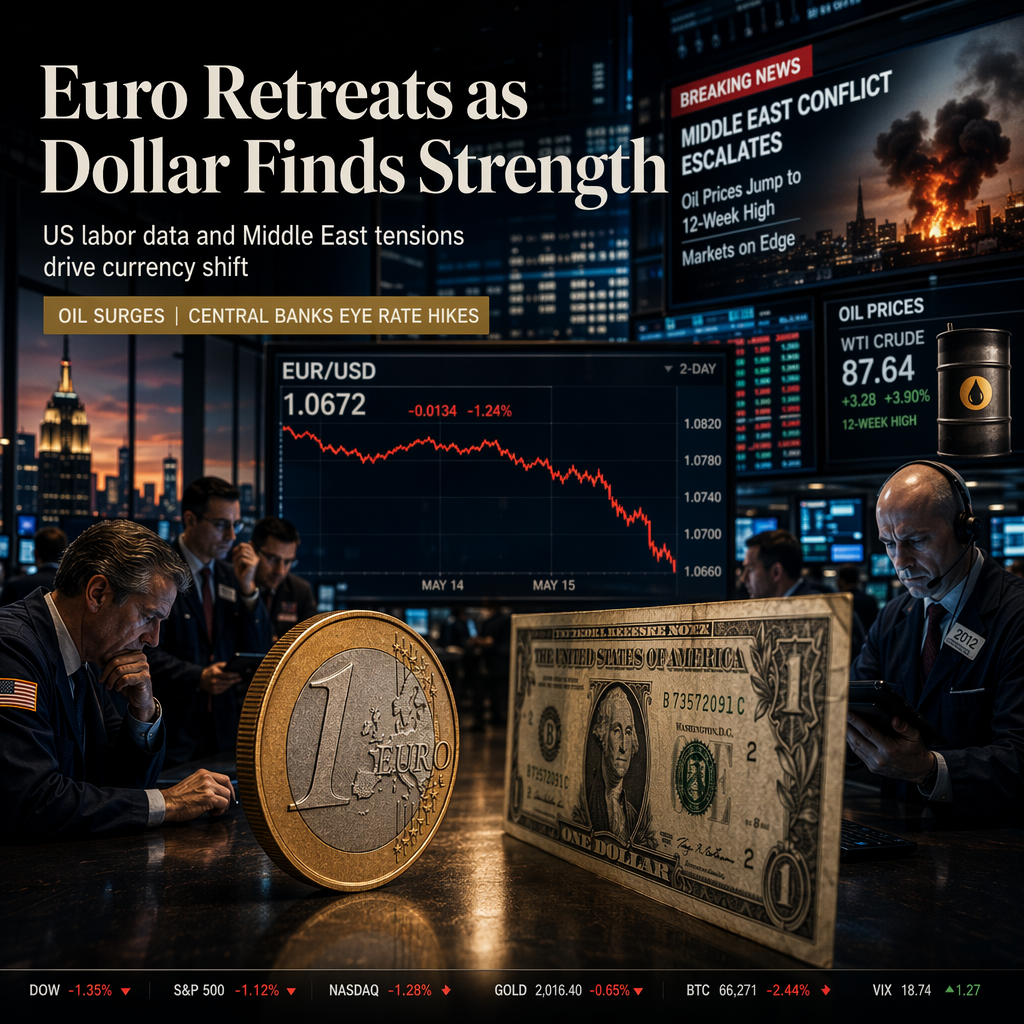
The Euro (EUR) ended its two-day winning streak against the US Dollar (USD) on Thursday, with EUR/USD trading around 1.1457, reflecting a modest decline for the day as the US Dollar steadied following recent losses attributed to softer-than-expected US inflation data [1]. The US Dollar Index (DXY) hovered near 100.60 after hitting a low of 100.35 on Wednesday, its lowest since June 18 [1].
Market sentiment remained fragile amid renewed tensions in the Middle East, which pushed oil prices higher and raised concerns that the recent slowdown in US inflation may be temporary. This environment limited downside pressure on the US Dollar, as traders continued to anticipate a potential Federal Reserve interest rate hike later in the year [1]. The Greenback received further support from robust US labor market data, with Initial Jobless Claims falling to 208,000 for the week ending July 11, below the forecast of 217,000 [1]. US Retail Sales increased by 0.2% month-on-month in June, matching expectations, while May's figure was revised up to 1.0% from 0.9%. The Retail Sales Control Group also met expectations at 0.5%, though this was a decrease from May's 0.8% [1].
Geopolitical developments contributed to market volatility, as the US conducted a fifth consecutive night of strikes against Iranian targets, prompting Tehran to retaliate by targeting US assets in Kuwait, Bahrain, and Jordan. Additionally, Reuters reported that Iran instructed Yemen’s Houthis to close the Bab el-Mandeb gateway to the Red Sea if the US attacks its power network. West Texas Intermediate (WTI) crude traded near $80, up approximately 12% for the week [1].
Higher energy prices have reignited expectations for another European Central Bank (ECB) rate hike. According to a Reuters poll, all 74 surveyed economists expect the ECB to keep its deposit rate unchanged at 2.25% at the July meeting, but 70% anticipate one more rate increase this year, most likely in September [1]. Currency performance data showed the Euro was strongest against the Swiss Franc on the day [1].
CONCLUSION
The Euro's recent gains paused as the US Dollar found support from strong labor data and heightened geopolitical risks, which also drove oil prices higher. Market participants are now watching for potential rate hikes from both the Federal Reserve and the ECB, with energy prices and geopolitical developments likely to influence future moves.