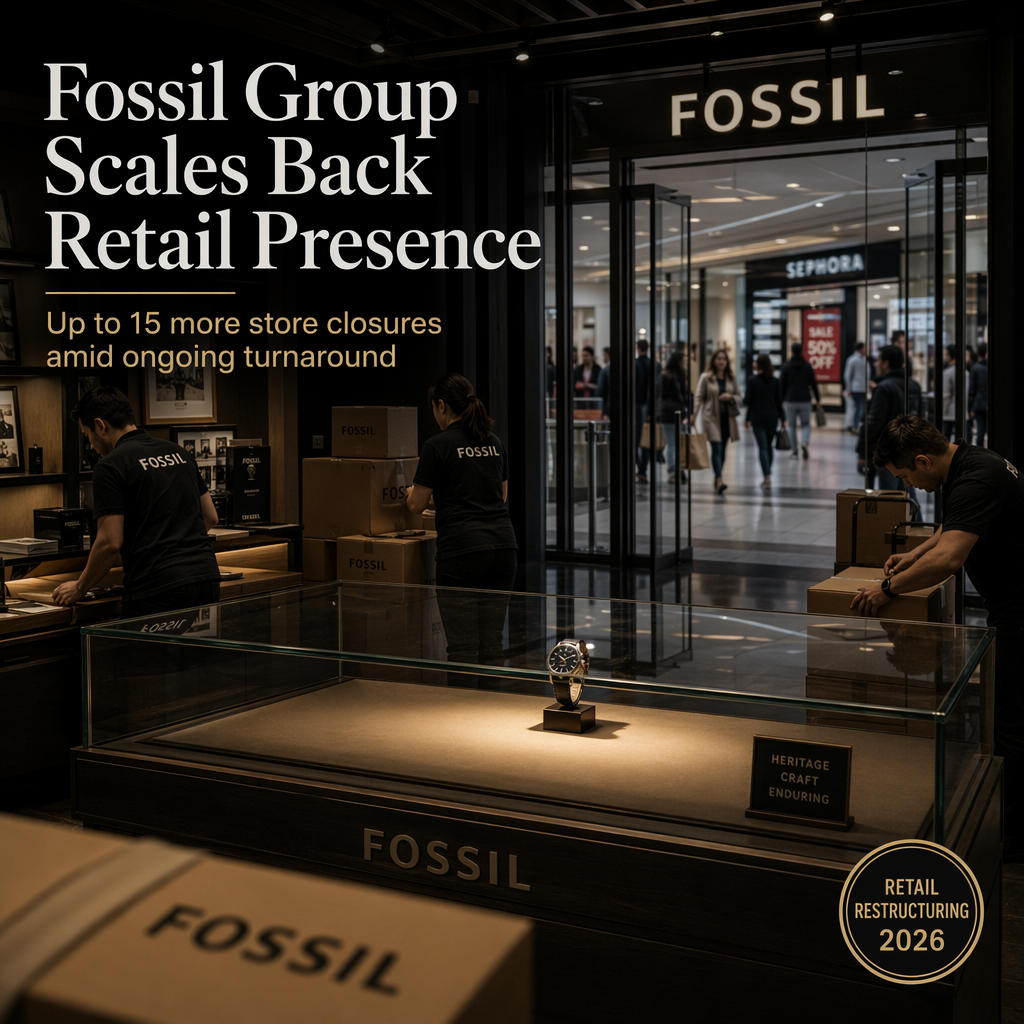
Fossil Group, a Richardson, Texas-based watch and accessories retailer, announced plans to close up to 15 additional stores in 2026 as part of its ongoing turnaround strategy focused on cost reduction, profitability, and strengthening its balance sheet [1]. During the first quarter, the company closed seven stores and expects to end the year with approximately 185 stores globally, down from 193 as of April 4 and 220 a year earlier [1]. Chief Financial Officer Randy Greben shared these details during Fossil's first-quarter earnings call, noting that the company closed 28 stores and opened one over the past year, with 92 stores in the Americas, 47 in Europe, and 54 in Asia [1].
Fossil reported first-quarter net sales of $224.8 million, a decrease from $233.3 million in the prior year. However, the company's net loss attributable to Fossil Group narrowed significantly to about $810,000 from $17.6 million a year earlier, and operating income improved to $12 million from an operating loss of $6.7 million [1]. The company attributed these improvements to its turnaround plan, which included a corporate workforce reduction, transitioning certain smaller international markets to a distributor model, and achieving approximately $100 million in selling, general, and administrative cost savings in fiscal 2025 compared to fiscal 2024 [1].
Despite the store closures, CEO Franco Fogliato emphasized that Fossil is not abandoning physical retail entirely. He stated that the company had 'significantly scaled back' its downsizing plan due to improved performance in full-price stores. The 2026 strategy now includes reducing the pace of store closures while focusing on profitable growth, operating-model improvements, and enhancing shareholder value [1].
Fossil acknowledged ongoing risks related to physical retail, particularly the dependence on mall traffic and the potential impact of anchor-store closures or declining mall performance [1]. The company's shares last traded at $4.00, down $0.03 or 0.74% [1].
CONCLUSION
Fossil Group's continued store closures reflect its efforts to stabilize and improve profitability amid ongoing challenges in the retail sector. While the company has made progress in narrowing losses and improving operating income, it remains cautious about the risks tied to physical retail. The market response has been muted, with shares showing a slight decline.