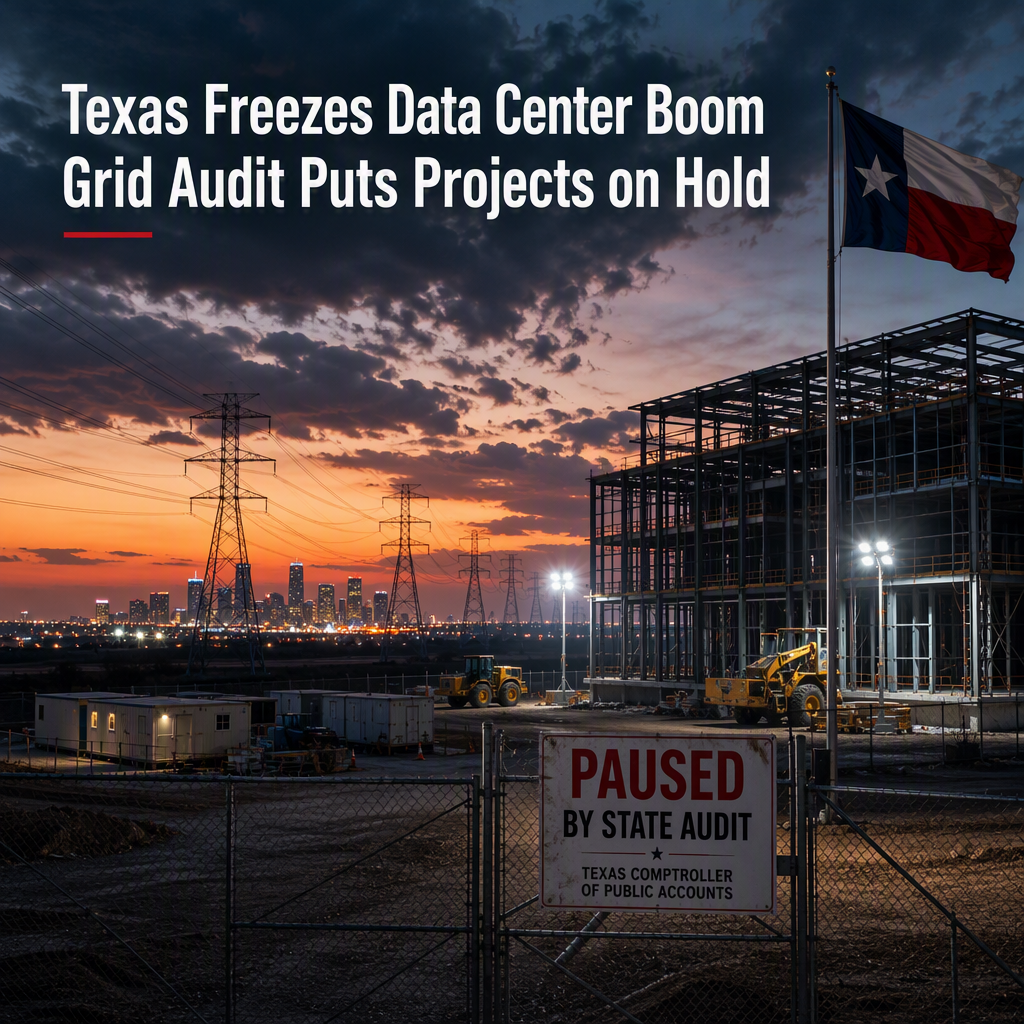
Texas Governor Greg Abbott has ordered state regulators to audit all pending data center projects seeking connections to the state's electric grid, a move that the Electric Reliability Council of Texas (ERCOT) says effectively pauses these projects as the state faces rapidly increasing electricity demand driven by artificial intelligence infrastructure [1]. Abbott directed the Public Utility Commission of Texas and ERCOT to review all pending data center projects and deny grid connection requests for facilities that do not meet state requirements [1].
ERCOT stated that the governor's directive 'effectively pauses all data center projects' and includes the postponement of the Batch Zero transmission planning study [1]. According to ERCOT, approximately 90% of the 474 gigawatts of projected large-load interconnection requests currently under review are from data centers, which is more than five times the state's record peak electricity demand [1].
As part of the audit, Abbott has instructed regulators to collect additional information from companies seeking grid connections, including whether the facilities plan to generate some of their own electricity, their projected annual and peak electricity demand, water consumption, and water sources [1]. This directive follows Abbott's recent push to tighten oversight of the data center industry, including calls for AI data centers to bring their own power, reuse water, and lower electricity costs for residents [1].
Texas has become a major hub for data center development, partly due to more than $1 billion annually in state tax incentives for qualifying projects [1]. Public Utility Commission of Texas Chairman Thomas Gleeson confirmed that the agency is working with ERCOT to implement Abbott's directive and ensure all requirements are fully carried out [1].
CONCLUSION
Governor Abbott's directive to pause new data center projects pending a statewide grid audit marks a significant intervention in Texas's rapidly growing data center industry. The move is expected to have a high market impact, given the scale of electricity demand from pending projects and the state's role as a national data center hub.