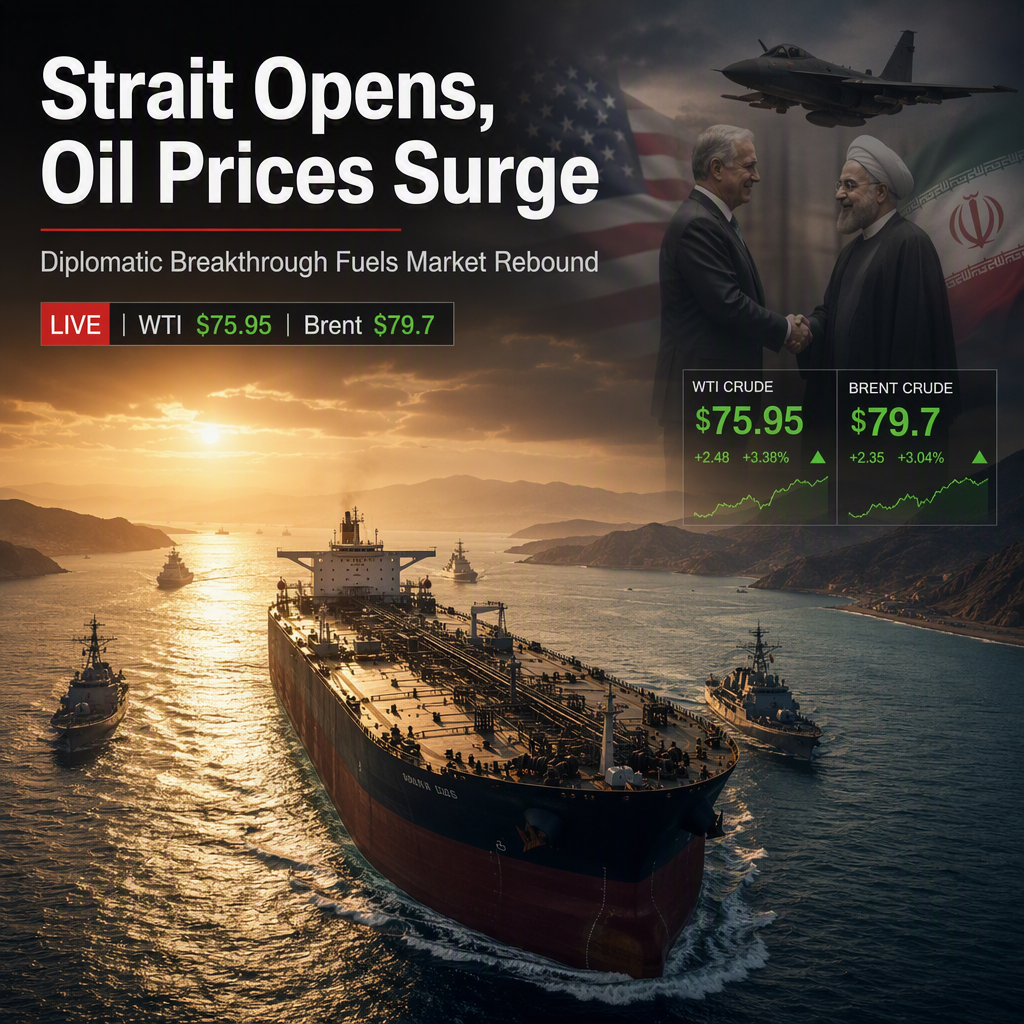
West Texas Intermediate (WTI) oil prices rebounded to trade near $75.00 per barrel during Asian hours on Wednesday, recovering from over 5% losses the previous day, as diplomatic efforts to reopen the Strait of Hormuz gained momentum [1][2]. Brent crude, the international benchmark, rose 0.43% to $79.7 per barrel, while WTI futures edged up 0.21% to $75.95, following a 5.7% slide the day before [2]. Qatari officials announced an interim proposal had been drafted, with both Washington and Tehran signaling tangible progress toward restoring access to the critical maritime transit route [1]. U.S. Central Command (CENTCOM) confirmed that the southern route of the Strait of Hormuz, through Omani waters, remains free and open, supporting over 1,000 vessels despite recent Iranian aggression [2].
U.S. Treasury Secretary Scott Bessent stated that a deal with Iran may be imminent, potentially as soon as this week, saying, "We are in talks with the Iranians. There is a chance we may have a deal today or tomorrow to open the Strait and move towards a more normalized position in this conflict" [2]. Diplomatic sources indicated that the U.S. and European countries are pressuring Oman to accept a temporary agreement with Iran, and a senior Pakistan government official noted that a document on reopening the Strait is "close to being finalized," with ongoing talks between Iran and Oman and mediation by Pakistan and indirect U.S. involvement [2].
Meanwhile, Iran is reviewing a framework that would permit European nations to clear naval mines from the strait, and discussions with Oman are advancing to safeguard trade routes [1]. Saudi Arabia is also engaging in mediated talks with Yemen's Houthi rebels via Omani channels to prevent further escalation in the Red Sea corridor [1]. Despite recent security incidents, Saudi Aramco has downplayed the impact, stating that July’s attacks had no material operational or financial effect, reinforcing that Saudi output and exports continue largely uninterrupted [1].
On the military front, earlier reports suggested U.S. missile stockpiles were depleted, but President Donald Trump countered these claims, asserting that the U.S. has ample munitions and that defense companies are expanding production at record levels [2]. White House deputy press secretary Anna Kelly echoed this, emphasizing sufficient military resources for all strategic goals [2]. Market participants are closely monitoring negotiations and military readiness, as these factors continue to influence oil prices, risk sentiment, and trading strategies around Brent ($79.7) and WTI ($75.95) per barrel [2].
CONCLUSION
Diplomatic progress toward reopening the Strait of Hormuz has led to a rebound in oil prices, with both WTI and Brent recovering from sharp losses. Ongoing negotiations between the U.S., Iran, Oman, and other regional players, alongside assurances of military readiness, are keeping market sentiment cautiously optimistic. The oil market remains highly sensitive to further developments in these talks and regional security dynamics.