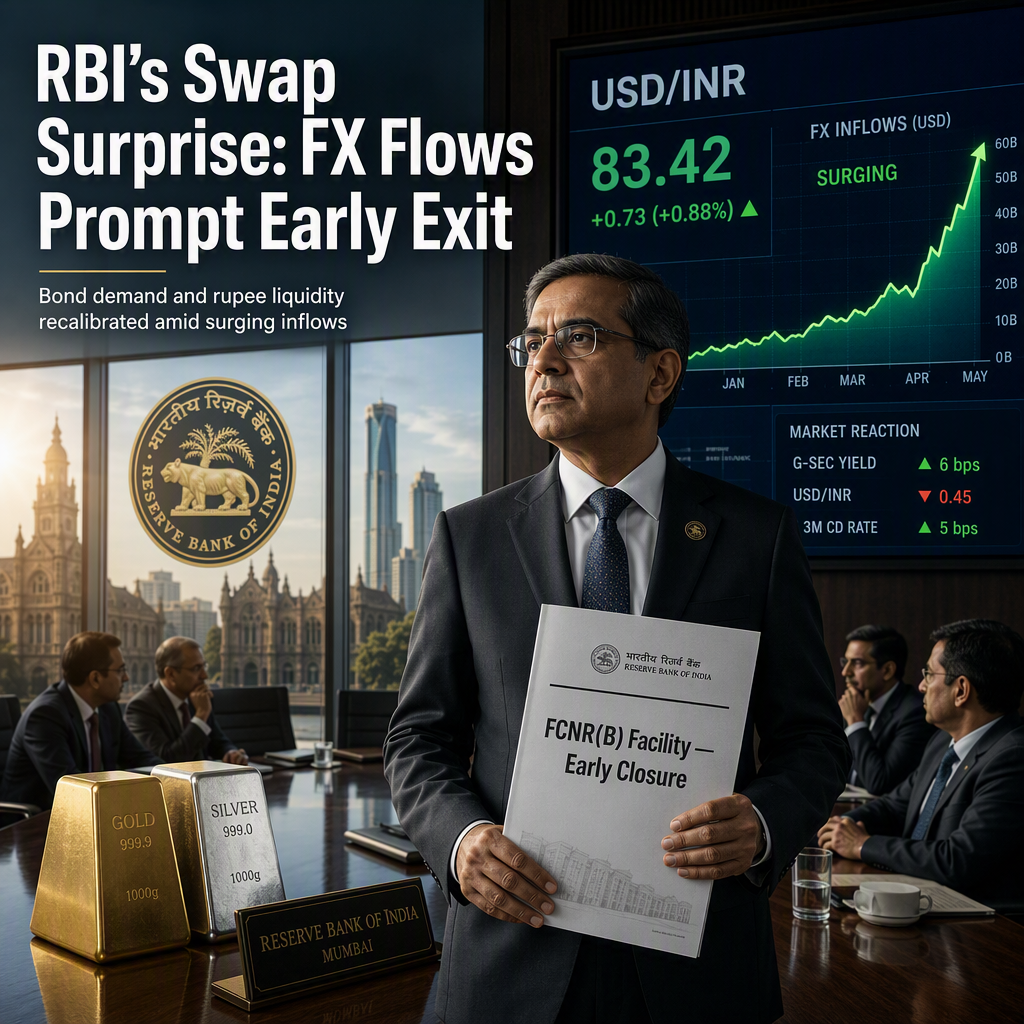
The Reserve Bank of India (RBI) announced the early closure of its concessional FX swap facility for FCNR(B) deposits, moving the deadline up to 31 August from the original 30 September date. This decision follows what the RBI described as an 'encouraging response to the swap facility for FCNR(B) deposits and the resulting FX inflows,' with the facility attracting USD52.3 billion as of 13 August [1]. The move was unexpected, especially since RBI Governor Sanjay Malhotra had stated just over a week earlier that there was no proposal to close the scheme prematurely [1].
Commerzbank analysts note that the early closure removes a source of bond demand and rupee liquidity, as the FCNR(B) inflows had contributed significantly to rupee liquidity and compressed government bond yields, particularly at the shorter end and belly of the curve. The analysts interpret the decision as a cost-benefit recalibration rather than a signal of outright bullishness on the Indian Rupee (INR) by the RBI [1]. Measures to support inflows via overseas foreign currency borrowing (OFCB) and external commercial borrowing (ECB) will remain in place until 31 December [1].
Following the announcement, USD/INR rose 0.2% to 95.61, though the pair has remained broadly range-bound between 94.70 and 96.70 since early July, with RBI intervention helping to suppress volatility and depreciation risks [1]. The report also highlights potential near-term headwinds for the INR, including higher precious metal imports, as gold prices rise and reports suggest that 400 tonnes of silver import licenses have been approved [1].
CONCLUSION
The RBI's early closure of the FCNR(B) swap facility surprised markets and signals a recalibration of its inflow strategy amid strong FX inflows and rising liquidity costs. While the move removes a source of rupee liquidity and bond demand, the RBI continues to manage INR volatility through intervention and maintains other inflow-supportive measures. Near-term risks for the INR include increased precious metal imports.