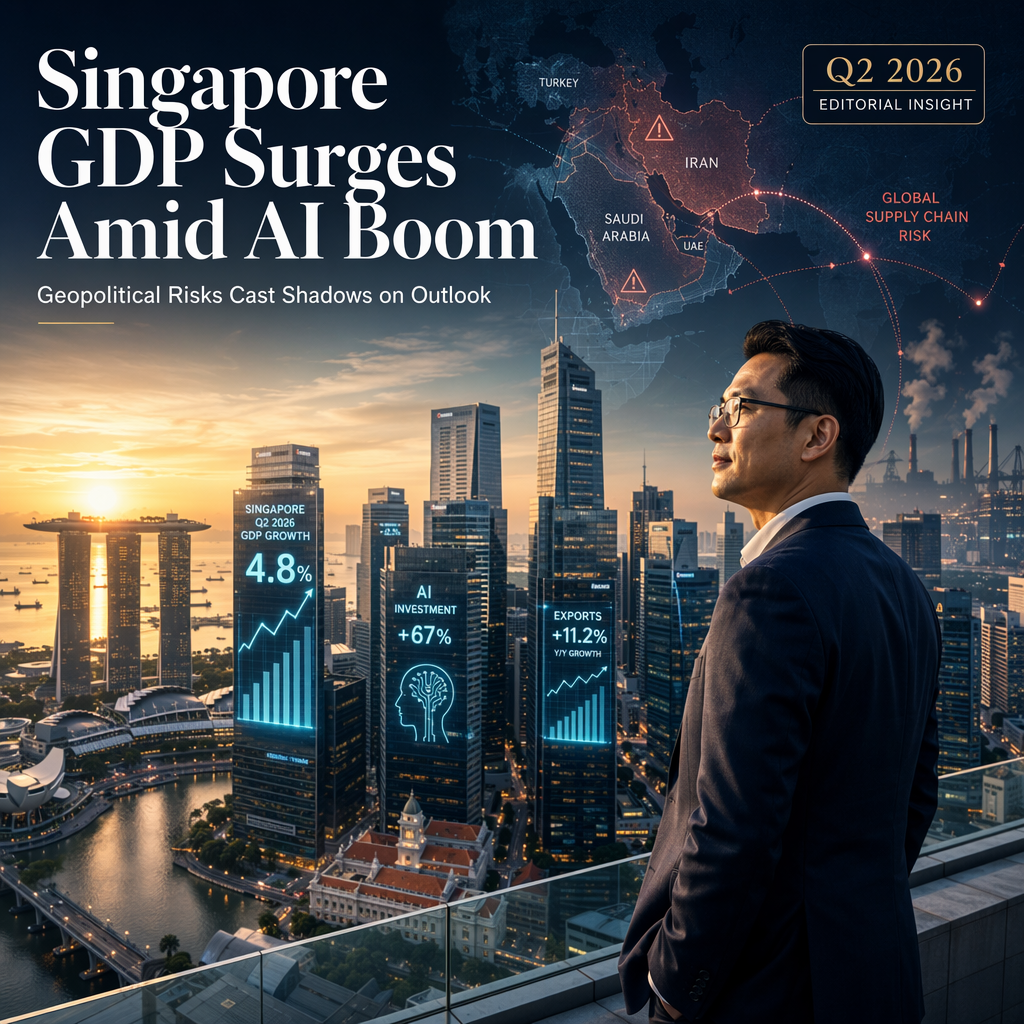
Singapore's economy expanded by 5.7% year-on-year in the second quarter of 2026, according to preliminary data released on July 14, 2026, surpassing market forecasts and reflecting continued strength in key sectors, particularly those related to artificial intelligence and manufacturing [1][2]. This growth outpaced the 5.5% expected by economists polled by Reuters, though it marked a slowdown from the revised 6.3% expansion recorded in the first quarter [2]. The goods sector saw a notable acceleration, expanding by 10.4% compared to 8.4% in the previous quarter, while the services sector's growth moderated to 4.6% from 6.2% [2].
The robust performance was attributed to strong demand in technology and services, with the AI boom significantly bolstering exports and contributing to GDP growth [1]. However, both sources highlighted that downside risks persist, particularly due to ongoing geopolitical tensions in the Middle East, specifically the US-Israel-Iran conflict, which has raised concerns about global supply chain disruptions and the broader economic outlook [1][2]. Singapore's Ministry of Trade and Industry projected full-year GDP growth for 2026 at 2%-4%, but cautioned that downside risks have risen significantly as a result of these conflicts [2].
On the monetary front, the advance GDP data was released ahead of the Monetary Authority of Singapore's (MAS) upcoming quarterly policy decision. Singapore manages its monetary policy by adjusting the Singapore dollar's value within an undisclosed trading band, rather than through interest rates [2]. Following the GDP announcement, the Singapore dollar traded marginally weaker at 1.294 against the US dollar [2].
Inflation in Singapore remained steady at 1.8% in May, its joint-highest level since September 2024, with MAS forecasting full-year inflation to range between 1.5% and 2.5% [2]. Market sentiment is described as cautiously optimistic, with traders monitoring the resilience of Singapore's tech sector alongside external risk factors [1]. No specific trading advice or technical analysis was provided in the preliminary reports [1].
CONCLUSION
Singapore's stronger-than-expected Q2 GDP growth underscores the resilience of its technology and manufacturing sectors, particularly amid the ongoing AI boom. However, persistent geopolitical tensions and elevated inflation present notable risks to the outlook, prompting a cautious market stance as policymakers and traders await further developments.