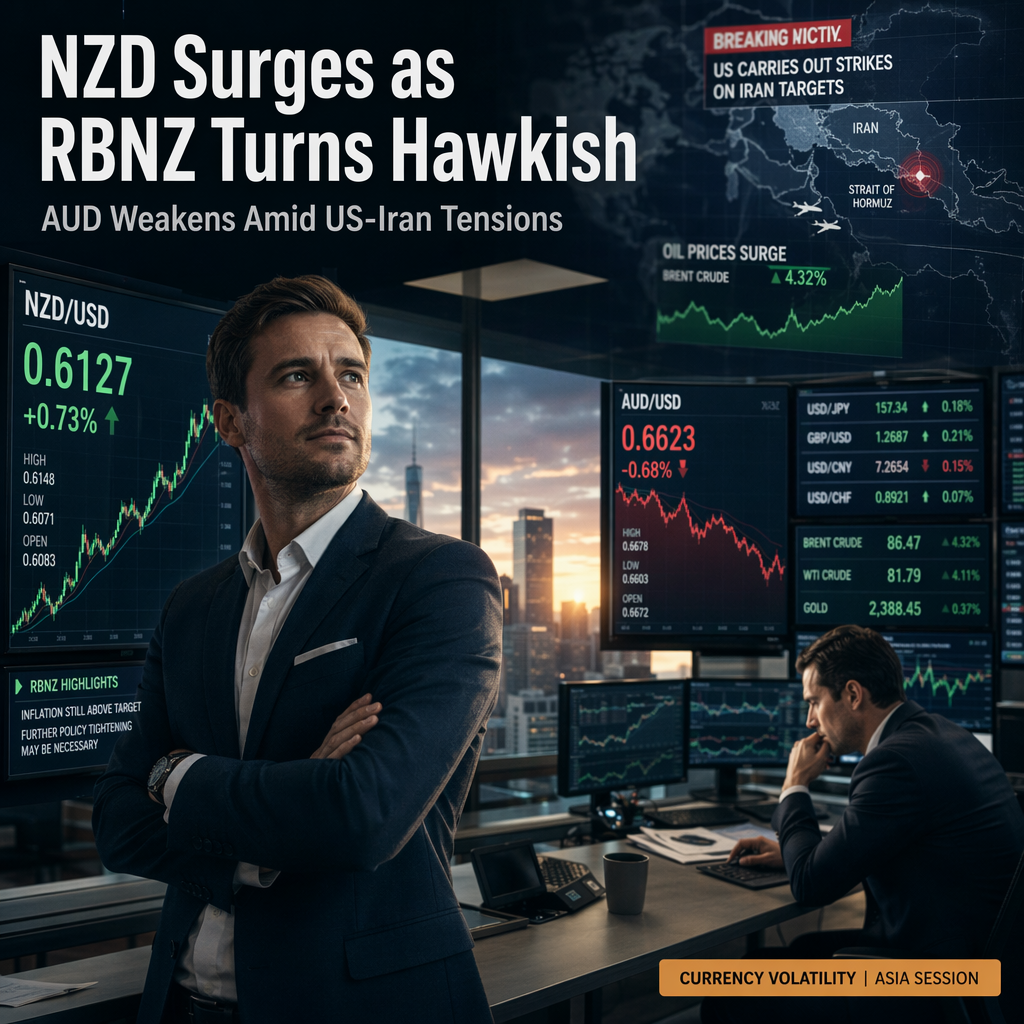
The New Zealand Dollar (NZD) experienced a notable rally during the Asian session on Tuesday, buoyed by hawkish remarks from Reserve Bank of New Zealand (RBNZ) Chief Economist Paul Conway. Conway stated that New Zealand inflation may not slow as quickly as the central bank forecasts, raising the prospect of further policy tightening following the first rate increase in three years on July 8 [1]. As a result, markets are now pricing in nearly 50 basis points of additional rate hikes over the next year, providing significant support to the NZD/USD pair, which climbed to the 0.5780 area despite a broadly firmer US Dollar [1].
In contrast, the Australian Dollar (AUD) weakened to near 0.6900 against the US Dollar, trading with mild losses around 0.6915 during the early Asian session on Tuesday [2]. The decline in AUD/USD was attributed to ongoing geopolitical tensions in the Middle East, which have boosted demand for the safe-haven US Dollar. The US launched a third consecutive night of strikes against Iran, with President Donald Trump announcing the resumption of hostilities and a blockade of Iranian ports [1][2]. Additionally, the United Arab Emirates (UAE) Ministry of Defence reported that two national tankers were targeted by Iranian cruise missiles in the Strait of Hormuz, further escalating tensions [2].
These geopolitical developments triggered a sharp rise in crude oil prices and reignited inflation fears, bolstering expectations that the US Federal Reserve may raise borrowing costs by the end of the year [1]. Despite the stronger US Dollar, the NZD/USD pair remained resilient, while the AUD/USD pair faced headwinds [1][2].
On the policy front, Westpac analysts indicated that further interest rate increases remain possible in Australia, with the Reserve Bank of Australia (RBA) potentially lifting the cash rate again as early as August due to persistent inflation risks [2]. The RBA has already implemented three 25 basis point hikes this year, bringing the Official Cash Rate to 4.35%. However, market expectations for a rate hike to 4.60% at the upcoming August meeting remain low at 16% according to ASX 30-day Interbank Cash Rate Futures [2].
Looking ahead, traders are focused on the release of the latest US consumer inflation figures and Fed Chair Kevin Warsh's congressional testimony, both of which are expected to influence USD price dynamics and broader market sentiment [1][2].
CONCLUSION
The New Zealand Dollar outperformed on hawkish RBNZ commentary and expectations of further rate hikes, while the Australian Dollar weakened amid heightened US-Iran tensions and safe-haven flows into the US Dollar. Market participants are closely watching upcoming US inflation data and central bank commentary for further direction. Overall, geopolitical risks and central bank policy outlooks are driving significant currency market volatility.